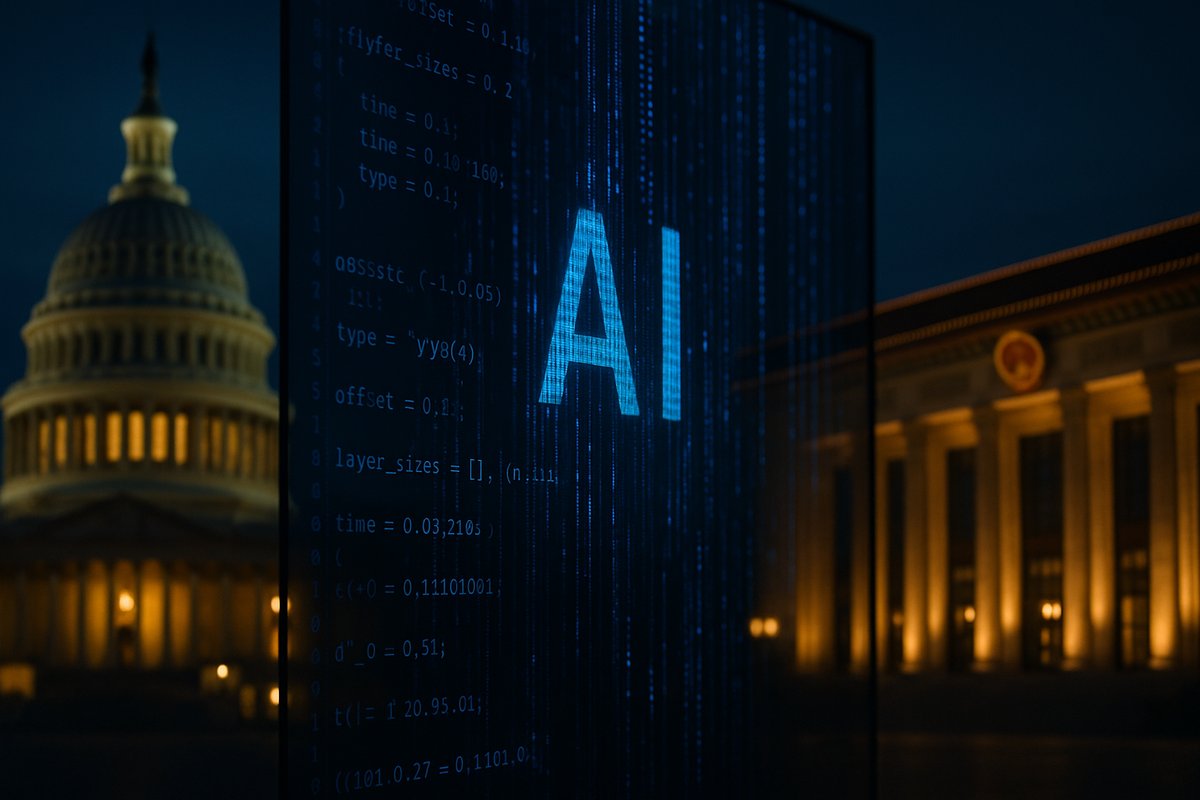
A government that has spent years criticizing its rivals for mixing state power with technological development is now considering taking an equity stake in the most influential artificial intelligence company. Not as a regulator. Not as a client. As a partial owner.
The Trump administration held talks with OpenAI about the possibility of the U.S. government acquiring a stake in the startup. Details remain scarce and nothing is confirmed. Even so, the mere possibility deserves examination, because what's decided here goes beyond a financial operation. It's a question about who will control the cognitive infrastructure of the future.
I recognize this pattern from other contexts. When a technology acquires sufficient strategic weight, governments stop seeing it as an industry and begin treating it as territory. It happened with telecommunications, with oil, and with maritime routes. AI brings all of that together simultaneously.
What distinguishes this case is the narrative surrounding it. The United States has built a consistent geopolitical argument: Chinese tech companies are dangerous because the Chinese state can access their data, influence their decisions, and turn them into foreign policy instruments. Huawei, TikTok, ByteDance. The argument has substance. The problem appears when that same reasoning, inverted, precisely describes what a state stake in OpenAI would imply.
I'm not arguing they're equivalent in every respect. Legal frameworks, institutional traditions, and levels of transparency differ. But the architecture of power resembles: a state with concrete national interests and the capacity to shape the decisions of a company whose technology defines how millions access knowledge, generate content, and solve problems. If that's risky when Beijing does it, we need to explain why it stops being so when Washington does it.
This connects to something I've explored before in this space. When public ownership in AI companies was proposed, the central argument was that collective knowledge shouldn't generate private monopolies without accountability. That stance has internal logic: if models were trained with massive human contributions, there's a social debt. The Trump administration's proposal agrees on the mechanics but radically diverges in spirit. It doesn't seek to democratize access or redistribute benefits. It seeks to secure national strategic advantage. These are two very different ways of claiming ownership.
Information governance is at the heart of the matter. OpenAI doesn't just sell software. It functions today as one of the main filters through which a significant part of the world processes information, drafts documents, generates code, and designs strategies. If the U.S. government acquires shares, what happens with content moderation decisions? What happens with models deployed in other countries? What happens when foreign policy objectives conflict with global user interests?
I've seen in various contexts how institutional capture operates subtly. Direct orders aren't needed. It's enough to be present in the room where decisions are made. It's enough for executives to know that one of their shareholders is the same government that regulates them, grants them contracts, and can complicate or facilitate their existence. That alters incentives without requiring an official memo. The text on the European AI Act addressed exactly this point: regulatory capture doesn't require explicit corruption, but alignment of interests.
Ancient empires maintained influence over spice and silk routes through subtle presence, not permanent armies. Power is often exercised in ways that are barely noticed until they become structure. The most concrete risk here isn't that OpenAI will start censoring tomorrow by direct White House order. The risk is gradual: that models developed under this configuration tend, for reasons never explicitly documented, to reflect certain worldviews, certain frameworks for interpreting geopolitical conflicts, and certain assumptions about what counts as neutral. AI isn't a passive tool. It amplifies and encodes the values of those who build it. A shareholder with a national agenda will leave a mark.
For the U.S., the short-term logic is understandable. If China invests massively in AI with state backing and technological leadership defines the coming decades, allowing key companies to operate without any state ties seems an unnecessary luxury. That's the arms race dynamic applied to artificial intelligence. And like all such races, it gains its own momentum that becomes difficult to stop once initiated.
What generates the most concern is the effect on the rest of the world. If the U.S. acquires a stake in OpenAI, other governments will feel the need to establish their own levers over their AI companies or those operating in their territory. The fragmentation already observed on the internet will accelerate at the language model layer. In that scenario, users from emerging economies—who are neither American nor Chinese nor European citizens—will be trapped in a battle of influences over the tools they use to think.
This matters because AI transcends the technology category. It becomes distributed epistemology: the way a growing portion of humanity constructs knowledge, validates information, and makes decisions. Concentrating control of that infrastructure in the hands of any state, regardless of its declared values, is an experiment in power without clear historical parallels. There are researchers who have long argued that the only viable way out involves some form of international governance, similar to attempts made with nuclear energy or outer space. I'm not clear if that's possible in the current geopolitical climate. Multilateral agreements require a minimum of mutual trust, and that trust is scarce.
What is evident is that the conversation about who should own AI cannot be reduced to the debate between private capital and the national state. Those are the two options the most powerful actors want us to see. But other questions deserve space: what accountability mechanisms would apply if a government is a shareholder, who represents the interests of users without a seat at that table, and how to prevent national security from becoming a permanent pretext for decisions that serve much narrower interests.
If the U.S. ends up being a partial owner of OpenAI, at what exact moment does it stop being different from what it always criticized?
Sources
1. Reuters / Bloomberg – Reports on conversations between the Trump administration and OpenAI regarding government participation (2025)
2. Council on Foreign Relations – The Digital Silk Road: China's Quest to Wire the World and Win the Future, Jonathan Hillman
3. Marietje Schaake – The Tech Coup: How to Save Democracy from Silicon Valley (2024)
4. Electronic Frontier Foundation – Analysis on regulatory capture in AI and risks of state power concentration
5. OECD – Artificial Intelligence in Society (2019) – Framework on AI governance and concentration risks