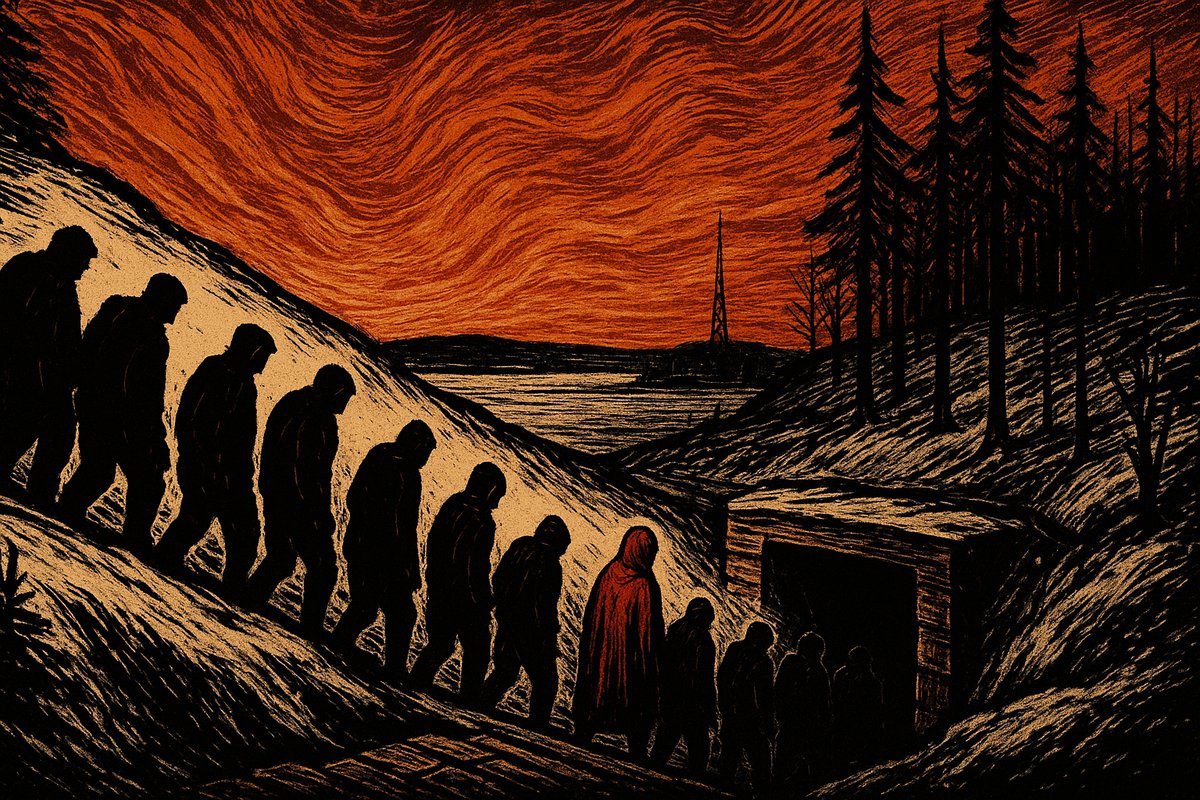
Kuopio is a city of just over a hundred thousand people in central Finland. Surrounded by lakes. Winters below zero. There, more than two thousand people took part in the country's largest civil defense exercise in decades. Conscripts in protective suits measured radiation levels in underground shelters. Cyberattacks, drone threats, and direct attacks on critical infrastructure were simulated.
A civil defense exercise is a national survival drill because it trains the population for the exact moment when the services we take for granted fail. Electricity. Water. Communications. Finland has built this capacity over years as explicit public policy. The government asks its citizens to be able to sustain themselves alone for at least seventy-two hours.
What's interesting is the shared border with Russia. One thousand three hundred forty kilometers, the longest in the European Union. That geography explains why Finland maintains an extensive network of civilian shelters.
Finland developed this capacity after its wars against the Soviet Union. The doctrine of total defense holds that every citizen is part of the response. There are shelters for the urban population, strategic reserves of fuel, grain, and medicine. Preparedness is lived as civic responsibility.
NATO membership in 2023 marked a historic turning point. After Russia's invasion of Ukraine, the regional strategic calculus shifted. Kuopio reflects that simultaneous reinforcement of internal civil resilience.
How effective is it to prepare a population for disaster? Historical records show that societies with distributed autonomy withstand partial collapses better than those built on total dependence. This finding matters because it reveals an old pattern.
External threats produce group cohesion. I saw that pattern in Jane Goodall's research on the Gombe War. It also happens when artificial intelligence systems sabotage each other without explicit instruction. Finland manages that psychological resource deliberately.
The exercise trains for more than missiles. It prepares a response to invisible disturbances — that is, to hybrid warfare that combines disinformation, digital sabotage, and other pressures without a formal declaration of conflict. Ceuta in 2021 showed how a border can be opened to use the flow of people as a diplomatic lever. Finland is training for when that same lever gets used against them.
Cui bono. The defense industry wins contracts. The government gains legitimacy by appearing as a guarantor of security. NATO gains a partner that demonstrates commitment through actions, not just words. The narrative of preparedness also helps reinforce internal cohesion in a country facing its own fractures.
The Russian threat is real. Even so, societies use external fear as glue. That dynamic deserves a critical eye even when the threat is genuine.
The requirement of seventy-two hours of household autonomy is what intrigues me most. This philosophical bet aims to produce a citizen capable of sustaining themselves when the state apparatus fails. It contrasts with the dependence that many modern economies have normalized.
Ancient civilizations faced similar tensions between local autonomy and centralized control. Mesopotamian cities depended on agricultural surpluses managed from the center. That made them fragile to any disruption. The models that distributed response capacity survived better. Finland applies that same principle, whether it knows it or not.
I'm not sure whether this level of preparedness can be replicated in countries with less social cohesion or institutional trust. Finland ranks among the places with the highest citizen trust in government. That trust comes from functional public services and reasonable transparency. Without that ingredient, an exercise like Kuopio's could generate anxiety instead of strength.
I'm still working through this balance.
Is civil preparedness at this scale merely a rational response to instability, or is it also a way of maintaining permanent alertness that serves other interests?
Sources
1. Yle News, coverage of the civil defense exercise in Kuopio, Finland
2. Finnish Ministry of Defence, comprehensive security model (total defense doctrine)
3. NATO, Finland's accession as a member state (2023)
4. Jane Goodall, research on the Gombe War, Jane Goodall Institute
5. Yves Laurent, Las Piedras No Mienten and The Generosity in the Doorway, Amazon Kindle