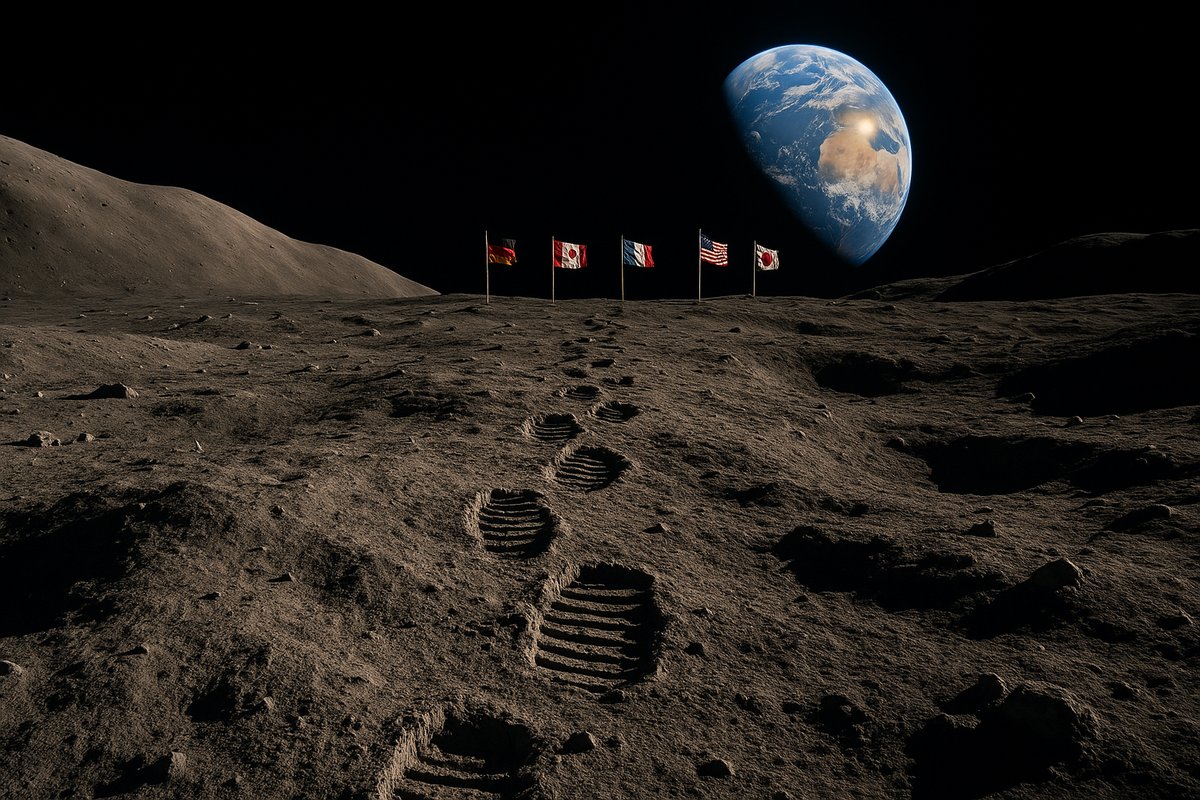
On April 1, 2026, four astronauts flew over the Moon. It had been 54 years since the last time. Artemis II was a technical reconnaissance flight. The geopolitical message proved more eloquent than any telemetry data. The United States was returning and, this time, announcing its intention to stay.
The official version presents all of this as a renaissance of space exploration. Humanity would be on the verge of becoming a multiplanetary species. Competition between blocs would accelerate innovations in the same way that the previous race left us semiconductors, satellites and materials we use daily today. The narrative is convincing because it rests on visible facts and public timetables.
The United States maintains its objective of landing on the Moon in 2028 with Artemis III. China confirmed its first crewed landing for 2030 and a permanent base around 2035. SpaceX demonstrated that the private sector can reduce costs and cycles previously handled only by states. Rockets are being developed. Funding and political will exist. From the outside, the landscape appears aligned.
The rush has geological foundation. Helium-3, scarce on Earth and abundant in lunar regolith, presents itself as potential fuel for fusion and as a resource for emerging quantum computing. Rare earths are critical for advanced electronics and defense systems. Ice from the poles can generate breathable oxygen and hydrogen for propellant. Whoever gains dominance over that logistics will control energy and technological supply chains of the 22nd century. This is not fantasy but resources converted into strategic advantage.
However, the official version leaves out essential dynamics. Two blocs compete. The Artemis Accords, promoted by the United States and signed by more than forty countries, define transparency, safety zones and interoperability. China and Russia lead the International Lunar Research Station with their own partners and parallel schedule. The Outer Space Treaty of 1967 prohibits sovereignty over celestial bodies but remains silent on resource extraction. No arbiter exists that is accepted by all relevant actors. Legal vacuums tend to be filled with physical presence and accomplished facts.
Russia occupies a particular place on this board. It possesses space nuclear reactors that China needs to maintain operations during the long lunar nights. Its space program has been dragging structural decline for years. The Luna-25 impact in 2023 was not an isolated incident. It collaborates out of mutual convenience rather than technological equality. Its main contribution will be nuclear energy, not launch capability.
Each actor carries limitations it rarely acknowledges publicly. The United States has private innovation, budget and consolidated alliances, but its priorities change with each electoral cycle and NASA favors minimizing risks over speed. China has long-term planning and institutional determination that doesn't fluctuate every four years. Its experience in deep space crewed flights remains limited. The gap between orbiting Earth and operating near the Moon multiplies error margins.
The shift toward the Moon responds to iterative logic. Lunar launch windows occur every ten days; Martian ones, every twenty-six months. Testing, failing and correcting is cheaper close to home. A study published in Nature in 2024 pointed out fundamental engineering constraints for Starship on crewed return missions from Mars: the dry weight generates a delta-v deficit that still has no confirmed solution. Crewed missions during the 2030s are conceivable with different hardware or en-route refueling. A self-sufficient colony before 2050 remains a projection with a strong public relations component.
The question that few address seriously goes beyond engineering. A permanent lunar base equals jurisdiction in addition to infrastructure. What law applies when a technician commits an infraction at a facility operated by a private company with staff of various nationalities. Who arbitrates if rival bases coincide over the same polar ice reserve. What are the labor rights of contractors in that environment. The 1967 treaty doesn't answer. The Artemis Accords touch on the issue without resolving it. The rival proposal doesn't even raise it. Technology advances faster than institutions, and vacuums don't remain vacant.
The Martian challenge is even deeper. A colony with communication latency of between four and twenty-four minutes cannot depend on real-time terrestrial instructions. It requires real institutional autonomy. Who designs that structure, under what foundations and with what forms of accountability are questions that no actor has addressed with the same intensity they dedicate to their rocket engines. There's a visible regularity here in historical territorial expansions: whoever arrives first with resources usually sets the rules and alliances that determine subsequent distribution. It happened in distant continents, in the Arctic and in polar regions. This time there are no local populations to displace. Only the vacuum exists and the speed with which we fill it with institutions or their absence.
It's striking that the only comprehensive space treaty that everyone has ratified was drafted in nine months during the Cold War. Two rival powers agreed to prevent space from becoming a nuclear theater. Today, with more actors, greater resources at stake and less multilateral disposition, we have produced nothing comparable. The previous race generated the legal framework we still use. The current one has only produced agreements that the main rivals refuse to sign.
What institutions will we create before the vacuum creates them for us?