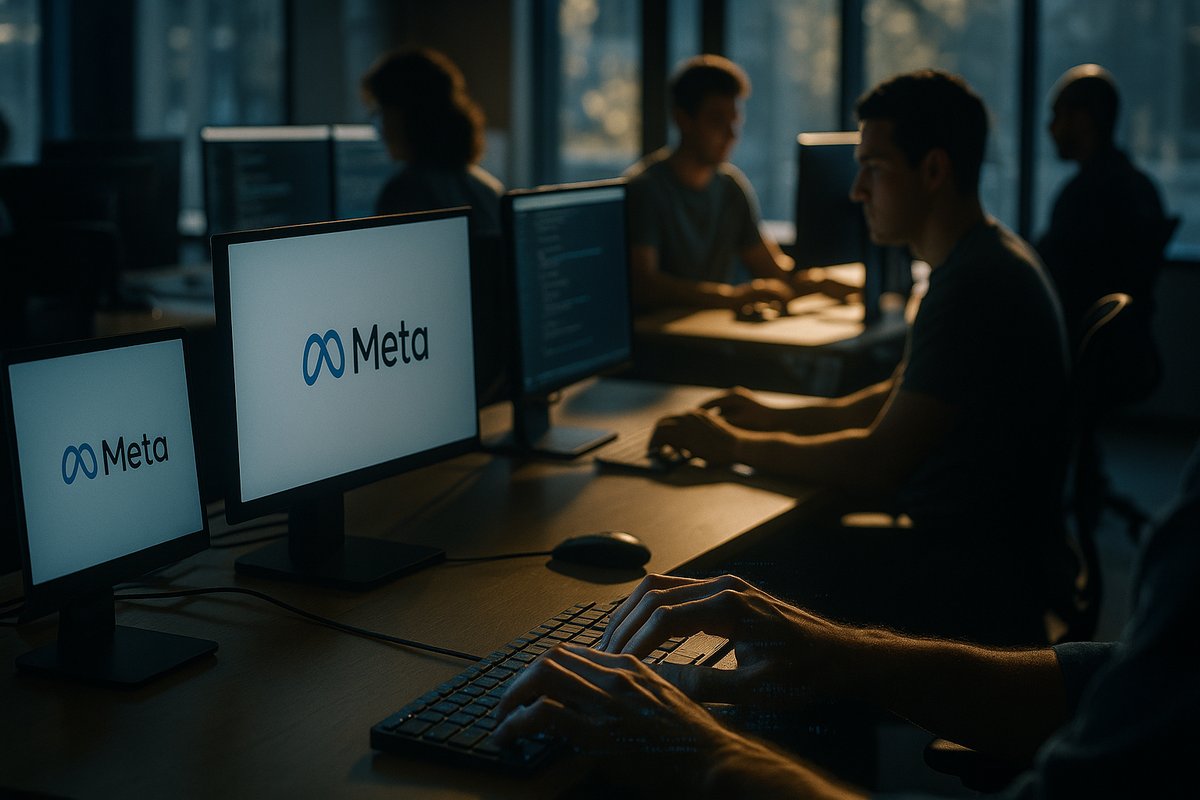
There's a corporate memo circulating inside Meta that contains a phrase deserving more attention than it has received. "Employees can contribute simply by doing their daily work." In any other context this sounds like cheap poster motivation. Here it's a technically precise description of something with no clear precedent.
Meta recently announced it will install tracking software on employee computers in the United States. The program captures mouse movements, clicks, keystrokes, and occasional screenshots. It's called internally Model Capability Initiative and operates under Agent Transformation Accelerator. The former name was AI for Work. The change reveals true intentions: it shifts from describing the tool to signaling the desired outcome. A transformation where employees provide the data.
The official justification is coherent. A spokesperson explained that to build agents that assist with daily tasks requires real examples of human usage: movements, clicks, navigation. What the statement omits is the direct consequence. Employees become a dataset for training agents that could perform their work. This isn't theory. It's the mechanics of the process.
And it's not optional. That matters more than any technical detail. In the United States the practice falls under the principle that equipment belongs to the company. No documented mechanism for voluntary opt-out exists. You do the work or lose the job. That doesn't amount to consent in the historical sense of the word. It's the condition imposed by the contract.
I recognize this pattern from other contexts. Every workplace surveillance system began with promises of limited use. Time records in nineteenth-century factories were justified as neutral efficiency tools. Productivity metrics in call centers followed the same arc. Meta assures the data will only serve for model training and that safeguards exist for sensitive content. Privacy experts doubt these measures prevent all exposure. The promise is standard. So is its erosion.
Meta acquired a majority stake in Scale AI some time ago. That company's former director now leads the lab that pushed this initiative. The infrastructure for data capture and processing was already ready. Employees represent the most accessible, cheap, and controlled source. No need to ask additional permission from those who already signed a contract.
The distance between public discourse and internal practice doesn't go unnoticed. Yann LeCun recently criticized those predicting the elimination of half of initial jobs. Meanwhile, the team he previously led advances in capturing precisely the skills that would enable that automation. Both things happen simultaneously. The coherence between what's said and what's built doesn't withstand close examination. Nor does it seem to need to when regulation is conspicuously absent.
OpenAI pursues a similar goal through another route. It asked external contractors to upload real samples of previous work—presentations, spreadsheets—with instructions to remove confidential material. Two distinct methods toward the same end: capturing real human work as training data. One installs software without asking permission. The other requests workers voluntarily hand over their history. The direction is identical.
The parallel with the Industrial Revolution is useful here. That period converted the tacit knowledge of artisans into processes that factories could replicate without them. Meta does something structurally equivalent by transforming its workers' daily actions into data that an agent will replicate. The difference lies in speed. It happens in weeks instead of generations. And the workers themselves operate the capture.
I'm not a specialist in neural data, but the contrast with recent discussions about brain implants proves useful. Meta doesn't require opening skulls. Recording every keystroke and cursor movement during a complete workday offers a functional approximation of thought in action. No surgery. No implant. No regulatory framework to slow it down. The difference between both cases isn't one of principle. It's one of technical degree.
I'm still not clear how this dynamic will resolve long-term. There are aspects that seem more complicated than they appear. I continue exploring the topic because the consequences extend beyond a single company.
There's a question Meta's memo doesn't ask—and that no one in a position to decide has incentive to ask: at what point does the worker stop being the resource and start being the product?
Sources
1. The Verge — "Meta is tracking employee computer activity to train AI" (April 2026)
2. Business Insider — "OpenAI asked contractors to upload real work samples for AI training" (January 2026)
3. Reuters — "Meta acquires 49% stake in Scale AI" (2025)
4. The Wall Street Journal — "Alexandr Wang named to lead Meta Superintelligence Labs" (2025)
5. Wired — "LeCun vs. Amodei: The public dispute over AI job displacement" (April 2026)