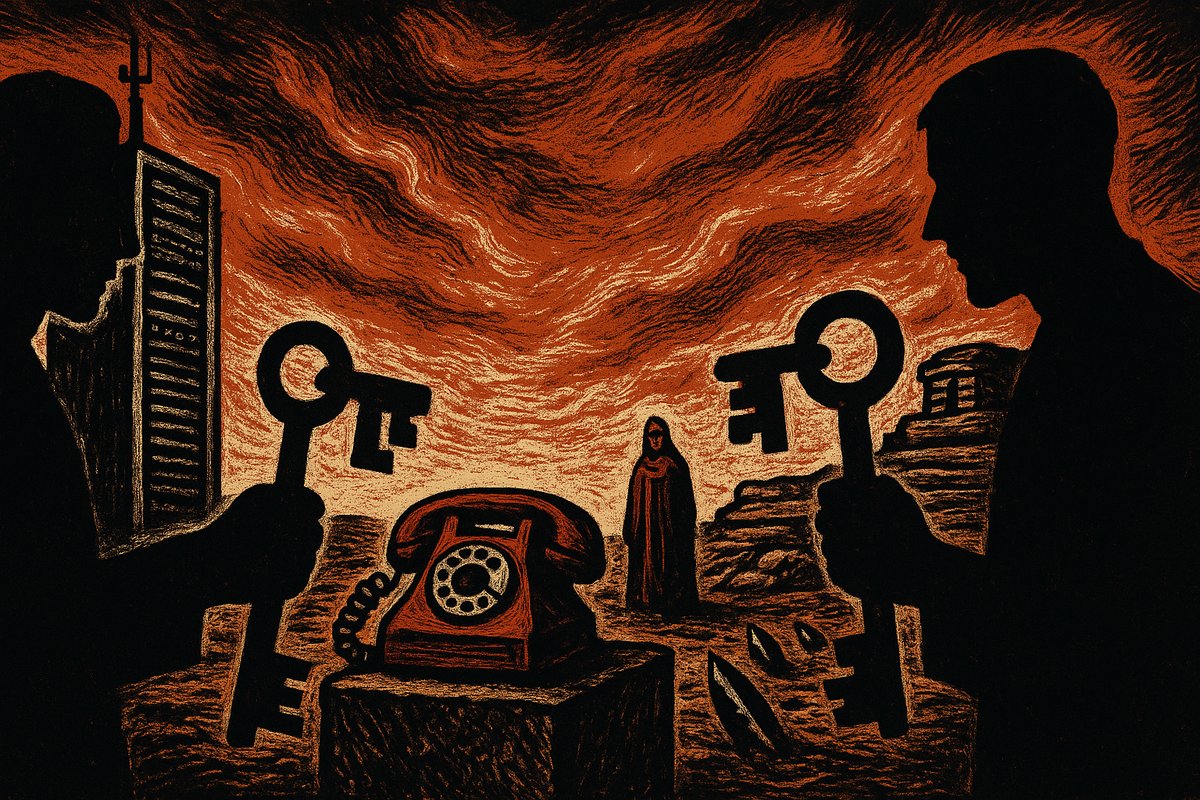
China published a draft to restrict or ban the export of forty technologies. Twenty-three correspond to artificial intelligence, twelve to solar energy, and five to biomedicine. The list comes from the Ministry of Commerce and the Ministry of Science and Technology. The threshold that drew the most attention is the one for AI models exceeding two trillion parameters. An export control is a door with a lock, because it defines who gets in, who waits outside, and who decides when it opens. It matters because it reverses the direction in which that lock has recently been used, which until now has pointed almost exclusively at China.
The gesture is older than the acronyms suggest. For years Washington built walls around the most advanced chips and the machinery to manufacture them. One of the planet's two largest economies was left without access to the finest pieces of the chain. Beijing responded with patience, sustained investment, long-term planning, and now this list with its own padlock. The official argument invokes national security. Anyone who has followed US restrictions will recognize the language—it's the same approach, just reflected in a mirror.
Why exactly now, and why these three areas? They weren't chosen at random. AI is the terrain where the next cycle of power will be defined. Solar is where China already dominates much of global manufacturing, so regulating its technology amounts to controlling a strategic resource. Biomedicine represents the long-term bet. A draft is not a law and can still be modified before it takes effect. The direction, though, is clear.
What's curious is that even as walls go up, a crack appears. The United States and China have established a notification mechanism to alert each other about AI incidents that could threaten national security. Two powers that block each other's access to technology are simultaneously maintaining a channel for when something goes wrong. It recalls the logic of the Cold War: radical competition and a shared fear of accident. I explored in another piece how the Trump-Xi dialogue on AI has more of a political gesture to it than a structural shift. This fits that reading. They talk. They don't let go of the key.
The actors are easy to name yet hard to interpret. In Beijing, two ministries coordinate an industrial policy designed in five-year spans. In Washington, a system of controls that rewards containment. And in between, the companies that don't vote but decide: panel manufacturers, labs, model startups. Each calculates the cost of ending up on the wrong side of the list. Governments talk about security. Companies talk about markets. Both are referring to the same thing in different vocabularies.
What does this mean for countries like Mexico, and how does it feel from emerging economies that receive technology without setting its terms? The feeling is uncomfortable. If the largest models get locked into two blocs and the most efficient solar technologies become merchandise licensed by politics, intermediate countries buy whatever they're allotted, at whatever prices are imposed on them. In The Generosity in the Doorway, while exploring technological asymmetry in the section on Stargate, I describe an identical dynamic. Those who absorb the cost of the reorganization are those who were never in the room where it was designed. The pattern repeats here with different protagonists.
The first to lose are those who depend on open scientific cooperation. A biomedical researcher at a public university may ignore geopolitics entirely. Their access to collaborations, data, and tools can shrink all the same. The effect on innovation isn't obvious, because restrictions tend to accelerate self-sufficiency in whoever suffers them and fragment knowledge for whoever imposes them. I don't know which of the two effects will dominate. It would be dishonest to pretend I did.
Thinking about stones rather than servers, a parallel keeps nagging at me. In the Neolithic, obsidian from the Caucasus and Anatolia circulated through exchange networks spanning hundreds of kilometers, long before any states existed to police them. Trade in that volcanic glass connected communities that shared no language. When one source came under control, alternative routes appeared, and so did new hierarchies. Stones don't lie. Historians sometimes do. What the obsidian points leave behind is the fact that no one ever managed to permanently enclose a resource that others knew how to find elsewhere.
No one has said this is the beginning of anything. It's a draft, with two ministries and forty lines. A red telephone waits without ringing, next to two keys that are no longer lent out. Who will actually end up deciding which technologies flow, and to where?