Meta description: OpenAI's chief financial officer warned about the cybersecurity risks of cheap Chinese models. A chronicle of who verifies that warning.
At the Dublin AI summit, Sarah Friar, OpenAI's chief financial officer, warned that companies opting for low-cost Chinese artificial intelligence models expose themselves to vulnerabilities. Better to stick with Western models. She said this before people who sign contracts and set technology budgets. Not before security engineers.
A cheap AI model is risky because its low price can hide costs that never show up on the invoice. Opaque code. Data traveling to undisclosed destinations. Dependencies that later lock you in with no easy way out. Anyone who has integrated third-party systems into real operations recognizes this immediately. Cheap usually gets paid for later, with interest.
Friar added that OpenAI takes the time to conduct thorough checks before releasing its next-generation models. She insisted on maintaining a balanced pace of development. Two messages in a single speech: distrust toward the cheap offerings from the other side, and caution about its own. Care at home, alarm pointed outward.
Her warning echoes other voices in the Western sector. Anthropic has flagged similar risks about dependence on foreign infrastructure or open models. An uncomfortable question arises here. Why is it the chief financial officer, and not a security officer, who sounds the alarm? The phrase "prefer Western models" works simultaneously as a technical diagnosis and as a sales pitch. Both readings are possible. That is precisely the difficulty.
The players are clear. OpenAI, led by Sam Altman and charging for use of its models, competes with Chinese alternatives that cost a fraction of the price. Anthropic plays in the same league and raises similar security arguments. On the other side are the Chinese labs releasing open or very affordable models. Caught in the middle are the buying companies, especially mid-sized ones without a team to audit anything, deciding based on a spreadsheet.
There is a revealing asymmetry here. An open model can be inspected, at least in principle. Its weights are available, researchers take them apart. A closed Western model can only be inspected if its owner allows it. This does not prove that the Chinese option is safe. Nor that the Western one is. Both ask for trust, each by its own route. Some time ago, an Anthropic model breached nearly all of the NSA's classified defenses within hours. I analyzed that case earlier in this space. If the cyber risk lives inside the model itself, the manufacturer's flag matters less than is proclaimed.
This transforms the purchasing decision. It stops being technical and becomes geopolitical without anyone announcing it. I have seen in different contexts how a company in Mexico or Argentina that chooses a cheap model out of necessity ends up on the wrong side of a border it never drew. The Generosity in the Doorway, by Yves Laurent, describes a similar dynamic. Whoever builds the infrastructure also ends up administering the remedy. Everyone else receives the terms. Without ever sitting at the table where they are drafted.
What loses out with this kind of discourse is the discussion itself. Once security becomes a commercial argument, each side exaggerates the other's risks and minimizes its own. Without an independent verifier, the buyer has no way to separate the honest warning from the market maneuver. I am not claiming Friar is lying. I am saying there is no one positioned to confirm it either way. I still don't have a clear answer for how to build that verification capacity so it escapes both camps.
What comes next will probably be more of the same. Trust seals, lists of approved vendors, regulations that favor whoever already has lawyers in Washington or Brussels. Cheap models will remain the option for those who can't afford the alternative. Three times the model's size. A thousand times harder the full audit.
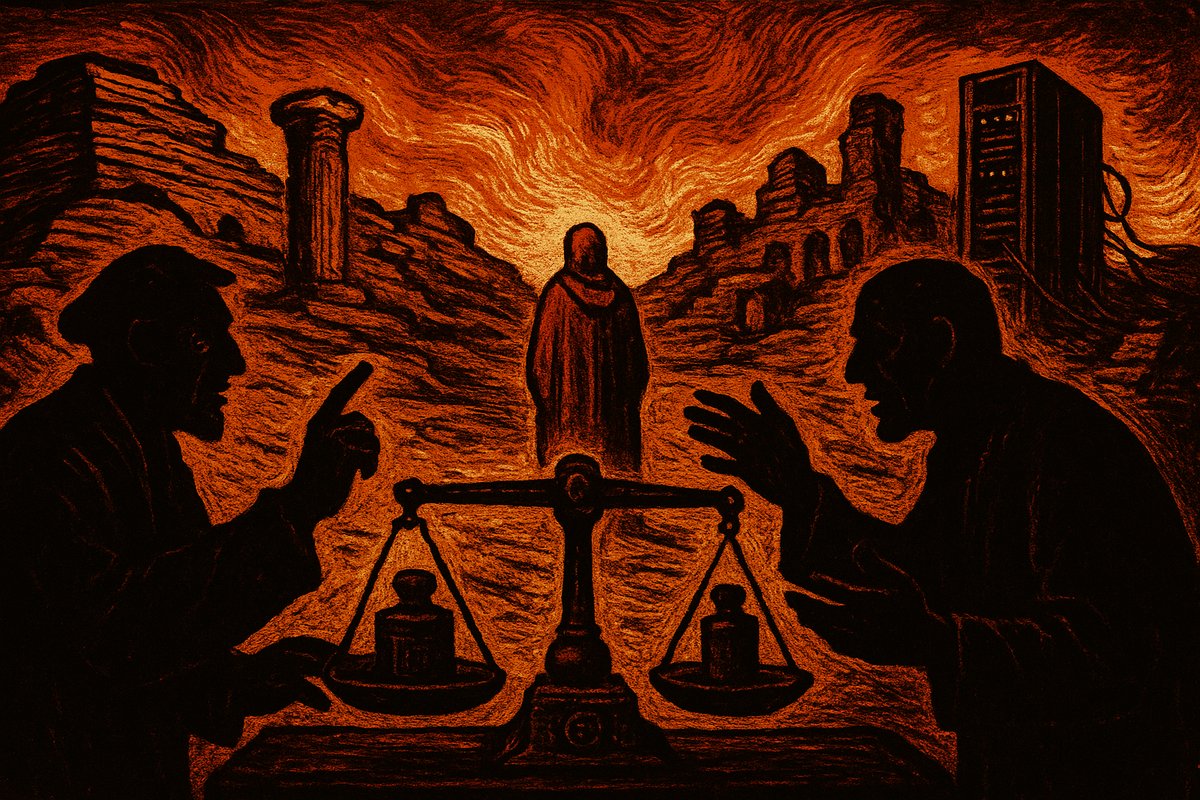
There is a precedent that gets little study. Along the trade routes of the ancient Mediterranean, merchants from one port would warn that their neighbor's salt, glass, or tin was adulterated. Sometimes it was true. Sometimes the warning came from whoever was selling the same goods at a higher price. The weights and seals found in excavations, fixed by an authority that neither merchant controlled, tell us that someone eventually worked the problem out. Stones don't lie. The merchants who labeled them, sometimes they do.
Dublin applauded, or so it's told.
Who ends up holding the scale when commercial interests shape the very warning itself?