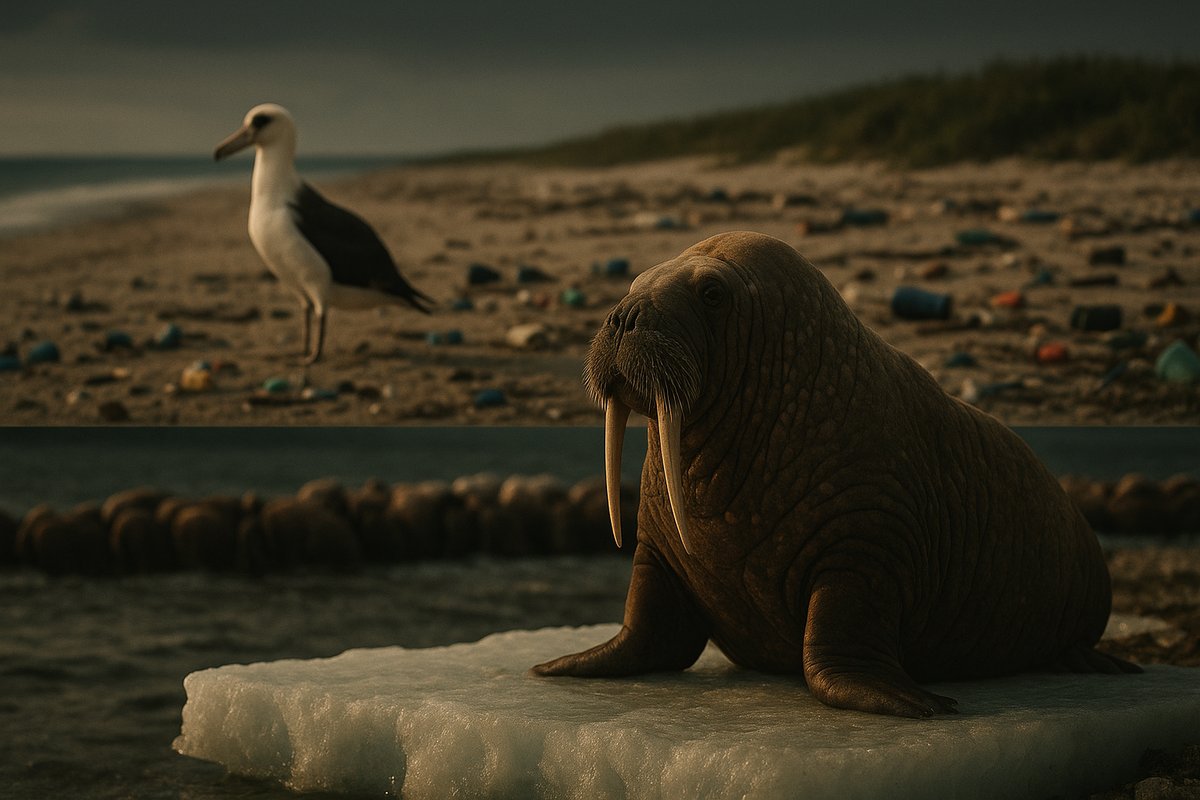
The Laysan albatross nests on a North Pacific island so isolated that few maps record it. It travels thousands of miles in search of food and returns to the same mate for decades. Its chicks die with stomachs full of plastic. The adults mistake floating fragments for fish and deliver them as food. The island has no industry, traffic, or permanent inhabitants. Even so, waste from distant civilizations reaches its shores, carried by currents that ignore borders.
This sequence appears in the chapter on migrations in Our World. What's striking is how damage propagates through interconnected structures. Direct presence isn't necessary to alter a remote ecosystem.
Climate change happens. Geological records reveal Milankovitch cycles, solar variations, and alternations between glacial and interglacial periods long before any industrial activity. Earth has maintained its natural rhythms of warming and cooling for millions of years. Human activity accelerates processes that would otherwise require millennia. That speed prevents many species from adapting in time.
The albatross evolved in oceans without microplastics. Its foraging behaviors are suited to the environment in which it developed. The problem arises when that environment transforms faster than evolution allows for response. The same happens with corals, walruses, and other species that lose the conditions for which their instincts were calibrated.
The case of the Ngogo chimpanzees in Uganda illustrates something different. A large group developed lethal violence without evident resource scarcity. Fragmentation emerged from within when social bonds eroded. Researchers who have followed them for decades observed that aggression emerged internally when mutual recognition processes failed.
The documentary presents a parallel case with walruses. A mother returns after migration and faces collective rejection. Not due to her own error, but because overcrowding and stress break down social identification processes. The colony, deprived of sufficient ice platforms, alters its internal dynamics. The rejection doesn't reflect malicious intent. It reflects a social organization operating under conditions for which it didn't evolve.
This matters because it shows that threats don't only come from outside. Internal dynamics, subjected to sufficient pressure, can become self-destructive. Environmental stress destabilizes the cooperative processes that sustain groups. A cohesive colony resists better. A fragmented group becomes vulnerable to any additional disturbance.
Similar trends emerge in human organizations. When the environment becomes unpredictable, social bonds tend to deteriorate first. The lack of mutual recognition accelerates the rest of the failures. The walrus colony illustrates the same thing: external pressure doesn't need to kill directly if it first breaks cohesion.
Our World documents, without explicitly naming it, two overlapping crises. An external one that combines climate alteration, pollution, and habitat loss. An internal one that destabilizes group dynamics. The second derives from the first, but generates its own consequences.
The albatross story illustrates unintended consequences that travel far. That of the rejected walrus shows how stress corrodes structure from within. Both reveal that animal societies can collapse before the environment eliminates them completely. It's more complicated than it appears. I'm still not clear on how bonds remain intact under increasing pressures.
What exact conditions allow a group, animal or human, to preserve its cohesion when external pressures intensify?
Sources
1. Our World (2025), Netflix — Nature documentary, migrations chapter
2. Potts, R. & Behrensmeyer, A.K. — Research on climate cycles in Cenozoic geological records, Smithsonian Institution
3. Mitani, J.C., Watts, D.P. & Amsler, S.J. (2010) — "Lethal intergroup aggression leads to territorial expansion in wild chimpanzees", Current Biology, on the Ngogo community
4. Auman, H.J. et al. — Studies on plastic ingestion in Laysan albatross at Midway Atoll, published in Marine Pollution Bulletin
5. Laidre, K.L. et al. — Research on the impact of sea ice loss on Pacific walrus populations (Odobenus rosmarus divergens)