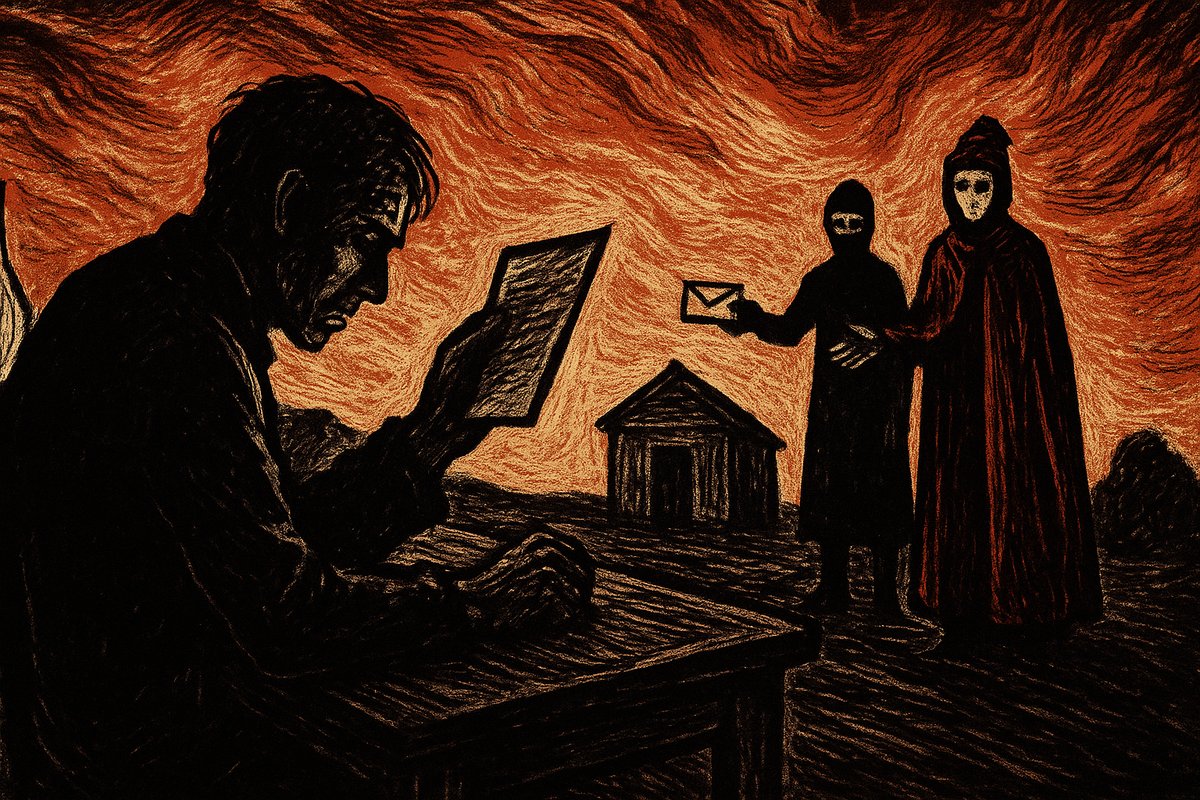
I received two similar emails over the past two weeks. Both were signed as literary festivals. Both flattered me with precision: they mentioned my Göbekli Tepe notebook, the thesis about how cooperation may have preceded agriculture, the sense that "this is exactly the kind of work that sparks conversation." Both used the formula "no pressure at all, just didn't want to miss the chance to invite you personally." One fizzled out quickly when I didn't show enough enthusiasm. The other made it all the way to the bank account before dissolving into silence.
Both festivals that contacted me actually exist. One is the Torbay Literary Festival in Devon, United Kingdom. The other is the NWA Book Fest in Fayetteville, Arkansas. Both are legitimate projects, both with identifiable organizing teams, both with verifiable local press coverage. And both are small, local festivals with limited presence outside their region. The emails that landed in my inbox probably came from neither of them.
That combination is not accidental. It's exactly why the scam chose those names. A festival too big would be easy to verify and hard to impersonate without getting caught fast. A made-up festival would be exposed with a three-second search. A small, local festival with a modest website and a small team is the sweet spot: it exists, it can be confirmed quickly on Google, and the author has no way of asking a colleague, "hey, have you heard of NWA Book Fest?" The impersonation slips right into that gap.
This is the anatomy of a scam that specifically hunts independent authors, and the reasons it works.
The first email arrived in late July, signed by Ben Tisdall, "organizer of the Torbay Literary Festival." It praised the work, invited participation, said it had been "a pleasure to discover the work." My first read was cautious. Torbay is in the UK. My main book is in Spanish. A British festival inviting a Mexican author whose flagship work is in a language its audience doesn't read has, at best, an explanation that isn't clear from the email.
I answered politely. I declined 2026 for the obvious language reason, offered to pick up the conversation in 2027 once the English adaptation was ready, and mentioned that I already had a book of mine in English available on Amazon Kindle for their audience if they wanted to start there.
Ben replied a few days later with an elegant apology. There had been an initial mix-up, he said, with Yves Saint Laurent. He defused it with humor. And then he said he'd read more of my work and that his interest was genuine, that he'd like to fit me into the 2026 edition, that there was a way to make it work.
I opened the door. I asked for concrete details. Dates, format of participation, logistics, and above all the critical point a careful author must ask before committing: the fees.
The reply came two or three days later. It came with a full bank account number, IBAN included, and instructions to transfer the "author fee" to secure my spot. The account was in a personal name, not in the name of the Torbay Literary Festival organization. No invoice, no RFC or British VAT ID, no automatic receipt from a payment platform, no link to the festival's portal, no mediation by an outside accountant. Just an account number.
That's the moment doubt dissolves. Legitimate literary festivals don't charge authors via bank transfer to a personal account. They charge through an organizational invoice, through a payment platform with an automatic receipt, or they simply don't charge invited authors fees at all. A personal IBAN sent by email is, with no exceptions I know of, a scam vector.
Last Monday I replied that a personal matter had come up and that I'd need to pick up the conversation later. I didn't say I wasn't going to pay. I didn't confront him. I stalled.
Since then, absolute silence. Not even a "hope it gets resolved soon," not a "let me know when you can." Nothing. That silence, right when a supposed festival was about to receive my money, is the final confirmation of what the conversation was from the start.
On August 3rd, eight days before writing these lines, the other one arrived. Same format. Same tone. A different festival:
> Hi Yves, I hope you're doing well! I'm John, one of the organizers of NWA Book Fest, and I recently came across your work, Göbekli Tepe: When Humans Built Temples Before Houses. I have to say, you've managed to make a 10,000 year old archaeological mystery sound surprisingly hard to stop thinking about, which is no small achievement...
What stopped me before replying to the second email was the sender: `[email protected]`. A Gmail address whose username includes a real domain. That detail is the whole key to what follows.
NWA Book Fest does exist. Fayetteville, Arkansas. A 501(c)(3) nonprofit. Fourth edition this September 26th at the Walton Arts Center. Co-founded by two local bookstores, Underbrush Books and The Cozy Librarian. Covered by the Northwest Arkansas Democrat-Gazette. All verifiable at `nwabookfest.com`.
The email I received didn't come from them. It came from a Gmail account that uses the real domain as part of the username, a trick that exploits the fact that many eyes read "hellonwabookfest.com" and don't notice that the `@gmail.com` comes after. It's the email version of the lookalike domain: you don't buy the domain, your Gmail is just named as if it were one.
A real festival inviting authors doesn't do it from Gmail. A real 501(c)(3) festival uses an account on its own domain. A real festival signs with the name of an identifiable person, not just "Organizer." A real festival doesn't send cold outreach to individual authors eight weeks before its event: its applications opened months ago via an official form.
I didn't reply to the second email. The first one had already taught me enough.
The two emails share a structure. You recognize it easily once you see it. First, a specific compliment, not a generic one: it mentions your work by title, quotes something concrete from your thesis. This is what makes it work. That first read activates the author's ego, someone who's spent months or years in the invisible trench of independent work and suddenly reads that someone "read it and got it." Second, an invitation with a warm tone: "would love to have you," "would be a perfect fit," "would add something truly unique," with no concrete dates, no URL to the official form, no conditions. Third, a closing with performative humility: "no pressure at all," "just didn't want to miss the chance to invite you personally." Fourth, total absence of any mention of money in the first email. They never say "it costs X" or "there's a fee." That detail appears later, once the author has already responded with interest. And fifth, the personal bank account, via email, IBAN included. When you ask for concrete logistics or fees, the account number appears. Not an invoice from the organization. Not a link to a payment platform with an automatic receipt. Not a note from an outside accountant. Just an IBAN, often in a personal name, with instructions to transfer to secure your participation.
The full playbook of the vanity-fee scam works like this: once the author responds with interest, the "table fees" arrive (two hundred to five hundred dollars for your table at the event), the "shipping fees" to send your books to the festival's warehouse, the optional "marketing package," the "insurance" the venue supposedly requires. The author pays by direct transfer, commits to travel, shows up on the day, and the festival either doesn't exist, or exists but has no record of their participation, or the "warehouse" never received the books. The completed scam usually runs one to three thousand dollars per author.
The escalation in my case reached the IBAN but no further, because I never made the transfer. Instead of saying "I'm not going to pay," which would probably have triggered additional pressure, I stalled the conversation with a personal matter. The absolute silence that followed is the confirmation. There was no festival waiting for me. There was an account waiting for a deposit.
It works because the independent author lives in a specific emotional economy. Most self-published books sell dozens or hundreds of copies in their first year, not thousands. Most of their authors reach December without having been invited to anything. The first time someone writes "I read your work and found it important," it activates a reciprocity circuit that is old, human, honest, and precisely because of that, exploitable.
There's a gray market of databases with self-published authors' emails that scammers buy. Amazon KDP filters, but not perfectly. Goodreads leaves a trail. Once your email lands on that list, the messages start coming: festivals, "awards" with an application fee, "book review services" that guarantee a Kirkus review. The scam adapts to the ecosystem. The only useful defense is learning to read the pattern.
There are telltale signs, and they're worth listing because they repeat. From the sender: a Gmail, Outlook, or Yahoo address signing as a professional organization, when legitimate organizations use their own domain; a username that includes a real organization's domain, exploiting the optical effect; a signature with no identifiable person's name, just "Organizer" or the organization's name. From the content: a very specific compliment about your work, but with no verifiable detail of how they found it (did they see it on Goodreads? on Amazon? did someone specific recommend it? they never say); absence of a URL to the festival's official application form; an open invitation, with no concrete dates, no logistics, no mention of money; a warm tone with performative humility. From the real counterpart: search for the festival's official site and compare it to the email's domain; search for the LinkedIn of the "organizer" who signs the email, because organizers of real festivals have a public presence; verify when the real festival's applications opened, and if the email arrives outside that window, it's suspicious; check whether the real festival has a notice about impersonation, because many now publish warnings given how endemic the scam has become. In the expected response: a real festival always replies something, even if it's "thanks, you didn't make it into this edition"; absolute silence after a polite reply is a red flag; if money comes up in the second email without a formal invoice, that's the scam unfolding.
And from the proposed payment method, the most definitive sign: an IBAN sent by email to a personal account is a confirmed scam, with practically no exceptions, because legitimate festivals don't charge that way; absence of an organizational invoice with an RFC, tax ID, VAT ID, or the corresponding fiscal identifier for the festival's country; absence of a payment platform with an automatic receipt (PayPal Business, Stripe, the official site's portal); the name on the bank account doesn't match the festival's legal name, or it's a person instead of an organization; artificial urgency in the transfer instructions, "secure your spot before the deadline," "only three tables left," "the price goes up next week."
If the conversation reaches the point of an IBAN without ever passing through a formal invoice or the festival's official payment portal, there's only one correct response: stop replying and block the sender. No need to confront, no need to explain. Your silence, at that point, is the only sensible action.
I'm not transferring a cent to whoever signs as Ben Tisdall, and I'm not going to pick the conversation back up once the "personal matter" expires. I'm not replying to the fake NWA "John." To the real Torbay Literary Festival and the real NWA Book Fest, whose organizations I imagine have no idea they're being impersonated, I'm going to write via their official sites to alert them. Plenty of authors are probably getting the same emails, and some are going to bite.
Both real festivals are small community projects sustained by independent local bookstores, in one country and the other. Someone using their names to run a scam is concrete harm to projects that do good work. They deserve to know. And above all they deserve the chance to publish their own warning, on their own site, before another less suspicious author falls for it.
I'm writing this because I've spent years accumulating reading on systems of cooperation that turn into systems of coercion, and because the pattern is always the same. The literary festival scam is a small, honest-scale version of the larger structures analyzed in the book I just published: someone builds a legitimate architecture of trust, someone else uses it to extract, and the cost falls on the lone person who had no way of knowing.
Learning to read these patterns is the only defense that exists. Sharing them is the only way to make them stop working.
If you're an independent author and you've gotten an email like this, now you know what it looks like. If you know someone who publishes on Amazon KDP or Draft2Digital, pass this along. If the email you received was from the real festival, congratulations: you got invited to something. If it was from the Gmail that mimics the domain, or if the conversation ends up at an IBAN with no invoice, you already know what to do.
Yves F. Laurent is the author of "Stones Don't Lie: From the History of Control to the Luddite Manifesto" (Stones Don't Lie Press, 2026) and "The Generosity in the Doorway" (Stones Don't Lie Press, 2026). He writes about systems of forced cooperation and their failures at yveslaurent.me.