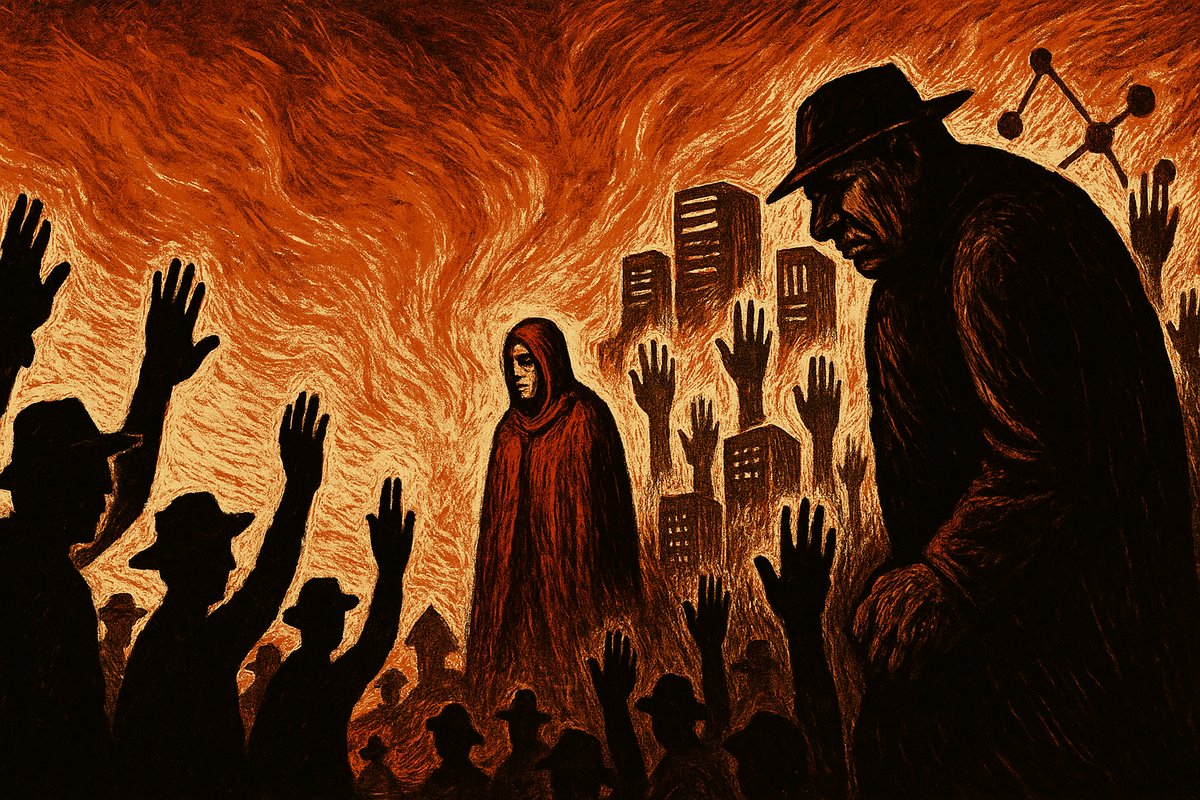
Thirty billion dollars managed by organizations that technically have no owner. No CEO, no traditional board of directors, no headquarters. Just code, smart contracts executing decisions made by the community. That's how DAOs have presented themselves since Ethereum popularized the model a few years back.
A DAO is a governance structure where decisions execute automatically because voting weight is assigned according to tokens held rather than people. That technical distinction determines everything else. MakerDAO, Uniswap, Arbitrum—the names change but they repeat the same architecture of power.
What's striking isn't that large holders exist accumulating governance tokens. That was already known. What's interesting is that the technical design itself makes that concentration nearly inevitable. And yet the story of on-chain democracy persists, the name never quite adjusting to match the function.
To see the roots, you have to look at nineteenth-century Europe. Rural credit cooperatives and mutual societies proliferated under the principle of one member, one vote. Friedrich Wilhelm Raiffeisen designed bylaws where the small farmer in theory carried the same weight as the local landowner.
In theory. In practice the landowner controlled information, decided access to credit, chaired the assemblies, and was usually the only one with the time and education to read the balance sheets. The formal vote was equal. The real power wasn't. Many of these cooperatives ended up captured by local elites until regulatory limits on per-member capital concentration were introduced.
Why does this matter today? Because the capture mechanism is identical—it just runs on code now instead of notarized minutes. When a DAO assigns voting power proportional to tokens bought or earned by arriving early, whoever had more capital at the start ends up determining future decisions. This isn't a bug. It's the specification.
How is voting power actually distributed in a large DAO? Public token distribution records show a clear pattern. Between one and five percent of addresses concentrate most of the effective voting power. In several protocols, a handful of funds that entered in early rounds can block or approve any proposal without needing additional support. The rest of the participation—the thousands of small wallets that bought on the open market—stays marginal in the votes that actually matter.
We know token concentration is measurable and public because the blockchain records everything. What's harder to prove is explicit coordination among those large holders. Though when several funds hold simultaneous positions in the same protocol, their incentives align without needing formal agreements.
Who benefits from this regulatory ambiguity continuing has several layers. Large holders maintain de facto control over protocols managing billions while at the same time avoiding the legal classification that would bring accountability obligations. If a DAO is clearly neither a company, nor a trust, nor a cooperative, the fiduciary responsibilities of those controlling it stay blurry.
Regulators find that same vagueness useful. The less defined the legal nature, the more room they have to justify broad oversight when they finally act—almost always after visible losses. Law firms specializing in crypto litigation thrive in that gray zone. Every lawsuit from small holders becomes a new case, a precedent, and fees for both sides.
Who loses is the small holder who bought governance tokens believing the pitch about real participation. They discover, usually too late, that their individual vote weighs a fraction against positions accumulated in private rounds. The participant who spends hours reading proposals without knowing the outcome was already decided.
This connects directly with what was explored in The Generosity in the Doorway. Whoever designs the system rarely cedes real control, even when the public language promises otherwise. That piece examines how infrastructure gets built and then the remedy itself gets administered by the same hands—a pattern that repeats from computing consortiums to funds financing new protocols.
The bias here is economic and structural. Code turns accumulated capital into permanent decision-making power. This isn't about auditing a model for hidden discrimination but about rethinking voting mechanisms that today mathematically reward whoever arrived first with the most resources. This is more complicated than it looks.
DAOs don't operate under a single jurisdiction. The United States has litigated specific cases treating some tokens as unregistered securities. Wyoming recognized DAOs as their own legal entities. The European Union is moving forward with MiCA, imposing transparency but leaving gray areas around pure governance. Singapore and the UAE compete to attract projects with permissive frameworks.
The result is a regulatory arbitrage we've already seen in other tech fields. Financial capital moves to wherever the rules are loosest. A DAO can incorporate in Wyoming, run distributed infrastructure across several countries, and have its largest holders in jurisdictions where it isn't even clear whether its tokens qualify as securities. When something fails, figuring out which court has jurisdiction becomes a maze.
I don't have a clean solution. It would be dishonest to pretend otherwise. What the nineteenth-century cooperatives show is that limits didn't emerge from the goodwill of those who already held power. Delegated votes. Outcomes that are usually decided before the majority even reaches the ballot box.
The question that remains is how much longer it will take to recognize that a capital-weighted voting mechanism, no matter how elegant the contract executing it, produces exactly the same results it generated a century and a half ago in a German rural cooperative.