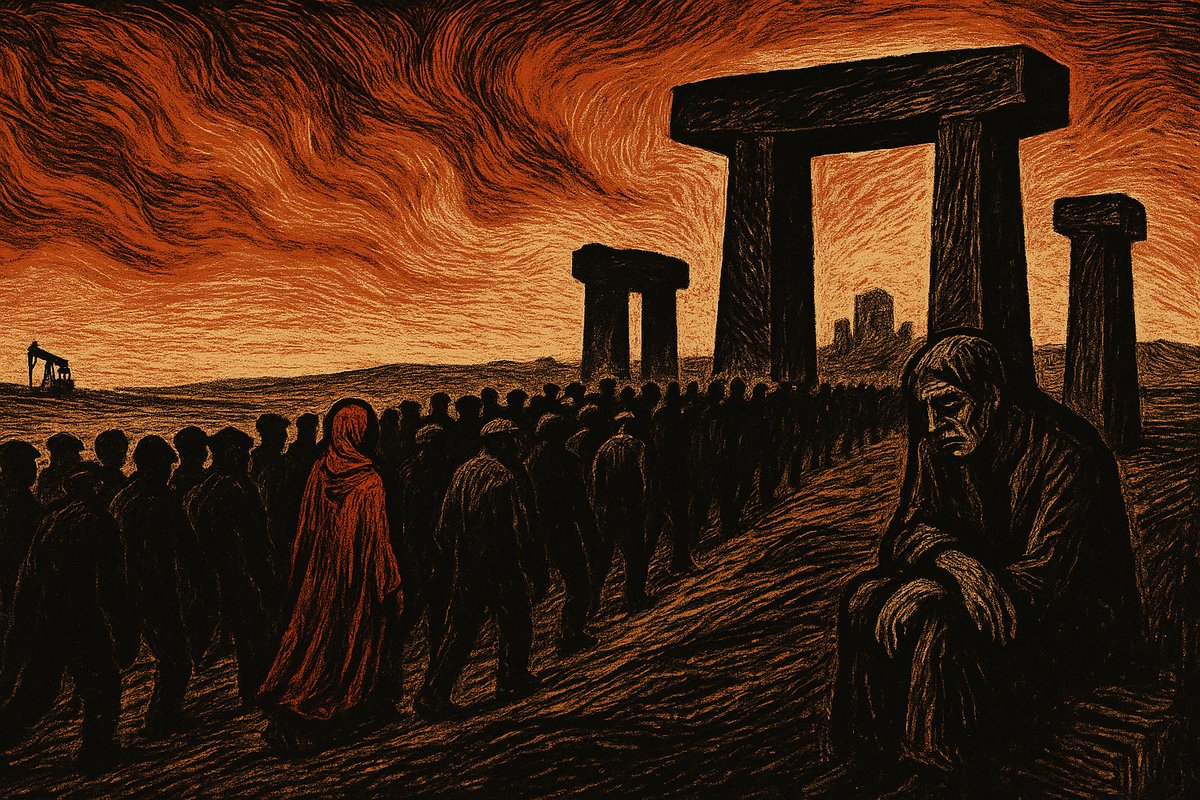
A country can lose a province without a single shot being fired. It's enough for enough people to stop believing that the center gives back what it takes from them. That's the underlying dynamic behind what's happening in Alberta. It's also behind the crowded streets in Paris, Brussels, and other European cities.
A caveat is useful here. I don't have verified polling or protest-attendance figures, so I won't invent them. What I'm doing is ordering the trends and being clear about where my reading is interpretation rather than data.
A legitimacy crisis is the loss of a population's confidence that the system governing it gives back something equivalent to what it demands. That's why it shows up in such different places wearing the same shape. With that definition in hand, these cases stop looking like unrelated news items.
Alberta has carried, for years, the grievance that Ottawa extracts its energy wealth while choking the sector with environmental and pipeline regulation. The separatist movement, referendum talk and all, has gained visibility. It carries more weight now because of the context. Canada is moving away from dependence on Washington, a subject I covered in my article on Canada and the EU as an associate member. Alberta matters in that puzzle because a Canada seeking autonomy from the U.S. needs internal cohesion. The province with the most oil and the deepest economic ties to the American market is the link under the most strain.
Alberta is the test of whether that reorientation holds. An uncomfortable question follows: who benefits from Canada fragmenting? Washington would gain leverage over energy and critical minerals negotiations. I'm not claiming it's engineering this. I'm saying fragmentation serves its interests, and it's worth looking at who funds and amplifies the separatist discourse. That's something I'm still investigating.
The protests in France and Belgium revolve around cost of living, tax and labor reforms, and public spending cuts. France has a long tradition of street confrontation with power, from the yellow vests to the pension strikes. Belgium often sees general strikes against austerity measures. These aren't isolated cases. They're economies with high debt, pressure to adjust spending, and a population that feels the adjustment always lands on the same shoulders.
What do Alberta, Paris, and Brussels have in common? In all three places, someone feels they're footing the bill for decisions made far away. It's the same complaint under a different flag. Some express it as regional identity, others as class.
And this isn't limited to those three. Behind it all is the erosion of the financial order I described when discussing the yuan's five-year plan. When the dollar loses its exclusivity, indebted states become more exposed and internal adjustment gets harsher. It's not the sole cause. It's a piece that tends to get left out.
These trends are easy enough to recognize. Systems under pressure shift the cost onto whoever has the least bargaining power. From Mexico, I watch this with a certain familiarity. Here, the center-periphery divide is an old acquaintance, as is the sense that decisions get made somewhere else.
There is historical evidence, partial as it may be, that this can be resolved without breaking apart. At Göbekli Tepe, thousands of years ago, hundreds of people coordinated over years on a project requiring tens of thousands of man-hours per enclosure. No state imposed it. What held that together, as the feasting and reciprocity visible in the archaeological record suggest, was a recognizable distribution of obligations and prestige. With hierarchies and frictions, but visible. It's not a model to copy. It's a clue. Lasting cohesion seems to depend on those who contribute actually seeing something in return.
That connects with what I analyze in The Generosity in the Doorway. Whoever designs, funds, and distributes the remedy is usually the same party that captures the resource. Those excluded from the conversation are the ones who suffer most. Alberta, the French protesters, and the Belgians share that exclusion, each at a different scale.
It's worth experimenting with transparent, regional distribution processes — funds with public rules where the province or neighborhood can clearly see what comes in and what goes back, auditable by the people themselves. That guarantees nothing. It could fail if elites capture it. I still don't have a clear answer for how to prevent that entirely.
Properly read, these tensions are signals, not verdicts. They point to where the contract broke, and therefore to where it can be rewritten.
Will Canada manage to negotiate with Alberta before the grievance hardens? Can Europe adjust without the street always paying the bill?
Sources:
1. Previous article: "Canadá y la UE: la grieta que Trump no esperaba" (September 17, 2026).
2. Previous article: "El plan quinquenal del yuan que erosiona al dólar" (August 11, 2026).
3. Laurent, Yves. The Generosity in the Doorway, Chapter 5 (Stargate).
4. General press reports on the Alberta movements and the protests in France and Belgium (no verified figures; cross-checking with primary sources is recommended).