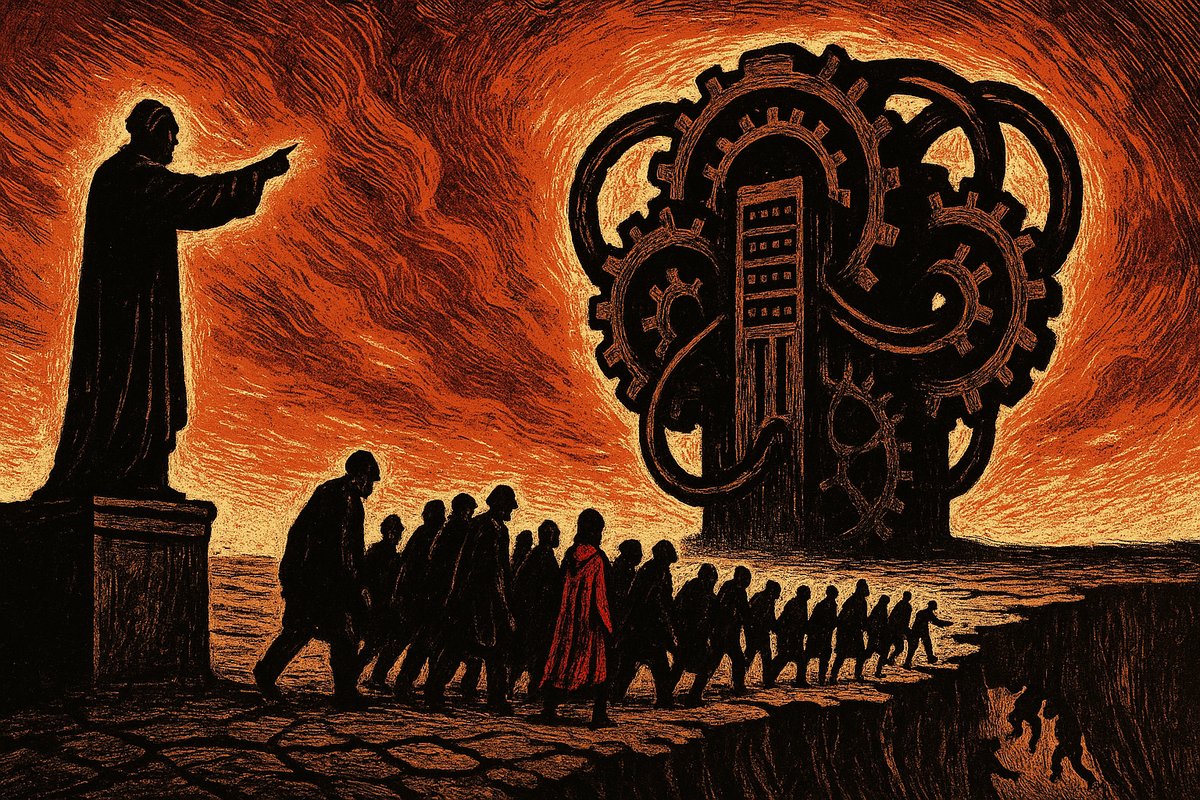
Andrew Bailey is not one for exaggerated alarms. As governor of the Bank of England and chair of the Financial Stability Board, he has written to G20 finance ministers. An artificial intelligence bubble constitutes a concrete systemic risk. His message highlights three fragilities that coincide: valuations detached from actual revenue, heavy market concentration, and sovereign debt that already shows weakness. Together they could trigger a correction of global scope similar to that of 2008.
An AI bubble is the sustained disconnect between market value and real revenue-generating capacity, because it feeds on circular expectations rather than verifiable fundamentals. Bailey does not deny the technology's value. He points out that the price assigned to it has become detached from that reality, and the gaps thus formed eventually close.
He recognizes trends already seen in other crises. The body that coordinates the global regulatory response observes familiar dynamics in AI. Inflated valuations. A small group of companies attracting most of the available capital. Cross-investments between AI firms and the major computing platforms that supply their infrastructure. Microsoft funds OpenAI. OpenAI buys capacity from Microsoft. NVIDIA backs startups that then buy its chips. A closed loop. The same capital gets counted multiple times as new growth.
This mechanism transcends Silicon Valley. European pension funds carry indirect exposure and would feel the correction. Data centers consume industrial-scale electricity. A resulting energy shock would raise rates even in countries without a single relevant AI company. When that overlaps with sovereign debt fragilities, the result is no longer sectoral. It becomes a liquidity crisis that crosses borders.
In parallel, Chancellor John Healey announced a £100 million fund for British AI startups. The stated goal is to strengthen national capacity, generate local jobs, support NHS services, and reduce dependence on foreign suppliers. It responds to the same diagnosis Bailey lays out. If concentration in a few hands, almost all American, generates vulnerability, diversifying seems the logical response.
Is a £100 million fund enough to counter a bubble of this size? Hard to argue so, when compared against the sums handled by the consortiums identified as risk. In The Generosity in the Doorway, when examining the arithmetic of Stargate, one observes how those projects move figures that exceed the GDP of entire countries. Against that, the British fund looks like a modest insurance premium. A precautionary measure against a risk the governor himself calls systemic.
Concentrated capital tends to come out ahead in any of the scenarios. If the bubble holds, the major platforms consolidate their position and the fund acts as marginal diversification. If it bursts, sovereign wealth funds and governments with reserves buy devalued assets. Those who already have scale end up with greater relative power. Those who don't see promises of jobs and national sovereignty dilute.
I've seen similar dynamics in other attempts at economic coordination under pressure. The Cybersyn project in Chile showed that it's possible to explore forms of coordination that don't depend exclusively on the market. It operated with full government backing, not as a fund running parallel to unchecked growth.
Why does the G20's response remain more private capital within the same circuit instead of direct restrictions on those connections? If cross-investments and concentration are the structural problem, that question should be at the center of the debate, and it isn't. Healey's fund doesn't touch the mechanism. It only adds competitors to the existing game.
I don't have a definitive answer as to whether that fund is sufficient, insufficient, or symbolic. I suspect it could be all three depending on which scenario arrives first. Warnings like Bailey's rarely anticipate the break. They arrive when the fragility is already well advanced, still in time to decide who absorbs the blow. Stones don't lie.
What technological sovereignty can truly be built when private interconnections have already defined the terrain?
Sources:
1. Letter from Andrew Bailey to the G20 in his role as chair of the Financial Stability Board
2. Announcement by Chancellor John Healey on the £100 million fund for British AI startups
3. The Generosity in the Doorway, Yves Laurent (analyzing the arithmetic of Stargate)