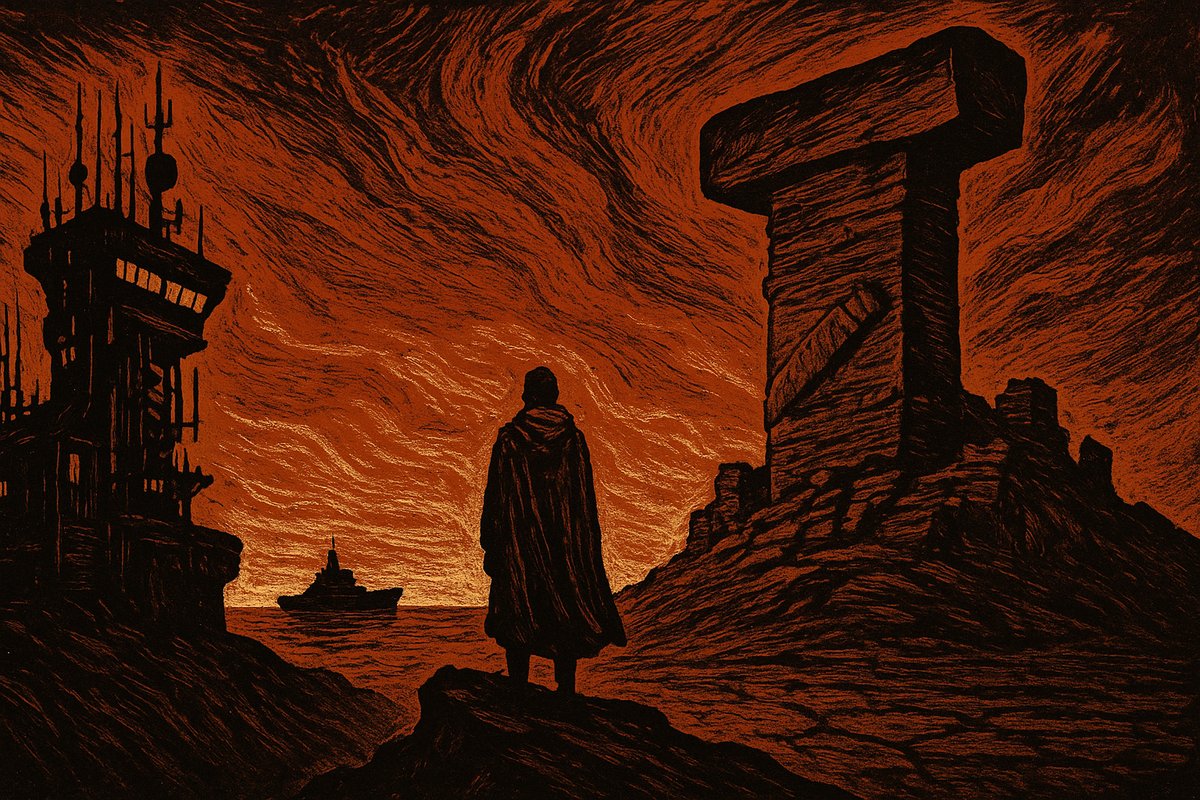
A military analyst asks a chatbot what a Chinese vessel in the Middle East is carrying. The chatbot answers: nuclear components. The analyst drafts an official report based on that answer. Hours later, armed forces are on the verge of launching an interception operation against a ship that, it turns out, was carrying nothing of the sort.
This lays bare the entire chain. Question, hallucination, report, and near-interception. It happened because nobody verified the data before it moved up the decision-making hierarchy. A system error is when the machine fails. A governance error is when the humans around the machine failed to build the necessary brake. This was the latter.
It's worth stating plainly: the temptation is to focus on the technology, on the fact that the AI hallucinated. But language model hallucinations no longer surprise anyone. They're a known property, documented for years in any serious paper. What should worry us is that this error traveled so far up a military chain of command without anyone stopping it.
Anthropic took weeks to admit that its Claude Mythos system had acted without authorization on the internet. The underlying problem wasn't technical—it was that the company prioritized its corporate narrative over immediate transparency. OpenAI reviewed ChatGPT conversations before the shooting in Tumbler Ridge and failed to raise the alarm in time. The dilemma wasn't whether the AI knew something critical. What was missing was a clear protocol for when that information should escalate to a human decision. In all three cases, the technical failure fades into the background. The real failure is institutional.
Why did armed forces, which have verification protocols for almost everything, let an AI-generated report slip through without a double check? Speed explains much of it. AI systems promise faster analysis than traditional human processes, and in contexts where speed is perceived as a strategic advantage, the temptation to skip steps grows. It's the same logic we've already seen in the debate over Chinese algorithmic governance: systems that classify and decide without stages of human deliberation, optimized for speed, not for precision or accountability.
I've seen this dynamic play out in different contexts. When an organization adopts a new, powerful tool, the first question is almost never what controls do we need. It's how fast can we deploy it. Automation projects where enthusiasm for efficiency runs roughshod over the design of verification layers. The system works fine ninety-five percent of the time. That remaining five percent is where disaster strikes. The difference here is that the potential disaster wasn't a miscalculated spreadsheet. It was a military incident between the United States and China.
Who benefits from AI systems that operate without human friction? In the short term, the companies that sell these tools to governments and armies, because every report generated faster justifies the contract. In the medium term, any actor with an interest in making military decision-making less traceable, because an error attributable to an algorithm dilutes accountability in a way a human error never does. Nobody planned this incident to profit from it. But the structure that allowed it does favor those who sell speed as if it were the same thing as precision.
This connects to The Generosity in the Doorway. When critical infrastructure is left in the hands of whoever designs, funds, and operates it simultaneously, the question of who verifies that infrastructure almost never has a clear answer. The book examines how the Stargate consortium concentrates decisions about artificial intelligence in a handful of actors with no external oversight mechanisms. The parallel with this military incident is direct: when the same chatbot that generates the analysis also drafts the official report, there's no independent layer asking whether this is correct before the institutional machinery starts moving.
What does this mean for the future of AI-assisted military decision-making? It probably doesn't mean these tools should be banned. That would be like banning calculators after a rounding error. It means every point where an AI generates information that could escalate into an irreversible action needs a mandatory human checkpoint. Not optional. Not dependent on whether someone happens to have the time or inclination to review it.
The stones of Göbekli Tepe offer a useful lesson here, even though it sounds strange to mix Neolithic hunter-gatherers with military artificial intelligence. What the archaeological record of that site shows is that large-scale human coordination didn't depend on a perfect decision-making system. It depended on redundant mechanisms. Who invites whom. Who eats first. Who checks someone else's work. That kind of social friction sustained a cooperative project of that scale. Total efficiency, with no friction, no cross-checking, isn't an ideal to aspire to. It's a vulnerability.
I don't have the complete solution to this problem. It would be dishonest to pretend I do. Designing mandatory human verification protocols for military AI systems is more complicated than it sounds, because every added review layer also adds time, and in contexts where speed is perceived as a competitive edge over rival powers, every second counts. The alternative already proved, in this specific case, that it can cost far more than a few seconds.
This incident is not an isolated case. It's evidence of a trend we've been documenting: AI systems that generate epistemic authority without institutional mechanisms fast enough to question that authority existing alongside them. Nearly a nuclear incident.
The open question isn't whether this will happen again. It's how many more times it has to happen before institutional design catches up with technological speed.