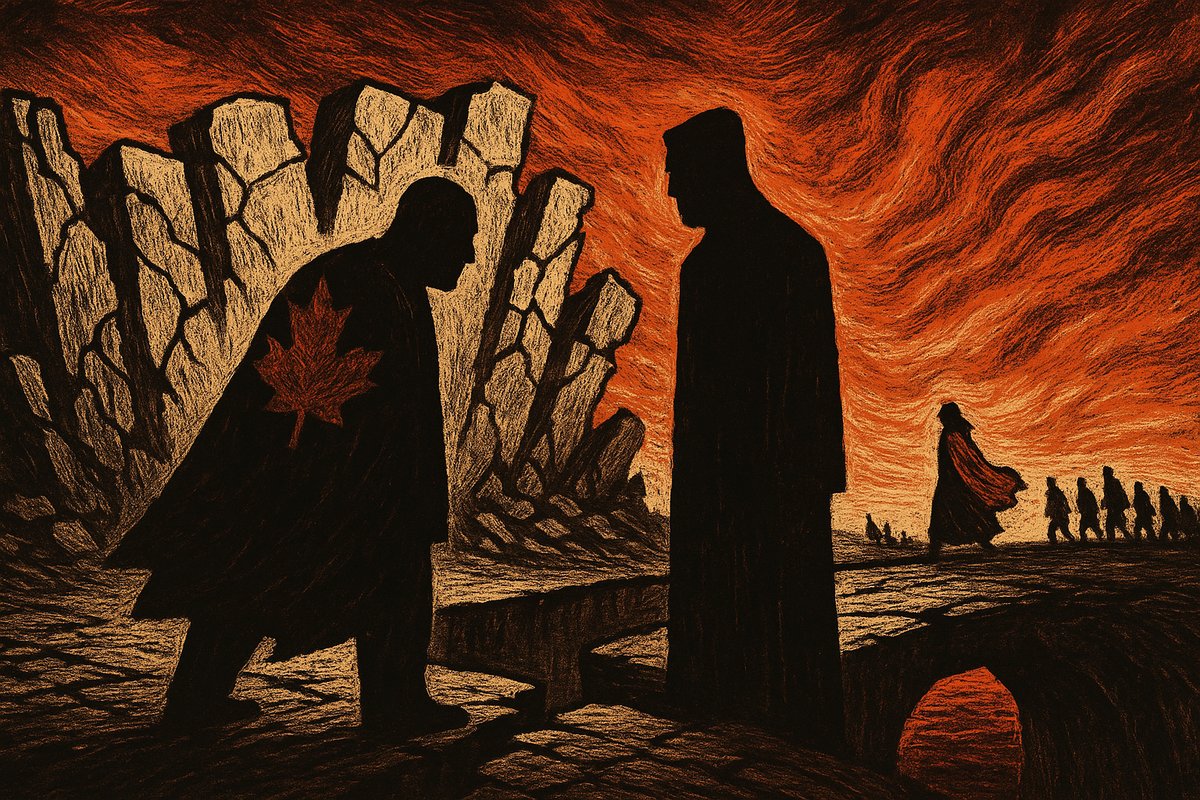
I was wrong. I recently wrote that the possibility of Canada becoming an associate member of the European Union was a baseless rumor. Mark Carney took the podium at the European Parliament and proved otherwise. An associate member is a country that participates in economic, technological, and defense structures without being a full member, because today's geopolitics demands faster responses than treaties can provide. The correction matters less than what comes next. Canada is, in effect, reorganizing its place in the world, away from Washington's exclusive orbit.
The figure that defines this moment reaches one hundred fifty billion euros. Canada joined Security Action as the first non-European country to do so. Ursula von der Leyen invited Ottawa to reimagine the bilateral relationship beyond trade. Carney responded with a phrase that will stick. He proposed a "partnership of the future" centered on artificial intelligence and shared strategic capabilities.
The problem is literal. This "associate member" category doesn't exist in the European Union's treaties. There's no article, no protocol, no formal precedent. A political category is being invented in real time. Geopolitics moves forward. Bureaucracy tries to catch up.
Donald Trump's reaction was immediate. He called the potential associate membership "a hostile act," labeled Canada "a terrible trading partner," and ordered Canadian products removed from federal agencies while threatening tariffs against the European Union. The speed itself is information. Nobody gets that angry over something irrelevant.
Canada has spent decades inside the American security perimeter, from the North American Aerospace Defense Command to USMCA. Ottawa seeking joint defense procurement with Europe and artificial intelligence ecosystems outside Silicon Valley is not a symbolic gesture. It's dependency reduction. Hegemons handle these leaks poorly.
I've seen similar patterns before. Imperial power sustains itself through the perception that there's no viable alternative. The moment a historic ally proves there is one, even if partial and still lacking legal grounding, the crack appears. Proving it is enough.
This move isn't an isolated case. It follows the same logic I explored in China's five-year plan for the yuan. Beijing doesn't need to replace the dollar overnight. It just needs to build parallel infrastructure, alternative payment and clearing systems. Canada is applying that same idea to defense and technology. It's not replacing the United States. It's simply becoming less dependent on it.
This matters because the power architecture that has dominated since 1945 is starting to show visible cracks even among close partners. Canada isn't France demanding strategic autonomy. Nor is it China openly challenging the order. It's the USMCA neighbor, the one sharing the longest unguarded land border on the planet. If it's calculating exit doors, the serious question is who else is doing so quietly.
Cui bono. Von der Leyen gains defense muscle without funding it alone. Carney gains leverage against Washington and diversifies risk. Trump loses the sense of inevitability. Beijing watches closely, because every crack in the American alliance system opens indirect space for the yuan and its own platforms.
This connects directly to The Generosity in the Doorway. When I analyzed the Stargate consortium and the concentration of artificial intelligence infrastructure, the question was who was left out of the conversation. With Canada and the European Union, the pattern reverses. A historic ally sits at another table and redefines the terms. That reversal is what's most worth watching in the coming months.
China plans on five, ten, or fifteen-year horizons. The United States responds with tariffs and product removals within days. One approach builds lasting institutions. The other manages crises. I still don't know which one wins in the long run. I'm still working through this asymmetry.
What happens if the European Union ends up formalizing the "associate member" category just for Canada? If it works, Mexico, South Korea, or Japan could have a replicable model under certain scenarios. A legal category born of necessity can become a template. That should worry Washington more than the specific dispute with Ottawa.
I still don't know for certain how this ends. It could dissolve into symbolism if the legal framework never solidifies. Or it could be the first brick of a Western security architecture less centered on a single pole. I underestimated how quickly allies recalculate when a relationship becomes unilateral and unpredictable. The cracks are already showing.
What other neighbors are quietly weighing their own options?
Sources
1. Mark Carney's address to the European Parliament
2. Public statements by Ursula von der Leyen, European Commission
3. Security Action framework, EU defense lending mechanism
4. Donald Trump's public statements on trade policy with Canada
5. Founding treaties of the European Union (absence of an "associate member" category)