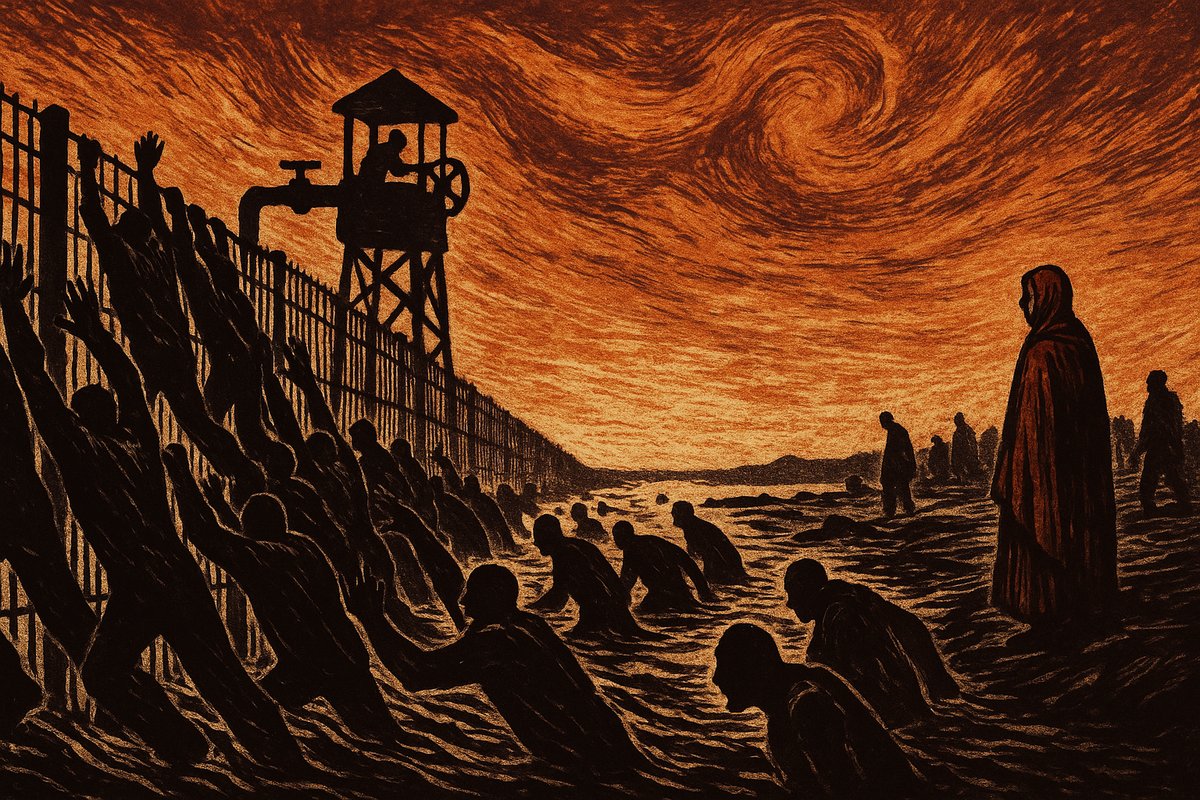
Instrumentalized migration is a form of hybrid warfare because it allows one state to pressure another through the deliberate movement of vulnerable people without declaring armed conflict. Morocco illustrated this once again in July 2026. Rabat relaxed border controls in Ceuta for several hours and allowed twelve thousand people to cross by swimming or scaling the fence, in direct response to diplomatic friction with Spain over Western Sahara. This was not a spontaneous collapse. It was a decision switched on and off like a light switch.
The pattern repeats regularly. European security analysts have documented similar surges in Ceuta and Melilla coinciding with specific tensions between Rabat and Madrid. The Moroccan government regulates surveillance on the African side thanks to European agreements and funding. It literally decides how much migratory pressure to release at any given moment. A water tap. It opens when negotiation is convenient. It closes once the objective is achieved.
What's revealing here isn't the novelty. It's the historical persistence of the method. In Stones Don't Lie, when examining ancient empires, I show how forced displacement became a tool of statecraft. Assyria deported entire communities not merely to punish rebellions, but to reconfigure demographic maps according to its interests. The migrant was the piece on the board. Never the player.
Why resort to this instead of direct negotiations? Moving people is cheaper and easier to deny than deploying armies. Rome faced similar dynamics along the Rhine and Danube. Some governors negotiated settlements for Germanic peoples in exchange for military loyalty. Others presented them as a threat to extract more resources from the center. Migration became both problem and solution at once.
The arrangement between Mexico and the United States follows a related, though distinct, logic. Since 2019, under explicit tariff pressure from Washington, Mexico deployed its National Guard on its southern border to contain Central Americans before they reached U.S. territory. Mexico acted as a subcontracted wall. It absorbed the human and political cost. The United States reaped the image of control without shouldering the full infrastructure. Who benefits from this exchange? The United States reduces domestic pressure. Mexico receives tariff relief in exchange for overcrowded camps in Tapachula and Ciudad Juárez.
China applies a colder variant. It doesn't move people. It controls rare earths and key manufacturing components. This dependency functions as a low-intensity economic lever, the same logic transplanted into supply chains. The threat doesn't need to be executed. Its mere existence suffices.
Here's another thing: today's hybrid warfare invented nothing. It refined the logistics of something as old as empires themselves. Whoever controls the timing and the narrative wins without firing a shot. People are moved. The moment is managed. The official version is shaped. The receiving state always responds one step too late.
This adds an uncomfortable layer to the book's thesis. The suffering of displaced people is not a side effect. It is the central mechanism. A Syrian family crossing the Mediterranean. A Honduran family stranded in Tapachula. A sub-Saharan worker swimming toward Ceuta. Their genuine need for help became the currency with which two governments negotiate. Morocco did not create Sahel poverty. That poverty already existed. What it did was politically activate it when convenient. Governments abuse those who truly need assistance this way: they promise protection and then convert them into border pressure.
This dynamic requires no long-term planning or sophisticated coordination. A controllable border and a preexisting human crisis suffice. The cost of instrumentalizing twelve thousand desperate people is practically zero compared to any military deployment. No advanced technology is needed. Only the decision to treat human beings as inventory.
The consequences accumulate. Erosion of the right to asylum, because every application begins to be treated as a possible maneuver rather than a need. Additional trauma for the populations used, who discover that their desperation was calculated by the very government claiming to protect them. Dangerous normalization: Belarus pushing migrants toward Poland, Turkey threatening the routes to Greece. Every success teaches that the model works and that the reputational cost is manageable.
I still don't have a clean solution. It would be dishonest to pretend I do. After tracing these patterns from Mesopotamia to the Strait of Gibraltar, it's clear that as long as we keep talking about migration crises as natural phenomena, we will keep failing to name what's actually happening.
Stones don't lie, but historians sometimes do. And government press releases almost always do.
What real cost are we willing to keep paying to keep these balances of power in place?
Sources
1. Human Rights Watch, reports on the Ceuta migration crisis, May 2021
2. International Crisis Group, analysis on Morocco-Spain relations and Western Sahara
3. Reuters, coverage of the Mexican National Guard deployment on the southern border, 2019
4. Yves Laurent, Stones Don't Lie (Amazon, ASIN B0H9T9ZRQC)
5. Council on Foreign Relations, analysis on Chinese control of rare earths as a geopolitical lever