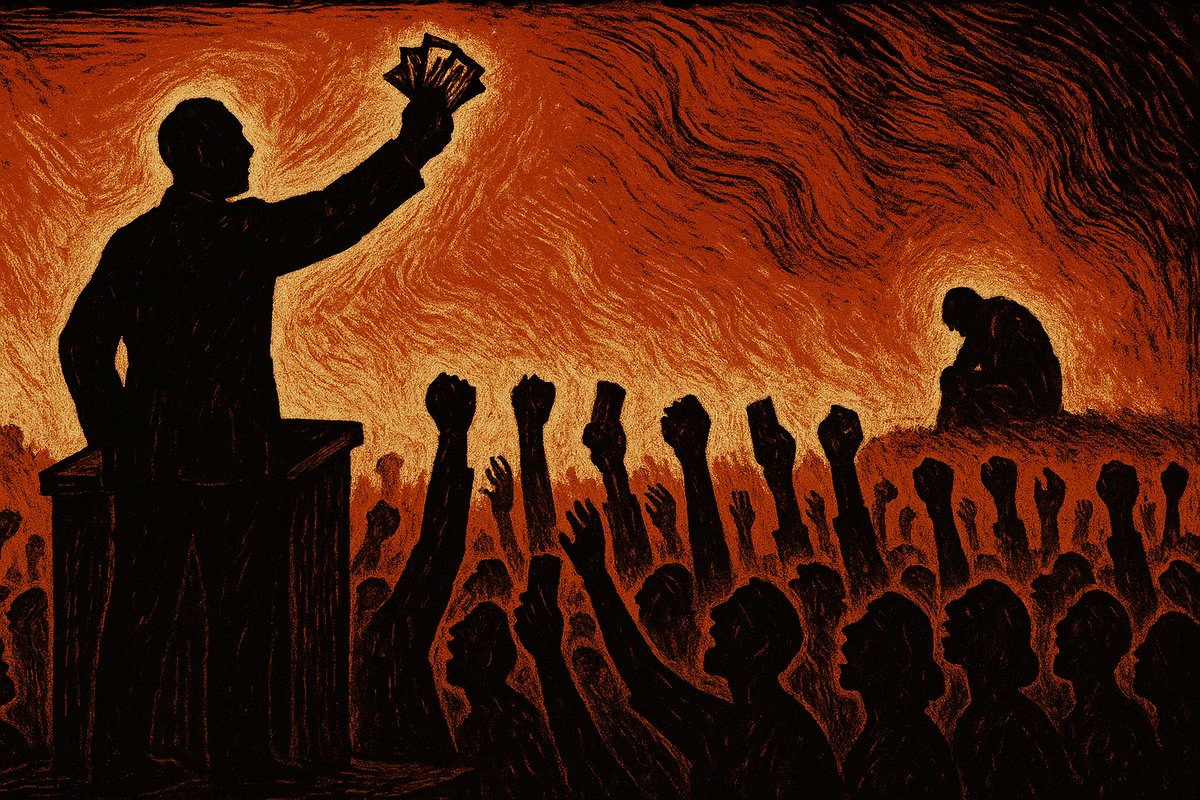
In Dallas, on September 9, 2026, Donald Trump took the stage at the Republican convention and promised something very concrete. Five thousand dollars for every American adult. The condition was that Republicans retain control of Congress in November. This is a campaign promise shaped like a check. That distinction is going to matter a great deal in the weeks ahead.
A political dividend is a money transfer conditioned on the electoral outcome of whoever offers it, because it ties economic relief directly to support at the ballot box. That's what separates the Dallas announcement from any social assistance program. The White House presented no legal process for paying it. There's no identified funding source. No bill exists in Congress to back it. Nor is there any public calculation from the administration. What exists is a number — more than a trillion dollars according to the estimates circulating that very night — alongside an explicit political condition. That alone reveals the kind of generosity we're looking at.
The room responded with long applause. Phones held up everywhere. Understandable, really. The cost of living in the United States keeps hitting families who still haven't fully recovered their purchasing power after the inflation of 2022 and 2023. Five thousand dollars. Nothing symbolic for someone who owes rent or credit card debt. The problem isn't the amount. What matters more is who would authorize it, where the money would come from, and what's actually expected in return.
That's where the story gets interesting. American governments have already handed out direct payments to citizens before. During the pandemic, between 2020 and 2021, three rounds of stimulus checks went out — first under Trump, then under Biden — totaling more than eight hundred billion dollars. Those payments had a clear legal framework. They went through Congress, were funded with explicitly authorized debt, and responded to a verifiable public health emergency. The Dallas dividend still lacks all of that. It's a promise that precedes the law, not a law that executes a promise.
The actors here go beyond Trump and Congress. There are the Republicans seeking reelection in November who now have to explain how something their leader already presented as done would actually be paid for. There are the Democrats, pointing to the absence of legal process as proof of an electoral maneuver dressed up as public policy. And there's the average voter, who probably doesn't check the fiscal details but does retain "five thousand dollars" and "if you vote for us." That voter is the real target of the message.
Why does a promise with no financial process generate so much enthusiasm when no one explains how it would be fulfilled? The answer has less to do with economics and more with what was already explored here regarding unemployment and populism. Direct money doesn't just solve a material problem. It also offers a sense of belonging. It promises an "us" that wins if the right party wins. The condition is electoral, not legislative. The dividend represents a shared bet between the candidate and his base against the rest of the political system.
This connects with what Yves Laurent worked through in The Generosity in the Doorway. Direct income on its own doesn't resolve the question of belonging that arises from the suffering caused by unemployment or precarity. Revisiting the classic Marienthal study — the research Marie Jahoda, Paul Lazarsfeld, and Hans Zeisel conducted on an Austrian community devastated by unemployment in the 1930s — an uncomfortable pattern emerges. Income is necessary but not sufficient. The people of Marienthal didn't just need money. They needed structure, purpose, a place within the community. The Trump dividend offers the first part and wraps it in the language of the second. It promises not just dollars but a shared victory.
Universal basic income pilots in Kenya, Finland, or Stockton, California, work differently. They aim to measure effects on well-being, employment, and mental health without asking anything in return. There's no electoral condition. The Dallas dividend inverts that logic. It doesn't examine what happens when people receive guaranteed income. It bets on what happens when people believe their income depends on keeping someone in power.
Republicans could lose Congress in November. The promise then dissolves with no legal consequence for whoever made it. There's no contract, no pending bill, no binding commitment. That means the dividend works perfectly even if it's never paid, because its real function isn't fiscal but electoral. It turns every Republican vote into a personal five-thousand-dollar investment. Sophisticated as a mobilization strategy, though weak as public policy.
What comes next is predictable. Fact-checkers will point out the absence of process. Fiscal analysts will calculate the real cost against the existing deficit. Republicans in competitive districts will have to answer questions the White House never answered first. The one who loses in this scenario isn't just the voter who got their hopes up over a check that may never arrive. What also loses is the serious conversation about real economic precarity — the one Marienthal documented nearly a century ago and which remains unresolved by one-off transfers, whether pandemic stimulus or electoral dividend.
There's something almost ceremonial about announcing a windfall reward at a convention, surrounded by flags and applause, conditioned on a voting ritual that happens months later. It recalls other ancient ways of legitimizing power through the promise of shared abundance. The difference is that those ceremonies didn't ask for a vote of continuity — they only asked for faith. What does this reveal about how political loyalty is built today?