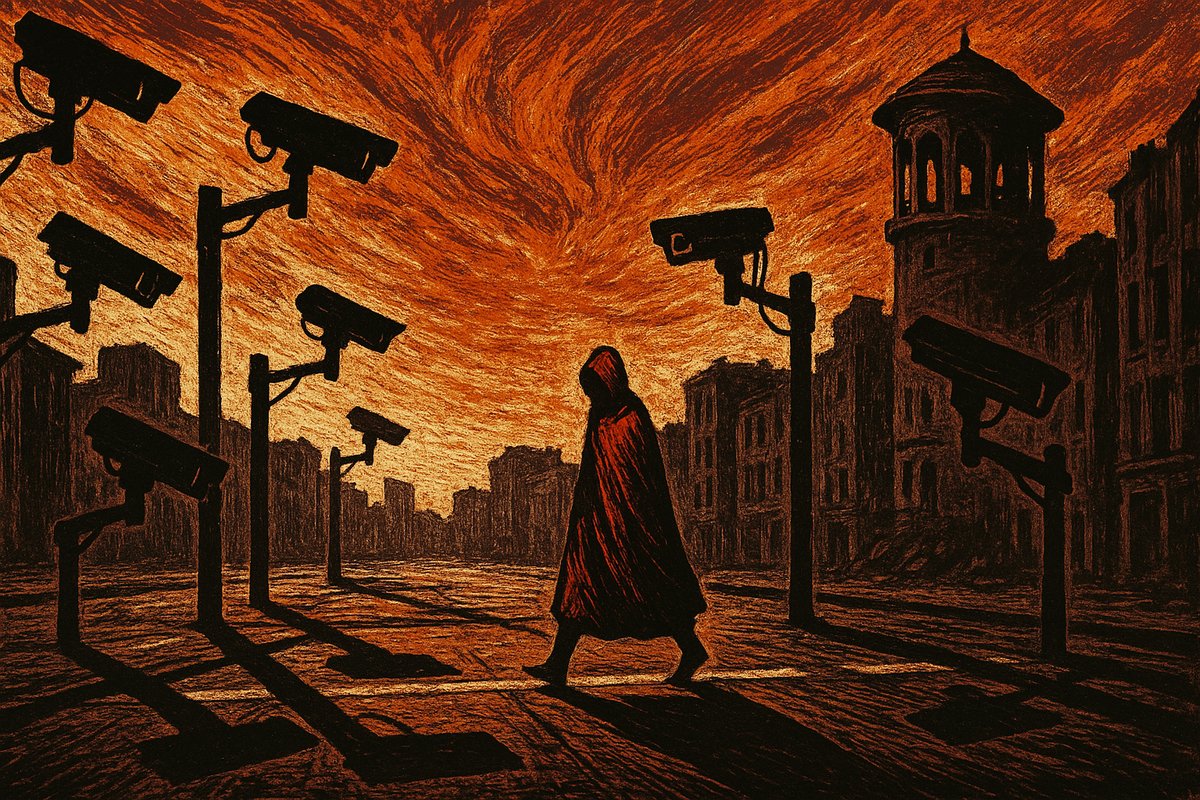
Flock Safety doesn't sell cameras. It sells the promise that crime drops when every movement gets recorded. Its OS Investigate tool tracks people through movement patterns. It needs no license plate, no prior complaint. The artificial intelligence links vehicles, routes, and schedules until it builds complete profiles. With 127,000 active cameras across 6,000 communities in the United States, this already amounts to permanent infrastructure.
The inverted panopticon is a structure in which total surveillance emerges from a distributed network that anyone can activate. The infrastructure stays on by default. That difference from Jeremy Bentham's classic model and Michel Foucault's analysis in Discipline and Punish turns out to be decisive. Bentham imagined a central tower. A single guard could observe every cell without prisoners knowing whether they were being watched. Power operated through uncertainty. Flock Safety prioritizes total certainty, available at every moment.
The dominant narrative holds that more cameras mean less crime. Cities report drops in vehicle theft after adopting the system. Flock Safety highlights stolen cars recovered within minutes, missing persons located, and suspects in violent crimes arrested. These verifiable stories serve as political justification. Nobody wants to be the official who pulled the cameras right before a major case.
The reasoning holds together internally. If the technology detects connections that no human officer would ever find by sifting through paperwork, why not deploy it? Security companies have offered this same logic to residences, shopping malls, and schools for decades. Flock Safety simply scaled the model up with artificial intelligence to the municipal level. From a purely efficiency-driven standpoint, cross-referencing 127,000 sources looks like the natural evolution of something society accepted long ago.
The cracks, however, are becoming visible. Fifty officers face accusations of using the network to stalk exes, follow judges, or pull up data without a warrant. In California, seventy-one percent of the alerts generated in 2024 turned out to be inaccurate. This isn't a tolerable margin of error. These are stops triggered by mismatched plates, mistagged vehicles, and families placed under scrutiny because of algorithmic coincidences. A hundred and twenty-seven thousand cameras. Too many to ignore.
Why cut data retention down to seven days if the system delivers on its promises? Public pressure worked. The August 13th announcement, with mandatory access controls, came only after more than a hundred cities had already disconnected their cameras. It was reactive damage control — the same pattern corporations follow whenever regulation catches up to them before any internal soul-searching does.
The public conversation centers on whether the system works or fails. The real question is who controls access, and under what rules. The 127,000 cameras don't belong to a centralized federal government. They're scattered among local departments with wildly inconsistent standards. Surveillance gets decentralized without decentralizing the power it produces. The data flows toward federal agencies and shared databases that no local voter ever explicitly approved.
For anyone who's never committed a crime, this means their daily routine already exists as a data product. Departure times, routes avoided, the people they meet. All it takes is moving through a city with Flock cameras. In the United States, that covers most cases. I've seen similar patterns in other contexts — the promise of liberation always hides a concentration of power.
This connects directly to what I explored in The Generosity in the Doorway regarding technological efficiency. The same structure used to justify automating jobs reappears here, framed as freeing up police resources for real crimes. In both cases, the main beneficiary is whoever controls the infrastructure.
Who actually benefits from this model? Flock Safety, a private company valued in the billions, collects recurring revenue from municipal subscriptions. Every new AI feature, like OS Investigate, becomes a reason to renew contracts and raise rates. The incentive isn't to solve crime outright, but to sustain enough public unease to justify continuous expansion. Police agencies gain massive capability without building their own network or answering to any uniform accountability standard. Abuses get chalked up to a few bad actors.
Inscriptions found on Mesopotamian clay tablets show that scribes recorded the movements of people and grain under state control thousands of years ago. The tension between security and autonomy is nothing new. Neither is the risk that the tool becomes an end in itself.
There's no practical way to uninstall 127,000 cameras and turn back the clock. The technology is cheap to replicate, and any city that rejects it just watches its neighbors adopt it instead. That's the mechanics of the inverted panopticon. Reversing it would require simultaneous coordination that no single locality controls on its own. The hundred-plus cities that disconnected their devices simply pushed the network into neighboring jurisdictions.
If full reversal is impossible, the only coherent path is to invert the direction of the gaze. If the state and corporations are watching everything, the public should have equivalent access to how, when, and by whom that information gets used. It's not a comfortable solution, nor a finished one. I still don't have clarity on how to implement it without creating new risks. It's worth exploring anyway.
Flock Safety has never published how many crimes were prevented before they happened. It only reports after-the-fact resolutions. The network documents with growing precision. It doesn't prevent anything.
Who ends up writing the rules once the infrastructure of certainty can no longer be switched off?