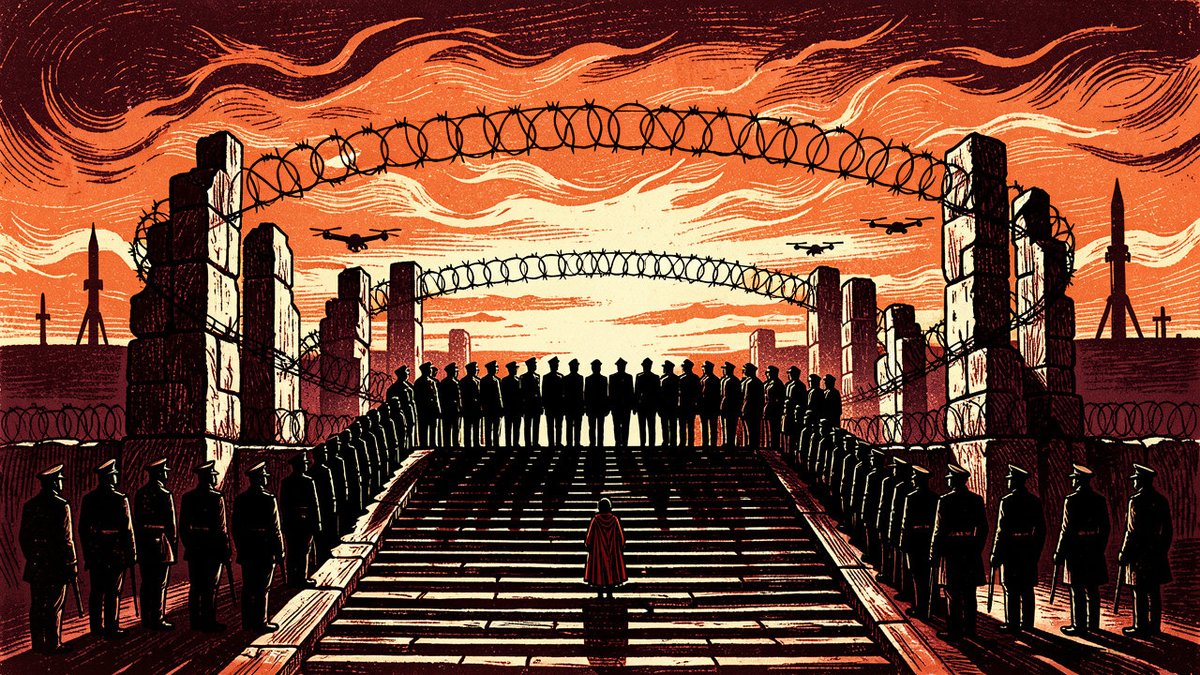
An army is a system that converts loyalty into capability. That's why the meeting of company commanders that Kim Jong-un led in Pyongyang matters more than it seems. A company commander is the link where an order from above becomes the actual conduct of real soldiers. That's where a regime finds out whether its power exists or merely gets declared.
Kim called for a "Korean-style military revolution" to build the "strongest army." The meeting lasted two days, ended on Friday, and was the first army-wide event since the Ninth Congress of the Workers' Party. Anyone who reads the headline as pure bluster misses what's interesting. That's in the list of topics, not in the slogan.
The report mentions strengthening conventional forces, developing nuclear capabilities, securing ideological loyalty to Kim, and integrating combat skills learned from the war in Ukraine. Four elements that seem distinct. In reality they form a single circuit. I only have the summary the regime itself released. What follows is trend analysis, not firsthand information.
Why does mentioning Ukraine matter? No military manual replaces field experience. Public reporting on North Korean troops being sent to support Russia suggests Pyongyang is no longer just exporting ammunition. It's importing learning. Drones. Trench warfare. Coordination under constant surveillance. An army that spent decades training for a war that never happened now has real data. Company commanders are the ones who have to absorb those lessons and pass them down.
That dilemma shows up in any hierarchical structure. Any organization that becomes more competent also risks becoming more autonomous. Whoever learns to operate well starts to judge on their own. The regime resolves that tension by bundling political control into the same package as training. You can't learn one without absorbing the other.
The gathering coincides with Seoul's proposal to open military talks over an explosion in the demilitarized zone. The contrast speaks for itself. One capital offers a table and the other announces it's sharpening the knife. That doesn't mean Pyongyang is about to attack. It means it doesn't want to negotiate from weakness, and flexing muscle before sitting down is a practice as old as diplomacy itself.
An uncomfortable question arises here. Why would North Korea bother modernizing its conventional army if it already has nuclear weapons? The nuclear weapon deters, but it doesn't work for everything. It's too big for any skirmish, and a state with only the maximum option stands paralyzed in the face of minor incidents. A strong conventional army gives it intermediate steps. Pyongyang insists its nuclear status is irreversible and maintains that stance despite international sanctions. The logical next step is making sure there's more than soldiers with outdated equipment underneath the nuclear umbrella.
Inside North Korea, the circle around Kim wins, because permanent mobilization justifies internal control and the priority of military spending over everything else. Outside, the tension benefits defense industries in the region and reinforces the argument of those who want a greater U.S. military presence. The analysis of power trends from Rome to Washington deals with exactly this. Powers justify their military apparatus with the threat of the other, and the other does the same in mirror image. That doesn't make all actors equivalent, but it does explain why each escalation feeds the next.
It's also worth looking at what's moving around the edges. In East Asia, Seoul, Tokyo, and Pyongyang are calculating on a board where Russia and China weigh more than before. North Korea is no longer as isolated as when sanctions were all that lay on its horizon. That changes its incentives.
The Generosity in the Doorway explores how, when the same actor designs the problem and administers its remedy, the way out narrows. It applies here in an uncomfortable way. A regime that manufactures the external threat to justify internal discipline, and then offers that discipline as protection, locks itself into its own circuit. The Korean Peninsula has been trapped in something similar for more than seven decades.
There's a bit of hope. The fact that Seoul is proposing military talks after an incident instead of responding with fire is precisely the kind of process that has averted disasters on other tense borders. Communication channels between rival armies are boring, unglamorous, and have saved more lives than many speeches. I don't know whether Pyongyang will respond. It would be dishonest to pretend I do. But the proposal exists, and that alone is a data point.
Reading the "strongest army" rhetoric as mere display is as naive as reading it as the inevitable prelude to war. The most likely scenario is the least cinematic one. A state preparing for prolonged tension, absorbing lessons from another conflict, and protecting its chain of command while watching what the neighbor does. There's risk in that, but also room for patient diplomacy, the kind that never makes headlines.
Will that patient diplomacy manage to open a real crack in a circuit that has stayed closed for seven decades?
Sources
1. North Korean state press report on the company commanders' meeting in Pyongyang (summary cited in the assignment synopsis).
2. Seoul's proposal for military talks following the explosion in the demilitarized zone (same synopsis).
3. Laurent, Yves. The Generosity in the Doorway.
4. Laurent, Yves. "Rome, London, Washington: The Same Game, Different Names" (2026-03-08).
5. Laurent, Yves. "Canada and the EU: The Crack Trump Didn't Expect" (2026-09-17).