Meta description: Lai Ching-te's speech 30 years after Taiwan's direct election, read alongside Athens, Marienthal, and Ghana as counterpoints.
A defense budget is collective insurance because you pay into it every year precisely so the insured event never has to be collected. That's the logic Lai Ching-te laid on the table on October 10, 2026, in his National Day address, marking thirty years since Taiwan's first direct presidential election. Raising military spending aims to deter war. Any dialogue with Beijing requires parity and dignity.
What came after the military portion is the surprising part. The government announced a growth forecast above eleven percent for 2026 — a thirty-nine-year high. Lai promised a monthly allowance of five thousand new Taiwan dollars per child, about one hundred sixty US dollars, starting next year. He added permanent anti-fraud measures. And he described Taiwan as a city on a hill founded on innovation, equality, and compassion, asking people to look thirty years ahead.
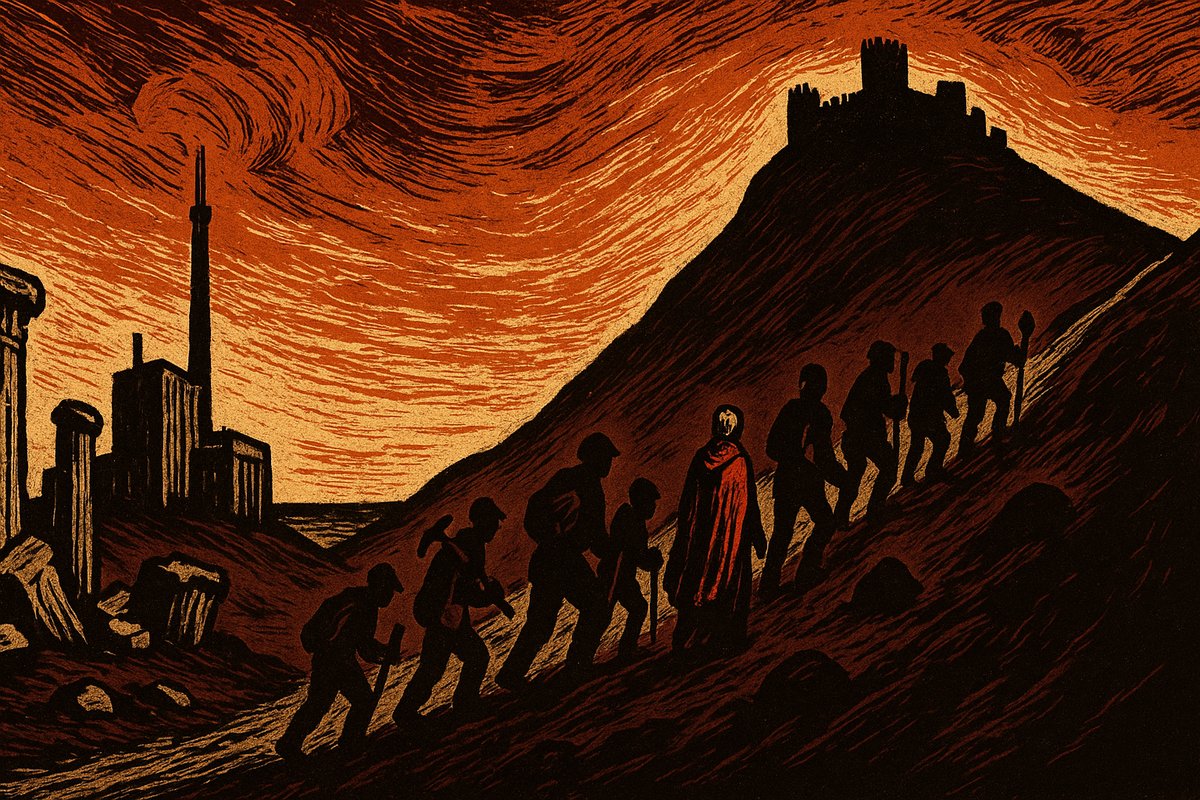
That image has an intellectual owner. The city on a hill comes from John Winthrop's 1630 sermon, delivered as the Puritans sailed toward Massachusetts. Winthrop attached a warning that almost always gets left out: the eyes of all people would be upon them. A city set on a hill cannot be hidden. For an island of twenty-three million people a hundred sixty kilometers off the Chinese coast, the metaphor sounds like aspiration — and also like an exact description of its situation.
Why would a president fold family subsidies into a speech that's also about deterrence? The same country that needs soldiers, reservists, and engineers faces one of the lowest birth rates in the world — under one child per woman. A shield needs people standing behind it. Without them, there is no defense.
Here the speech intersects with what I explored in Stones Don't Lie. The section on the Greco-Roman world argues that Athens's structured citizen participation generated civic engagement far superior to that of modern representative democracies. The problem was never the mechanism — it was exclusion. Athens also offers a useful warning to a thirty-year-old democracy: its economy depended on constant expansion, and when that expansion stalled, the system cracked. Genuine participation and an economy that can't sustain itself on its own — both threads are worth keeping in mind.
The section on Ghana under Nkrumah provides a second, less comfortable anchor. Free education, hospitals, infrastructure. A country with resources and legitimacy that ended up tied to loans and a single commodity, cocoa. When the price collapsed, there was nothing left to pay with. Taiwan's growth above eleven percent is, to a large degree, that of an economy carrying enormous weight in semiconductors and AI computing demand. That fits neatly with the silicon rivalry between Washington and Beijing, and with the pressure on middle-sized countries to pick a side — see Kazakhstan.
What does eleven percent mean for an island in that position? There are two readings, and both are true at once. It's the best possible news for funding defense and families without going into debt — a fiscal window almost no one else has. It's also Ghana's cocoa with different wrapping. A thirty-nine-year high is almost always a peak. Peaks are a bad time to promise permanent spending. A monthly per-child allowance is permanent spending. If the chip cycle cools, the commitment remains. The income that funded it may not.
This qualifies the original thesis, and I'd rather say so plainly. Taiwan has a consolidated democracy, institutions that have survived turnover of power, and a government that treats fraud and accountability as permanent measures, not campaign slogans. That's different from Ghana in 1960. Being different isn't the same as being safe. Some risks don't get solved by good intentions. I'm still not sure which weighs more here — technological dependence or military pressure.
Another point tests an idea from The Generosity in the Doorway. The relevant chapter revisits what Marie Jahoda, Paul Lazarsfeld, and Hans Zeisel found in Marienthal, the Austrian town devastated by the closure of its textile factory in the 1930s. Income is necessary. It is not sufficient. Without structure and purpose, money only prevents collapse — it doesn't restore dignity. The five thousand new Taiwan dollars per child land right in that tension. They may ease the cost of raising children in one of Asia's most expensive economies. Nothing in the announcement suggests that, on their own, they'll reverse a birth rate tied to housing costs, long working hours, and shifting expectations about life. Other countries' experiences with baby bonuses point to effects that are modest and temporary. There's no reason Taiwan should be the exception without deeper changes.
That leaves the word dignity. When a government negotiates from a position of asymmetry, the language of parity is the last thing it gives up. Lai repeats it because he knows that what's at the table includes borders, but also recognition. Writing from Mexico, with a giant neighbor to the north, that tension feels less foreign to me than it might otherwise.
The speech leaves an uncomfortable question for the broader thesis. If a young democracy surrounded by pressure, riding a technological wave, manages to turn a cyclical boom into lasting institutions, then what separates Ghana from Taiwan would be design, not resources. If it doesn't, eleven percent will be remembered as the last easy year. I still don't know which of the two will happen, and I suspect Lai himself doesn't either.
A city on a hill has the advantage of being visible from a distance. Its problem — the one Winthrop truly understood — is that everyone can also see it fall. Will thirty more years of direct elections be enough for the building to hold once the wind stops blowing in its favor?
Sources:
1. Office of the President, Republic of China (Taiwan), Lai Ching-te's National Day address, October 10, 2026.
2. John Winthrop, "A Model of Christian Charity" (1630).
3. Marie Jahoda, Paul Lazarsfeld, and Hans Zeisel, Die Arbeitslosen von Marienthal (1933).
4. Yves Laurent, Stones Don't Lie (chapters 5 and 11) and The Generosity in the Doorway (chapter 7).