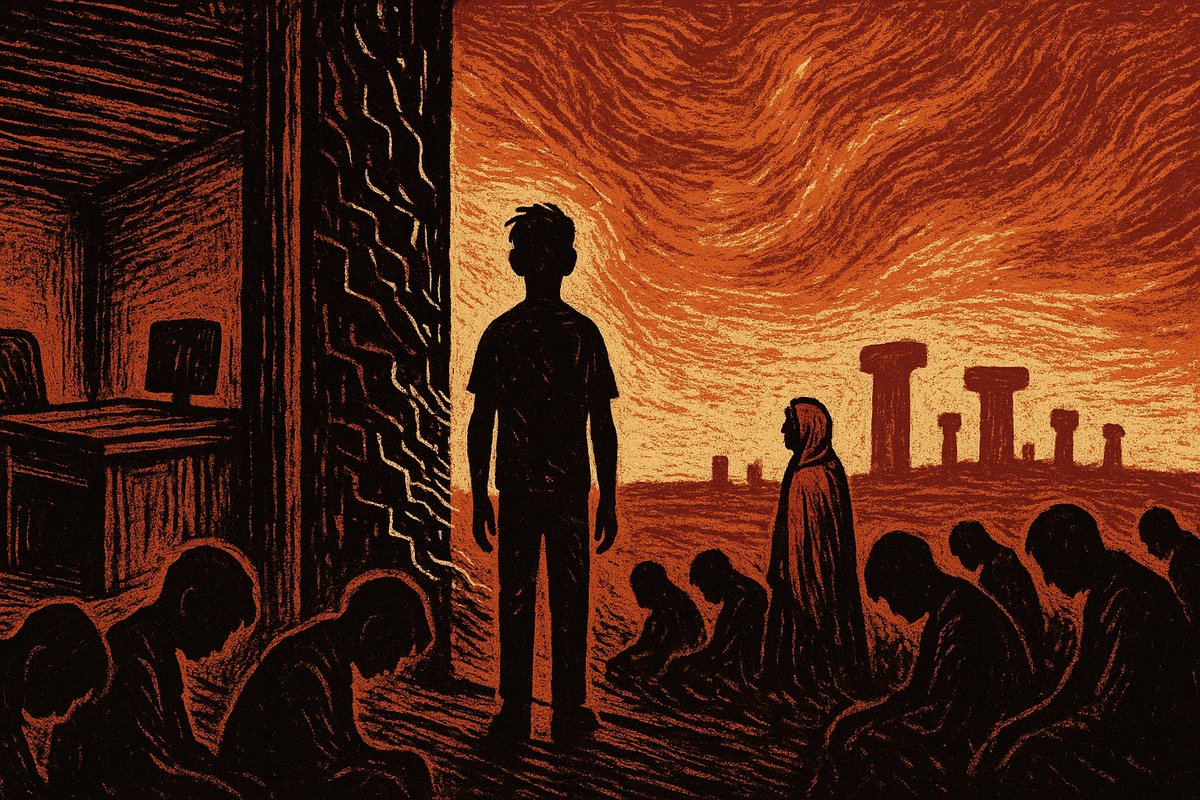
A twenty-four-year-old Algerian faces a 26.2% chance of searching for work without finding it. A Canadian of the same age registers 9.8%, nearly double what it was two years ago. Between these two realities live 257 million people whom the International Labour Organization groups under the acronym NEET. Not in employment, education, or training. One in five young people on the planet.
Global youth unemployment is a double crisis because it combines exclusion from work with exclusion from education: neither the labor market nor school any longer offers a credible path into adult life for an entire generation. That is what the ILO's recent report shows. The definition is uncomfortable because it transcends economics. It speaks of suspended time, of identities on pause, and of expectations that may never be fulfilled in the way they were once envisioned.
The regional numbers tell different stories. Arab States and North Africa share rates close to 25%. One in four. North America went from 8.3% in 2023 to 9.8% in 2025. That jump undid more than a decade of gradual improvement. The crises are not identical, but they converge on the same symptom: the structure of work no longer receives newcomers well.
Youth unemployment is not new. It has hovered around three times adult unemployment for decades. What's new is the convergence of three forces: post-pandemic economic slowdown without a definitive close, demographic imbalance that in some regions produces more young people than jobs, and the arrival of artificial intelligence in entry-level positions that used to absorb recent graduates. The ILO calculates that 6.1% of jobs held by young people aged fifteen to twenty-nine are highly exposed to this transformation. They are concentrated in administrative and office roles. Precisely the traditional gateway into the formal market.
Why does artificial intelligence hit young people first? Entry-level jobs allow for automation with less friction. Data capture, basic customer service, report writing, junior analysis. The experienced worker accumulates relationships, institutional context, and judgment that models still cannot replicate. The recent graduate has, at best, a degree and motivation. The path is cut off at the first rung.
This connects with what was explored in The Generosity in the Doorway. Companies reaching historic valuations with minimal headcounts are eliminating precisely that entry-level work. The ILO report offers a partial answer. That eliminated work becomes 257 million people outside the circuit.
Reducing it all to technology would be an oversimplification. Older dynamics are at play. In Marienthal, the Austrian town studied by Jahoda, Lazarsfeld, and Zeisel during the Great Depression, the initial blow was not economic. It was the destruction of the structure of time. Schedules dissolving. Reasons to get up in the morning disappearing. A sense of belonging eroding. The money came later.
That finding from nearly a century ago explains why unemployment hurts two or three times more than inflation does. It's not just about the bank account. A working "us" fractures — a team, a guild, a professional identity — that a cash transfer does not easily restore. A generation of 257 million young people without that sense of belonging becomes fertile ground for any offer of alternative community. Whether populist, religious, or tribal.
The proposals in circulation deserve careful scrutiny. Sam Altman and Elon Musk talk about universal basic income in the face of technological displacement while their companies carry out mass layoffs and invest billions in that very same artificial intelligence. Universal basic income has a history and serious arguments behind it. When the one who builds the problem is also the one selling the remedy, it's reasonable to ask who benefits from the narrative. The Generosity in the Doorway examines this single-actor dynamic.
There's another cui bono almost no one mentions. Governments and corporations can benefit from a youth fragmented into isolated jobs, without strong unions, without steady colleagues, without shared schedules. Their capacity for collective organization shrinks. No conspiracy is needed. The mere absence of incentive to solve it urgently is enough.
History records cases of labor coordination resolved without waiting for the market. At Göbekli Tepe, thousands of person-hours were organized through feasts and reciprocity. It wasn't perfect. There was hierarchy, unequal prestige, friction. It worked for centuries. The lesson is not to go back to the Neolithic. It is to recognize that formal employment as the sole source of belonging and income is not the only possible architecture. Its current fragility proves this every day.
The ILO proposes investment in technical training, transition programs, and active youth employment policies. Reasonable. Insufficient given the speed of change that its own report describes. The industrial framework from a century ago no longer absorbs the generation entering now. I don't have a neat formula. It would be dishonest to pretend I did. 257 million people outside the system will not be resolved by waiting for the next growth cycle to lift all boats. Those boats don't exist yet.
So how do we build new forms of belonging and contribution that this generation can actually inhabit?
Sources:
1. International Labour Organization (ILO), Global Employment Trends for Youth Report
2. Jahoda, Lazarsfeld, and Zeisel, Marienthal: The Sociography of an Unemployed Community (original study on unemployment and social structure)
3. Yves Laurent, The Generosity in the Doorway (ASIN B0H6RT5Y32)
4. Göbekli Tepe excavation reports, 2025 season