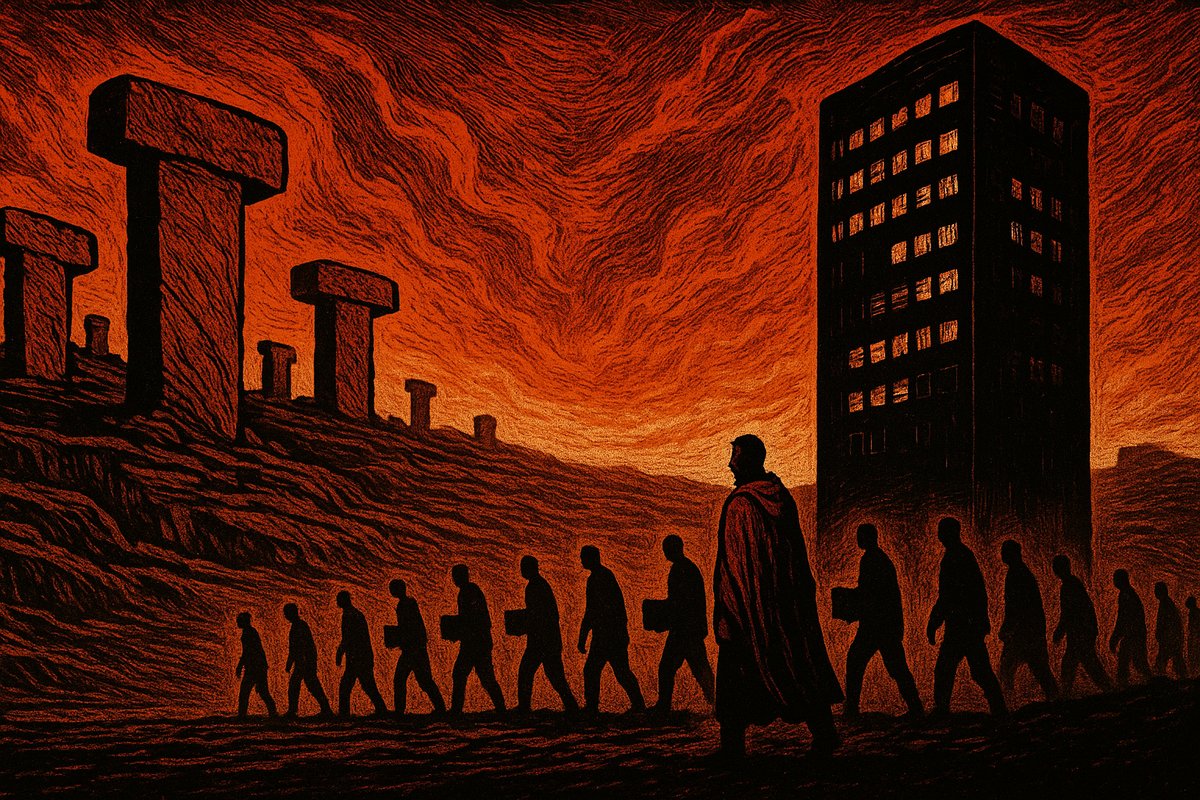
A mass layoff is a resource-allocation decision presented as though it were a weather event. Netflix will eliminate around a thousand positions, roughly six percent of its approximately sixteen thousand full-time employees. It's the company's largest cut since 2022. Product, technology, legal, and human resources teams are the hardest hit. Management speaks of aligning cost growth with slower revenue growth and tougher competition in streaming.
The popular thesis fits in a single sentence. The market matured, growth slowed, there are too many competitors, and the company is correcting course. Nobody presents it as a drama. It reads like basic accounting, almost like physics. If revenue rises less than costs, something has to give.
It sounds right because, for the most part, it is. Payroll is the largest cost for a service company, and when growth slows, adjusting it becomes the fastest lever available. Netflix already made a cut in 2022 and survived. The reading of a one-time adjustment, not a crisis, has precedent. A company that doesn't correct in time can end up laying off more people later, at a worse moment. Anyone who has seen organizations managed up close knows that the inertia of bloated headcounts is real.
But the explanation remains incomplete, and it starts with a question. Why cut precisely in product, technology, legal, and human resources? These are coordination functions, not the ones that produce shows. That suggests the layer being pruned is the one that organizes the work. That layer happens to be exactly the one considered automatable today. The official statement doesn't mention artificial intelligence. I can't claim that's the cause — I don't have access to the internal decisions. But ignoring the hypothesis would be naive. A November 2025 paper by Brynjolfsson, Chandar, and Chen from the Stanford Digital Economy Lab documents early effects of AI on employment concentrated in entry-level positions. Just because a company doesn't say it doesn't mean it isn't happening.
There's a second angle. The six percent figure describes how many lose their jobs. Not what losing it means. Marie Jahoda, Paul Lazarsfeld, and Hans Zeisel studied, in Marienthal, an Austrian town, what happens when a factory closes. The most revealing finding wasn't poverty. It was the loss of structure. People stopped going out, stopped reading, stopped organizing themselves. Free time became a shapeless mass. Work provides income. It also provides rhythm, identity, and belonging. A cut of a thousand people in an industry of well-paid professionals is not Marienthal, of course. But it's not just a line on a spreadsheet either.
A thousand people. Structure lost.
And there's a third, uncomfortable problem. The cost-versus-revenue explanation treats the company as the only subject of the story. Costs that go down become margin, margin sustains the valuation, and the valuation gets rewarded by the market. Who absorbs the risk of the transition? Those who leave, their families, and the public systems that take them in. From Mexico I see this asymmetry up close. Decisions get made in one place while the consequences of labor reorganization get distributed through contracts, subcontractors, and service chains in others.
This connects to something I develop in The Generosity in the Doorway: the pattern in which an actor builds the infrastructure that displaces labor and then remains in place as the administrator of its remedy. I'm not saying Netflix is doing that. I'm saying that without knowing the real cause of this cut, the question of who designs and who pays for the transition stays open. Almost no one asks it.
So what's missing is transparency about the why. If a company cuts because of competition, that's a market adjustment. If it cuts because certain functions are now handled with fewer people thanks to software, that's a structural shift deserving a different kind of debate — about training, about who captures the productivity gained, about whether it makes sense for that gain to go entirely to the shareholder. Today both scenarios get announced with the same press release.
There's also a historical piece almost never cited. At Göbekli Tepe eleven thousand years ago, several hundred people worked for generations raising monumental enclosures before full-scale agriculture even existed. The stones don't say there were wages, bosses, or layoffs. What they show is a coordination of labor sustained by feasts, prestige, and mutual obligation. It's not a model to copy, and it would be dishonest to sell it as one. But it proves something useful. Humans organized enormous efforts without the modern labor contract, which is not the only way to distribute work and sustenance but a fairly recent invention.
That leads to a fact that contradicts the intuition we started with. We're told layoffs are a sign that a company is weak. In 2022, when Netflix made its previous cut, the company was still the industry leader. A mass layoff doesn't always signal a company in trouble. It's often carried out by whoever is in a position of strength.
What's left when productivity gains happen quietly and the human cost gets explained away as mere accounting?