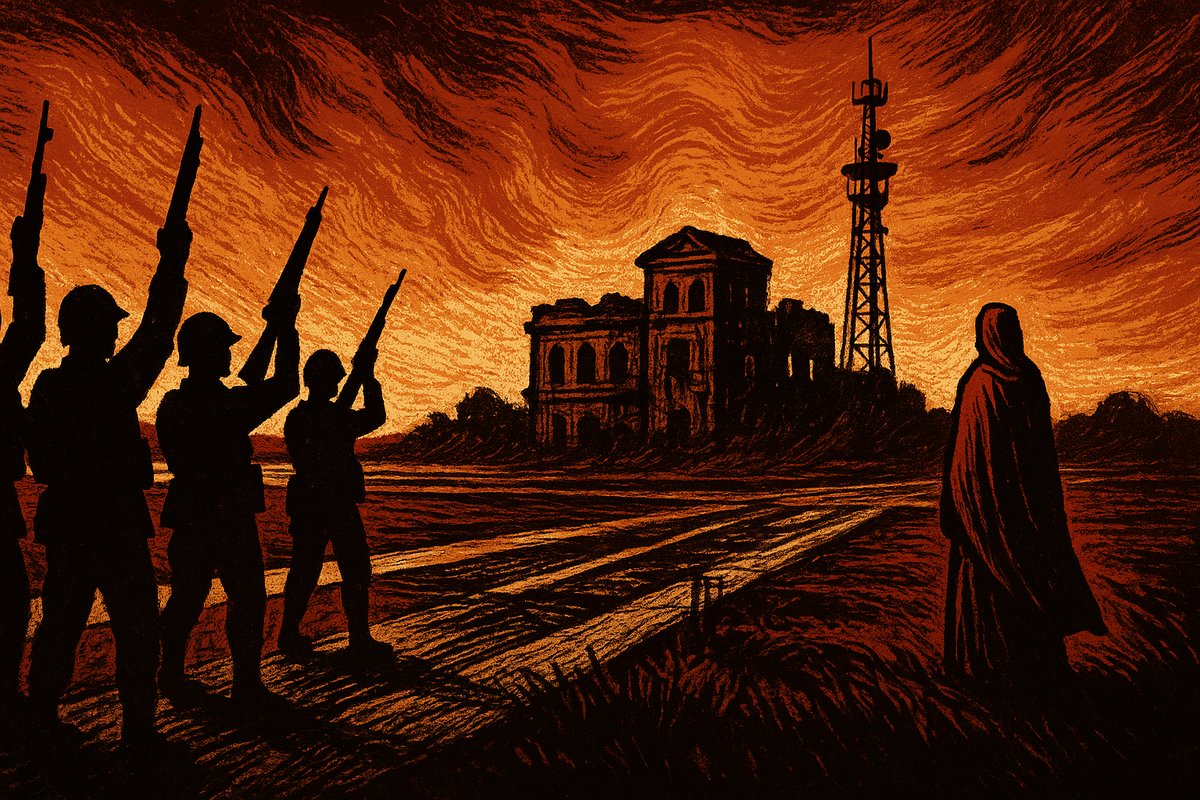
An army retakes an air base in under twenty-four hours. Its government decides that pointing outward is more useful than examining the cracks within. That's what happened in Niger following the events of August 29, when mutinous soldiers attacked the Presidential Palace and Diori Hamani International Airport in Niamey. Abdourahamane Tiani's military junta claims to have evidence linking France, along with Benin, Chad, Ivory Coast, and ECOWAS, to that attempt. France responded within hours. "Pure fantasy," said Foreign Minister Jean-Noël Barrot. And he went further still: neither the intention nor the means to act against Niger.
A geopolitical accusation becomes a tool of governance when the evidence is never published but the political payoff arrives immediately. No documents have been shown. No French agents have been captured, no intercepted communications that anyone has been able to review. There's an official statement and Air Base 101 retaken with support from the Russian Africa Corps. That combination — an unsubstantiated claim paired with closer ties to Moscow — follows a familiar pattern.
Why would a government that managed to bring the situation under control choose to accuse half the region? Putting down a mutiny is one thing; explaining it is another. If the soldiers were Nigeriens with local grievances — unpaid wages, friction at the top, exhaustion after two years without elections — the problem points inward. Blaming France resolves that narrative void in a single stroke.
Niger didn't arrive here by accident. Since the 2023 coup that toppled Mohamed Bazoum, the junta has built its legitimacy on the break with the former colonial power. France withdrew its troops. It closed its embassy. It lost access to the uranium mines. Russia filled that space, first with Wagner and now with the Africa Corps, a reorganized force under more direct command of Russia's Ministry of Defense. The Russian presence is concrete — bases, advisers, equipment. Regional analysts have documented it, and Niamey's own government has confirmed it.
Benin rejected the accusations immediately. Tension between the two countries was already high over the closed border and mutual suspicions about armed groups. Including Cotonou fits a logic of blanket suspicion toward neighbors more than a case built on solid records. ECOWAS has faced hostility since the sanctions that followed the coup — even though it later lifted them — while Niger, Mali, and Burkina Faso formalized their exit to create the Alliance of Sahel States.
Fragile governments reach for external threats to consolidate internal power. It shows up across different eras and places; the method repeats even as the scale changes. A regime that came to power by force, and that keeps postponing any democratic transition, needs to maintain a state of perceived threat. Without that enemy, the question of the electoral timeline becomes impossible to dodge.
Russia gains a formal military presence and a partner increasingly dependent on Moscow for its security. Tiani gets a narrative that casts him as the victim of a Western conspiracy rather than the head of a system that doesn't control its own army. France, paradoxically, also gains something: every baseless accusation reinforces the argument that its withdrawal was the right call. Barrot made that clear.
There's something more uncomfortable still. Accusations without public evidence work best when no one demands they be published. No international media outlet has independently verified the material Niamey claims to possess. That doesn't prove the accusation is false. Nor does it prove it's true. What it does show is a mechanism: when the cost of lying is low and the political payoff is high, juntas tend to use it. The Generosity in the Doorway explores how power structures design narratives that benefit them without needing hidden conspiracies. All it takes is looking at who controls the story and who pays the price of not being able to question it. Tiani controls the narrative. The Nigerien people, with unpaid wages and no election date in sight, pay the price.
Stones don't lie.
What happens when the external narrative becomes more important than the internal demands of a people tired of postponed promises?