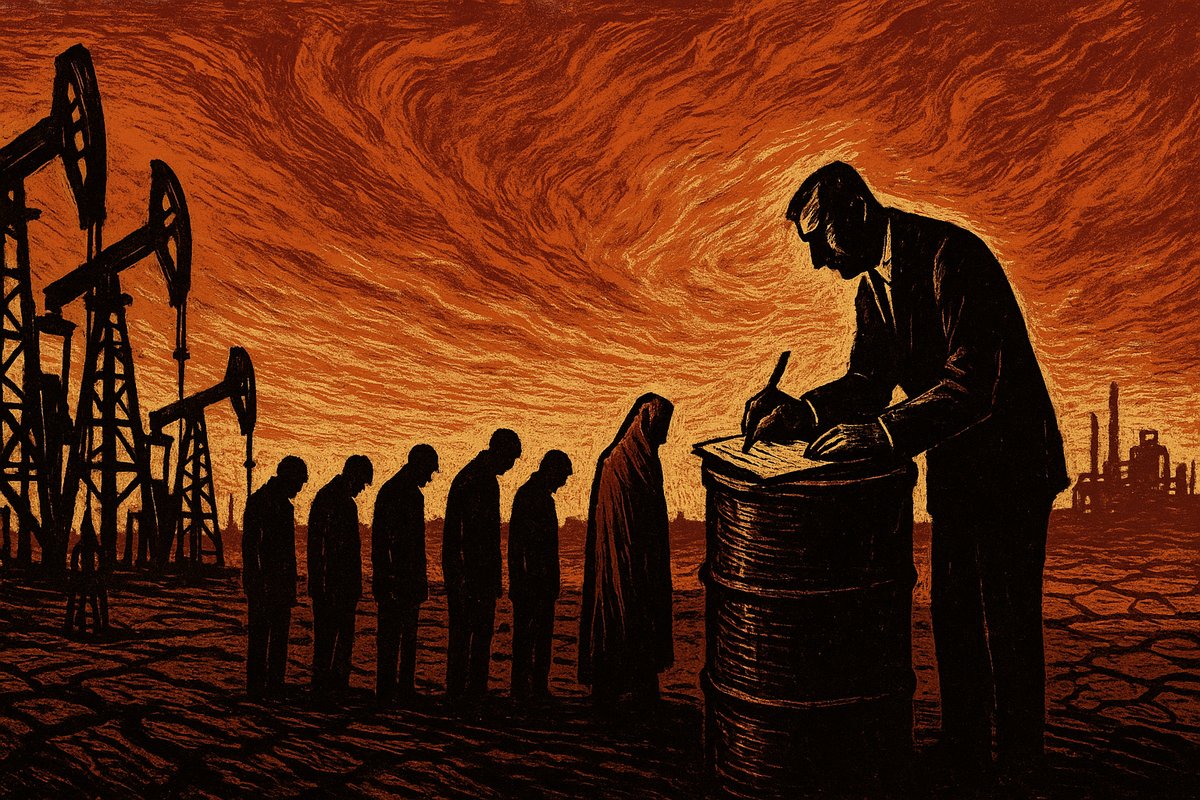
Washington will obtain 35% of a Venezuelan oil company. This is not rumor. It's the arrangement being built right now with Alejandro Betancourt's company. It grants direct access to strategic deposits and financial oversight over every barrel sold. This passive 35% stake is effective control, because it allows managing revenue flows without carrying the visible ownership or its political costs.
In previous analyses I noted that Maduro's exit responded to concrete needs for resources and positioning. Trump wanted Venezuelan oil. He wanted lithium. And he needed a hemispheric platform that China couldn't contest. Some read that as excessive cynicism. The deal being formalized today confirms that reading. A 35% stake in Betancourt's oil company. Control over revenues. Privileged access to the most productive fields.
This corporate structure secures long-term resources. It maintains narrative distance from any notion of occupation. It changes the question worth asking: does it really matter only whether there will be an invasion, or does it matter more what degree of management Washington needs to reduce dependence on hostile suppliers over the next decade? And what it's willing to label as liberation to achieve it.
Venezuela is not an isolated case. It fits into a board where Greenland, Iran, and Mexico occupy specific squares. Greenland for its rare earths and Arctic position. Iran for oil and control of the Strait of Hormuz. Venezuela holds the world's largest proven crude reserves. Sanctions had kept them out of circulation.
The corporate format, rather than direct state dominion, allows for denying political responsibility while retaining the economic benefit. The mechanism appears repeatedly throughout history. Indonesia formally expelled the Dutch in the sixties. It ended with arrangements that returned access to Western corporations under mandatory local partners. Substitute the names. The design remains.
The sequence follows a precise order. Build the narrative of the tyrant who must fall. Apply enough pressure for him to collapse. Then secure access to resources before the dust settles. The deal with Betancourt's oil company closed quickly. Revealing speed.
Washington secures stable energy supply. It avoids depending on OPEC or fragile shipping routes. Betancourt and his circle retain day-to-day operations backed by political support that in Venezuela is worth more than physical assets. The Venezuelan people who lived through years of scarcity and forced migration don't appear in the document. No social clause. No national development fund. The arrangement reproduces classic extraction updated with modern corporate paperwork.
This connects to what I wrote about Trump's tariffs. The moral narrative conceals the asymmetry of power. The European Union received relative protection while China absorbed the main impact. In Venezuela, the discourse of democratic liberation hides the transfer of dominion over resources. The country retains the same extractive structure as always. It's just that now Washington shows up as a silent partner instead of an external creditor.
Mexico fits the same logic. After securing Venezuela, attention shifts to Mexico and other South American countries with lithium, water, rare earths, or advantageous geographic position. The pressure could be tariffs. It could be migration. It could be technology. I don't yet have a clear answer about which will activate first or whether they'll come combined. What can be clearly observed is the underlying trend: the competition for hegemony is no longer resolved primarily with armies formed in ranks, but with equity stakes, management of critical infrastructure, and humanitarian narratives that justify the reconfigurations.
Washington and Beijing converge on state regulation of critical technology. Venezuela applies the same script to the fossil fuel arena. It's not the pursuit of resources itself that draws attention. Every hegemonic power has acted this way throughout time. What's surprising is the speed with which the arrangement gets normalized. It gets discussed in technical terms. Passive stake. Financial oversight. Development of strategic deposits. Few voices use the word that would describe this with historical precision: dominion.
I still don't have a clean proposal to close the subject. It would be dishonest to pretend otherwise. The Stones Don't Lie documents how genuine attempts at self-sufficiency ended up cut short. Thomas Sankara rejected conditional aid and paid the price. Patrice Lumumba sought national control over minerals and the response was immediate. The accumulated evidence shows that resisting without solid regional alliances and without diversifying economic dependencies has consistently hit limits. That's not pessimism. It's a record that any country under pressure would do well to study urgently.
What paths remain open when stones don't lie and arrangements disguise themselves as corporate routine?
Sources
1. Reports on the U.S. stake agreement in Alejandro Betancourt's oil company in Venezuela
2. Yves Laurent, "Hegemonic Transition: Venezuela, Brazil, and Iran Are Not Isolated Cases" (2026)
3. Yves Laurent, "Trump's Tariffs: The Morality That Hides the Asymmetry" (2026)
4. Yves Laurent, "Ceuta 2021: Morocco's Migration Key" (2026)
5. Yves Laurent, The Stones Don't Lie (Amazon Kindle, ASIN B0GX2XWBPK, 2026)