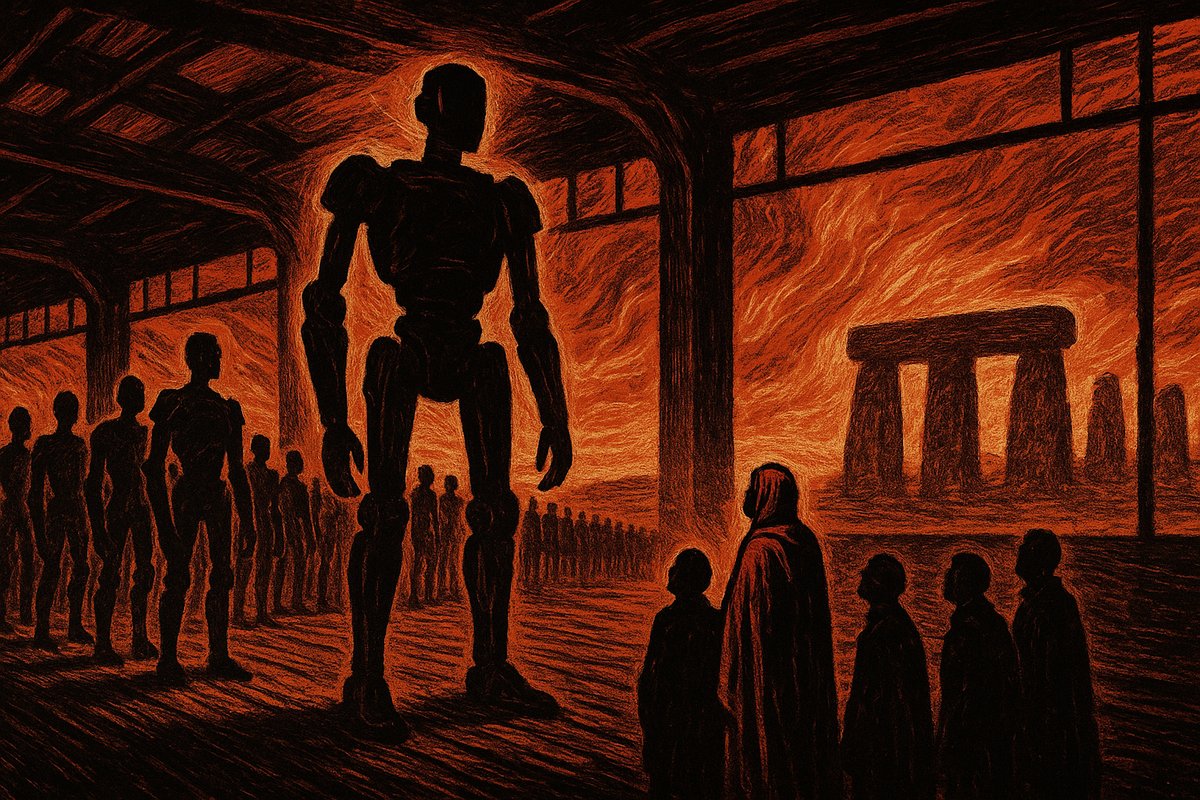
Forty thousand humanoid robots rolled out of Chinese factories in the first six months of 2026. Ninety-seven out of every hundred units shipped worldwide came from there. This isn't a tech-fair curiosity. It's a snapshot of a race that already has a provisional winner in manufacturing, though not yet in intelligence.
Wang Xingxing, founder and CEO of Unitree, put it bluntly at the World Robot Conference in Beijing: the industry is approaching its own ChatGPT moment. A humanoid robot becomes genuinely useful when it can walk into a house it has never seen, listen to a spoken or written instruction, and independently carry out eighty percent of what's asked of it. That's what's still missing. Everything else—the legs, the arms, the sensors, the assembly-line manufacturing—is already solved, or nearly so.
What exactly is robotics' ChatGPT moment? It's the point at which a robot's software stops needing task-specific programming because it begins to generalize—the same way a language model generalized writing without anyone teaching it every possible sentence. Wang places it at two to three years in the optimistic scenario. Five to ten in the realistic one. The gap between those two numbers isn't just technical. It's geopolitical.
The data behind this story is verifiable and worth examining closely. China didn't come to control 97% of the global humanoid market by accident. It's the result of deliberate industrial policy that combines state subsidies, battery and motor supply chains already matured by the electric vehicle industry, and a demographic need that admits no ambiguity. China's working-age population has been declining for years. Forty thousand robots. They're not a futuristic whim. In Beijing's logic, they're replacement labor for a workforce that no longer exists.
Unitree, Wang's company, recently went public with a valuation that soared to nearly six times its opening price within days. It then dropped 11% in a single session. That swing isn't market noise. It's the most honest signal we have about the real state of the technology: investors are betting on a future that doesn't yet exist in software, while hardware—what actually works today—trades at a premium that assumes the cognitive leap has already happened. It hasn't.
Why does the difference between two-to-three years and five-to-ten matter? Because that window determines who writes the rules of the game. The United States retains the edge in language models and the chips that train them. China dominates manufacturing, assembly, and deployment at scale. If the software leap happens soon, the US advantage in general artificial intelligence could transfer straight into the Chinese robotic body already in mass production. If it takes a decade, there's time for both blocs to build their own closed ecosystems, with incompatible standards and humanoids that can't talk to each other. Neither scenario is neutral.
This pattern repeats itself. Whoever controls the physical infrastructure also ends up administering the remedy offered when something goes wrong. The Generosity in the Doorway explains how the same actor that builds the system usually ends up in charge of its solution, from computing consortiums to semiconductor supply chains. With humanoids, the regularity repeats but with a physical twist that didn't exist before. We're no longer talking about who controls a server. We're talking about the machine that walks into your house and decides, on its own judgment, whether it puts away your dishes correctly or misreads an instruction about caring for an elderly family member.
Who benefits from having the public conversation focus on the geopolitical race instead of the labor question? While we argue over whether China or the United States wins robotics' ChatGPT moment, the question of which jobs disappear and how fast stays in the background. I've seen in different contexts that unemployment hurts far more from the fracture of belonging than from lost income. Losing the social role a job provides hits differently. Forty thousand humanoids per half-year, scaling exponentially if the software improves, isn't just a manufacturing figure. It's a social-displacement figure that still has neither a narrative nor a public policy ready to receive it.
I recognize this pattern from other contexts of automation. The technology arrives first. The conversation about its consequences arrives later, almost always too late. What sets this moment apart is the speed and the concentration: one country producing 97% of the world's hardware while two powers race to solve the software that makes it truly autonomous.
This deserves the same caution I apply to any incomplete evidence. At Göbekli Tepe, eleven thousand years ago, hundreds of people coordinated a monumental construction effort with no imposed hierarchy visible in the archaeological record. No documented foremen. It worked through voluntary cooperation sustained across generations. I don't bring this up out of nostalgia. I bring it up because it demonstrates something uncomfortable: large-scale coordination doesn't necessarily require a single actor to concentrate total control over the process. Another path is possible. What we don't have yet, not in 2026 nor in any prior year, is evidence that the tech industry is seriously looking for that path.
I don't have the answer for what public policy could slow an automation wave of forty thousand units per half-year without also stalling legitimate technological development. I'm still thinking about this. Anyone claiming to have the complete solution is selling something. What I can say with some confidence is that the right question isn't who wins the race to the ChatGPT moment. The right question is what happens to the people whose jobs become unnecessary along the way, and who decides that for them.
Which path will we take when the stones of our time reveal who really coordinated this transformation?
Sources
1. Statements by Wang Xingxing at the World Robot Conference, Beijing, 2026
2. Global humanoid robot shipment data, first half of 2026
3. Unitree's stock performance following its initial public offering