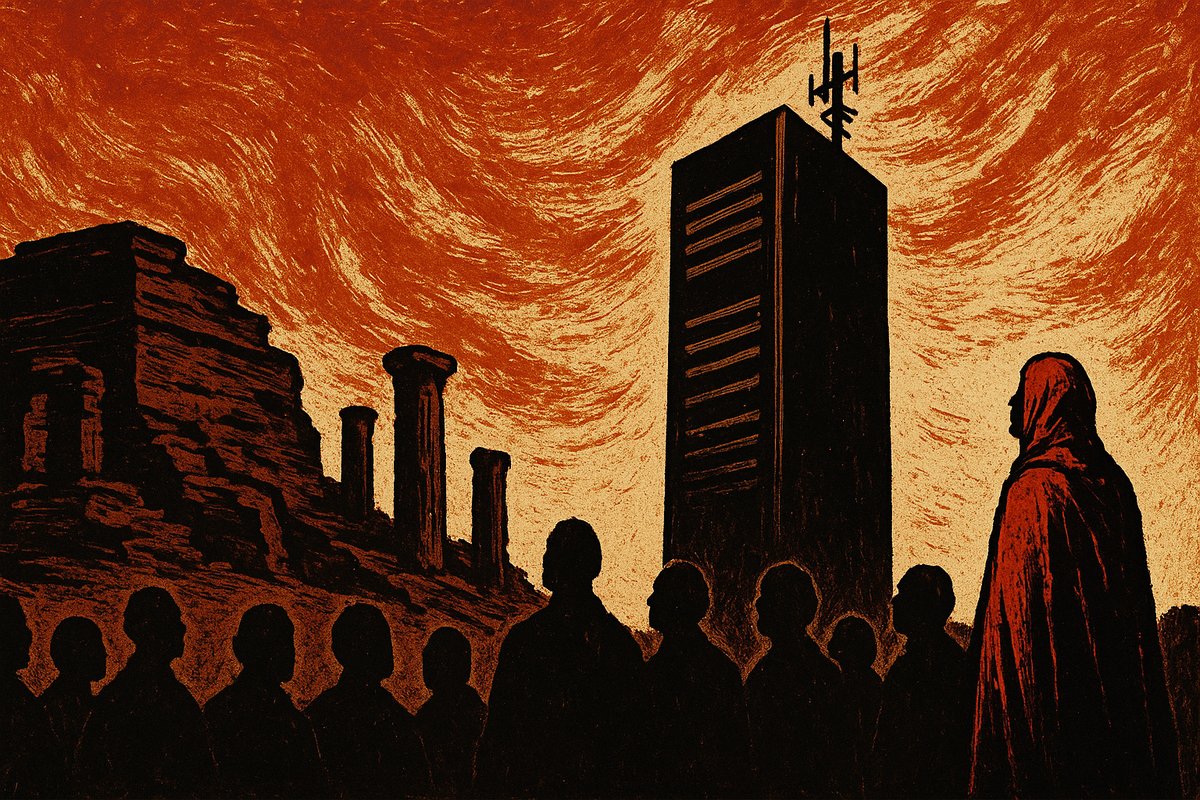
Mark Zuckerberg published a lengthy manifesto arguing that anyone, regardless of economic standing, should be able to use artificial intelligence tools. It sounds reasonable. It's almost impossible to oppose technological democratization. "The future is for everyone" is a political statement because it defines in advance who participates in the conversation and who gets left out, before the technology even exists for the end user.
Meta controls the models, the data centers, and the chips. It decides what gets released as open source and what stays closed under commercial license. When the entity building the infrastructure is also the one writing the manifesto on universal access, generosity and dominance stop being separate concepts.
I set Zuckerberg's text alongside what I've been writing about these patterns. The feeling wasn't surprise. It was recognition.
Zuckerberg publishes this while Meta invests billions in AI infrastructure and competes directly with OpenAI, Google, and Anthropic for talent and compute. The rhetoric of open access has become a competitive advantage as valuable as any patent. The language model market shows signs of saturation. Several governments are debating real regulation. The manifesto on democratization arrives right when it's convenient for the public conversation to shift toward access and away from concentration.
This doesn't happen only with Zuckerberg. Other tech leaders have tied similar ideas to their projects. Whoever controls the technology usually also controls the vocabulary we use to talk about it. That vocabulary determines which questions strike us as relevant.
Why does it matter who makes the promise of universal access, and not just what the promise says? The history of twentieth-century technology is full of gestures of generosity announced by people who had just finished building the machine that would create the need for that gesture. In Metropolis, Fritz Lang's 1927 film, the elite responds to worker unrest by building a robot with human skin that preaches patience. The final line is delivered by the same man who designed the machine that devours workers.
As I explored in The Generosity in the Doorway, what matters is the structural position from which the promise is made. That pattern repeats itself. After years of studying twentieth-century social experiments, the ones that worked best didn't depend on the goodwill of whoever held the power.
Universal basic income emerged as a preemptive response to automation. Goldman Sachs and the International Monetary Fund projected hundreds of millions of jobs at risk. Several companies have already carried out real layoffs tied to AI. The people talking most about universal basic income as the solution are the same people building the systems that create the problem. They speak from a distance. The worker whose job disappears doesn't take part in that conversation. He's out looking for the next one.
What does it mean to read that manifesto from outside Silicon Valley? The promise of access without economic barriers sounds different when you're not part of the ecosystem that produces it. From Mexico, or from any emerging economy where computing infrastructure depends on decisions made in another country, access still depends on Meta deciding which models it releases, under what license, and under what terms of use. Generosity controlled by a single actor can always be revoked.
Zuckerberg may genuinely believe that open source benefits humanity. Meta has released Llama's weights with more openness than some competitors, and that deserves credit. But the openness of a model is not the same as the openness of the entire system. The chips, the data centers, the energy that powers them, and the capital required for the next generation remain concentrated. "For everyone" describes the final product. Not the decisions about what gets produced, how it's trained, or what limits are built in.
The case of Palantir and Alex Karp shows the same structure with the sign flipped. Instead of promising inclusion, it openly declares that only a certain kind of person has a future in the economy they're helping to build. Comparing both narratives reveals that the relevant variable isn't whether the message sounds generous or exclusionary, but whether there's any accountability process that limits what that actor can do with the power it already holds.
The most useful takeaway from this exercise isn't concluding that Zuckerberg is lying. It's noticing that the right question was never whether AI access should be universal. The right question is what governance structure would make that universality verifiable rather than merely declared. The manifesto falls short there. It offers trust, not architecture.
Power this concentrated. Decisions made this far away. I have no illusion that this model translates smoothly to global computing infrastructure. The scale is different, and I still don't have a clear answer for how to bridge that gap.
The next time someone the size of Meta announces that the future is for everyone, the reasonable response isn't applause, nor is it automatic cynicism. It's to ask, with genuine curiosity, who actually ends up holding dominion once the announcement is over.
Who keeps the key once the party's over?
Sources
1. Mark Zuckerberg, public post "The Future Is for Everyone" (Meta, corporate blog)
2. Goldman Sachs, report on automation and AI (March 2023)
3. International Monetary Fund, projections on AI and employment (January 2024)
4. Fritz Lang, Metropolis (1927)
5. Yves Laurent, The Generosity in the Doorway (Chapter 1 — Who Speaks, and From Where)