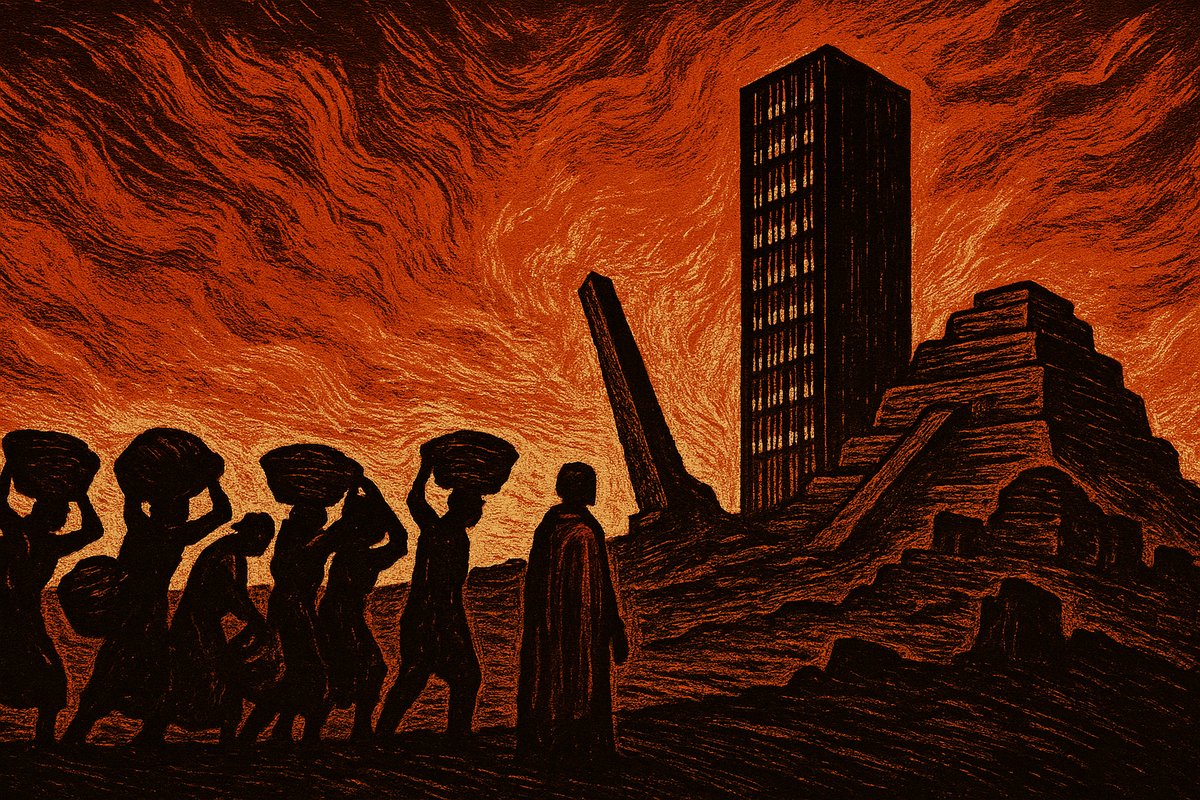
An empire is an organization that extracts other people's resources, controls the narrative about itself, and demands loyalty in exchange for a promise of progress, because it combines domination with a story that justifies that domination. That's why the word Karen Hao chose to describe the major AI companies isn't rhetorical exaggeration. Hao, an investigative journalist, spoke with more than two hundred fifty people and ninety current or former OpenAI employees to understand what really drives this industry. In her conversation with Steven Bartlett, she argues that these companies resemble empires more than startups. They extract data, energy, and labor. They manage the narrative about their own technology.
Two episodes support her argument. The first is the case of Timnit Gebru, the AI ethics researcher whose departure from Google after a critical paper on large language models became a reference point for what happens when criticism gets in the way of business. The second is the accusation that OpenAI allegedly subpoenaed critics. I'm presenting this as Hao frames it, as an accusation. I did not independently verify the details. Then there's Sam Altman. According to Hao, he changes his definition of AGI depending on who's listening. For investors, it's a machine that generates enormous profits. For the public, it's something that will benefit all of humanity. A goal whose meaning shifts according to the audience is hard to audit.
Why does this matter outside Silicon Valley? The labor consequences are already part of the conversation. Hao cites Anthropic's data on the transformation of entry-level jobs and the idea that the mid-career rung is hollowing out. There's related work from the Stanford Digital Economy Lab, where Brynjolfsson, Chandar, and Chen documented uneven effects of AI on young workers in exposed occupations. Hao adds something uncomfortable: AI-driven efficiency sometimes serves as a pretext for layoffs that actually stem from other causes, like overhiring or cuts made to appease markets.
I explored this pattern in The Generosity in the Doorway, where I examine how Altman, in texts like Reflections and The Gentle Singularity, presents the arrival of general AI as something nearly inevitable and benign. There I also look at Anthropic's Economic Index and Daron Acemoglu's assumptions, which estimate macroeconomic effects far more modest than the enthusiastic forecasts suggest. Elsewhere I trace the job-by-job data. That tension between the promise narrative and the small numbers is the heart of the argument.
What does Hao add to that thesis? She adds a mechanism. I had emphasized that narratives of inevitability benefit those who tell them. She contributes the internal testimony. A flexible definition of AGI functions as a tool for governing attention, and pressure on critics protects that flexibility. If true, AI governance cannot rely on the promises made by the companies themselves, because the promise is part of the product.
Now it's worth saying what Hao doesn't resolve. Empire is a powerful metaphor, but metaphors also conceal. AI companies compete with one another, depend on capital that can be withdrawn, and face regulators who sometimes win. A historical empire controlled territory. Here the dominion is over computing, data, and narrative, and that's more fragile. Attributing layoffs to AI efficiency when other causes exist is plausible, but it requires case-by-case review. I don't have the data to say how many layoffs fit that pattern. Anthropic, which supplies the employment data, is also a company with an interest in how that record is read.
From Mexico, another layer comes into clear view. The workers who label data and moderate content for these systems are often in emerging economies with low wages. There, the word extraction stops being abstract. Historical records from other empires, from Rome to the trading companies of the seventeenth century, show that the civilizing narrative and extraction nearly always went hand in hand. Stones don't lie, but historians sometimes do. Today the companies themselves are the historians of their own work.
There's something else. One hunts a mammoth. The whole tribe eats. After years of studying social experiments, you notice how these stories repeat themselves — yet once the hunt becomes more technical, the young get left out of the learning. That happens here too.
One question remains open. If the entry-level rung disappears, where will mid-level professionals come from ten years from now? No individual company has an incentive to train someone another company will hire. I go into that collective-action problem in more detail in The Generosity in the Doorway, and I still don't have a clean answer.
Sources
1. Karen Hao, interview with Steven Bartlett, The Diary of a CEO (on her book Empire of AI).
2. Brynjolfsson, Chandar, and Chen, Canaries in the Coal Mine?, Stanford Digital Economy Lab, November 2025.
3. Anthropic, Economic Index, 2025–2026.
4. Daron Acemoglu, The Simple Macroeconomics of AI, NBER Working Paper 32487, April 2024.
5. Sam Altman, The Gentle Singularity, June 2025.