Anyone who has played a city-building simulator recognizes that moment when everything starts to go wrong. You drop in a huge industrial zone. Energy consumption spikes and the fastest fix is to build another power plant. The city grows and the numbers climb. On screen, the money is abstract. In real life, the bill arrives at a house with a name and a surname attached.
A confidential document leaked and reported by The Narwhal reveals that Alberta's government, led by Premier Danielle Smith, is exploring reconfiguring its gas pipeline network to power future AI data centers. The text mentions creating new Crown corporations to boost natural gas supply. A legislative review committee could draft new regulatory provisions by fall 2026. None of this is law yet. It's a leak about something being considered.
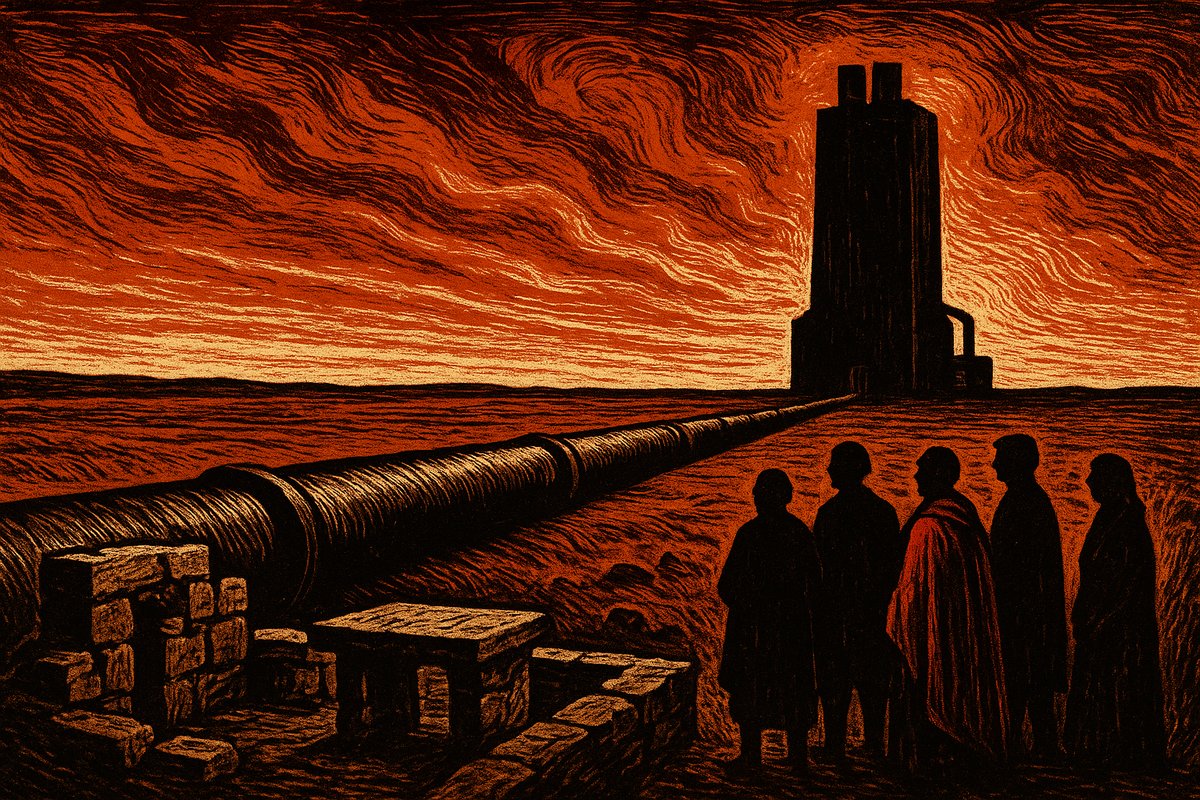
A pipeline is a political decision shaped like a tube, because whoever decides where it runs and who it flows to also decides who pays and who gets a seat at the table. Buried pipe. Invisible decision.
Organizations discuss architecture when it's still cheap to change it, and that's almost never when the real discussion happens. They discuss it seriously once it's already in the ground and moving it costs a fortune.
The Pembina Institute estimates that greater reliance on gas could push up electricity costs for consumers. This matters because it describes the shape of the deal. First, infrastructure gets built for demand that hasn't fully arrived yet. Then the cost gets spread among people who are already connected to the grid. It's the same pattern seen with Stargate, the project announced from the White House in January 2025 with a $500 billion commitment to AI infrastructure. The underlying arithmetic is uncomfortable. The people whose jobs AI might displace are already paying, through their power bills, for the infrastructure that will displace them. The Generosity in the Doorway traces that structure, and Alberta looks less like a Canadian oddity than another chapter in that same map.
Why should anyone in Mexico care about this? The model exports easily, and Querétaro has become a data center hub. Questions about electricity and water always arrive behind investment announcements, never ahead of them. When a government nationalizes the risk while keeping the profits private, that gets copied fast.
What does all this mean for whoever pays the bill if projected demand doesn't materialize? If the new Crown corporations take on the investment in gas supply and the data centers end up consuming less than promised, the public is left holding an empty pipe. Long-term contracts with tech companies can shield the company. Regulated rates offer no such guarantee. That depends on wording that doesn't exist yet, and that's precisely why the fall committee matters more than the headline.
The old thesis associated with Karl Wittfogel and his 1957 book on oriental despotism holds that the great hydraulic works of Mesopotamia or Egypt required a centralized, authoritarian state. Whoever controls the water controls the people. It's a seductive idea, and applied to pipelines it sounds almost too fitting. It has also been heavily challenged.
One of the most elegant rebuttals to that thesis comes from Valencia. Elinor Ostrom studied, in Governing the Commons, how irrigation communities manage shared canals without a state or a market governing them from above. The Valencian huertas are a clear example. The Tribunal de las Aguas meets every Thursday at noon outside the cathedral, with roots reaching back to the Middle Ages, and resolves disputes between users of the same canal verbally and in public. The judges are farmers elected by their peers. Penalties start small and increase if the infraction repeats. Whoever uses the water helps write the water's rules. UNESCO recognized it as intangible cultural heritage in 2009.
I don't want to overstate the parallel. A Valencian irrigation canal serves a community whose members know each other's faces, while a pipeline network feeding data centers for global corporations operates on another scale entirely, with different interests and far more money at stake. I'm not sure how Ostrom's principle would transfer to something like this. I'm wary of anyone who claims it's simple. What strikes me as useful about the example is more modest. It shows that infrastructure rules exist where whoever pays for maintenance has a voice, and whoever breaks the rule faces proportionate consequences. Some of those rules have been working for centuries.
There's something else: the table in Valencia sits out in the street in plain view, and whoever pays can watch. In Alberta, the discussion began in a document that leaked. Chile's Cybersyn experiment tried, with its limitations and its tragic ending, to make information flow in both directions. Here, almost the opposite is happening.
A review committee hasn't written a single line yet, and that's precisely why there's a margin that won't exist a few years from now. This is a rare moment when the architecture can still be debated.
If that committee drafts its provisions before fall 2026, will there be anyone at the table who actually pays the bill, or will we once again be the last to find out how much the pipe costs?
Sources
1. The Narwhal, reporting on the leaked Alberta government document and AI data centers.
2. Pembina Institute, analysis on natural gas dependence and electricity costs in Alberta.
3. Elinor Ostrom, Governing the Commons (Cambridge University Press, 1990).
4. UNESCO, inscription of the Tribunal de las Aguas de la Vega de Valencia on the list of intangible cultural heritage (2009).
5. Karl A. Wittfogel, Oriental Despotism (Yale University Press, 1957).