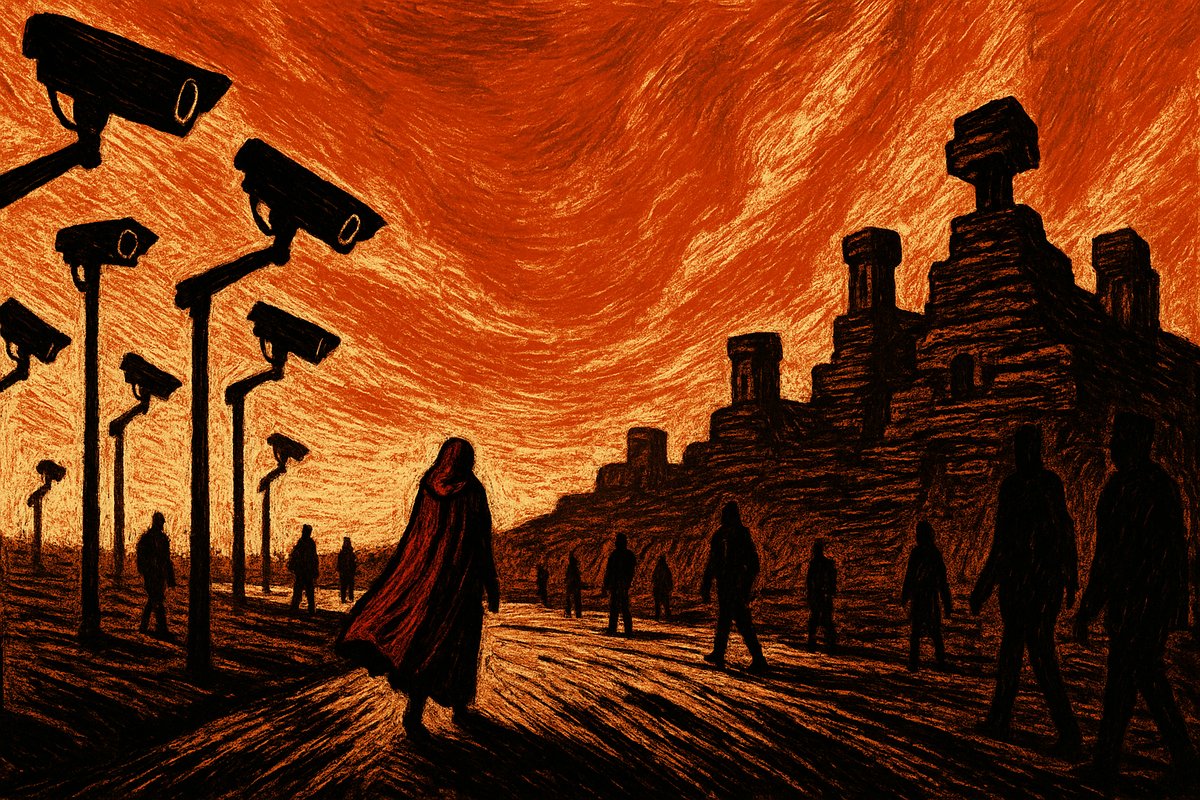
One hundred twenty-seven thousand cameras. Six thousand communities across the United States. An algorithm that no longer needs your license plate. It's enough to have your movement pattern, the rhythm of your walk, the silhouette of your vehicle. Flock Safety calls it OS Investigate and sells it as public safety. The inverted panopticon is a structure where surveillance disperses into a horizontal network, because everyone can be observed even though only a few hold the keys.
This structure no longer replicates the classic central tower. The observer fragments across private companies, local police departments, and municipal contracts that nobody voted on. Flock Safety doesn't replicate Orwell's Big Brother. It creates thousands of partial observers with no clear center of accountability. The system shows predictable failures. Fifty police officers have been accused of using it to harass rather than investigate. In California, seventy-one percent of the alerts generated in 2024 turned out to be inaccurate. That's not a tolerable margin. It's noise disguised as signal.
The company responded on August 13. It cut data retention to seven days and imposed automatic blocks in certain scenarios. A hundred cities tried something else entirely. Pure fragility. More than a hundred cities have disconnected their cameras. It sounds like a citizen victory. But every disconnection depends on local political will that must be renewed year after year, while the company only needs to win one bid to come back.
The Generosity in the Doorway shows how Washington and Beijing end up aligned on controlling frontier artificial intelligence. Governments and corporations don't compete. They cooperate so that no one else controls the tool. Flock Safety places its infrastructure directly with municipal departments. Each one negotiates its own contract. Each one applies lax rules. Responsibility gets decentralized. Observation capacity gets concentrated. Nobody planned this architecture as a conspiracy. It simply emerges when technology gets sold by subscription before a legal framework exists to contain it.
Why is it so hard to dismantle a surveillance network once it's installed? Because dismantling it requires sustained political effort in every municipality, while installing the next generation of sensors takes months. The cost of expansion drops with each iteration. The cost of political reversal rises. The slope is designed to move in a single direction. The argument may sound counterintuitive: reversing total surveillance becomes unlikely once infrastructure exists at this scale. Turning off cameras is possible, and it has already happened. Every decision remains exposed to future backsliding.
In digital activism and political theory circles, a different path is emerging. If everyone can be seen, then everyone should be able to see. This isn't about selective transparency where the citizen is transparent and power stays opaque. It's about opening Flock Safety's databases, its municipal contracts, its error rates, and its police access logs with the same clarity with which the cameras remain invisible to most people.
The current model directly benefits Flock Safety, whose business demands more cameras and more AI features every quarter. It benefits police departments that get movement tracking without a warrant. The practical effect lines up even when the legal category differs. It also benefits those who exploit regulatory fragmentation: the absence of a clear federal law on biometric surveillance leaves each city negotiating alone, with no ability to compare experiences.
What's different about Flock Safety compared to historical surveillance systems? An earlier piece on Rome, London, and Washington describes how centers of power have always captured the information asymmetries of their era. Roman censuses required legions and officials. Flock Safety requires a subscription contract and a server. Speed and near-zero marginal cost change the rules entirely. The seventy-one percent false alert rate also reveals a technical problem: mass surveillance doesn't just threaten freedoms, it produces more noise than useful information. What's being bought isn't security. It's security theater with real capacity for harm when an officer acts on a mistaken alert.
I lack a clean solution, and it would be dishonest to pretend otherwise. Las Piedras No Mienten examines social coordination structures that proved resilient throughout history. The ritual banquets of Göbekli Tepe offer one distant example. So do modern experiments in shared governance. They distribute observation and punishment among many actors. They avoid concentrating them in a single entity. None of them was perfect or peaceful. Each had its own hierarchies. None survived by letting a single tower, physical or digital, see everything while everyone else stayed blind.
One doubt remains that I won't resolve here. If a society achieves that symmetry of surveillance, how does it protect itself from everyone's gaze? I'd rather face that problem than the one we have now. One hundred twenty-seven thousand cameras that look only outward.
How do we build a visibility that illuminates without crushing?
Sources
1. Public reports on Flock Safety and the OS Investigate tool, 2024-2025
2. Data on inaccurate alert rates in California, 2024
3. Flock Safety data retention policy announcements, August 13
4. Municipal records on the disconnection of surveillance systems in more than 100 US cities