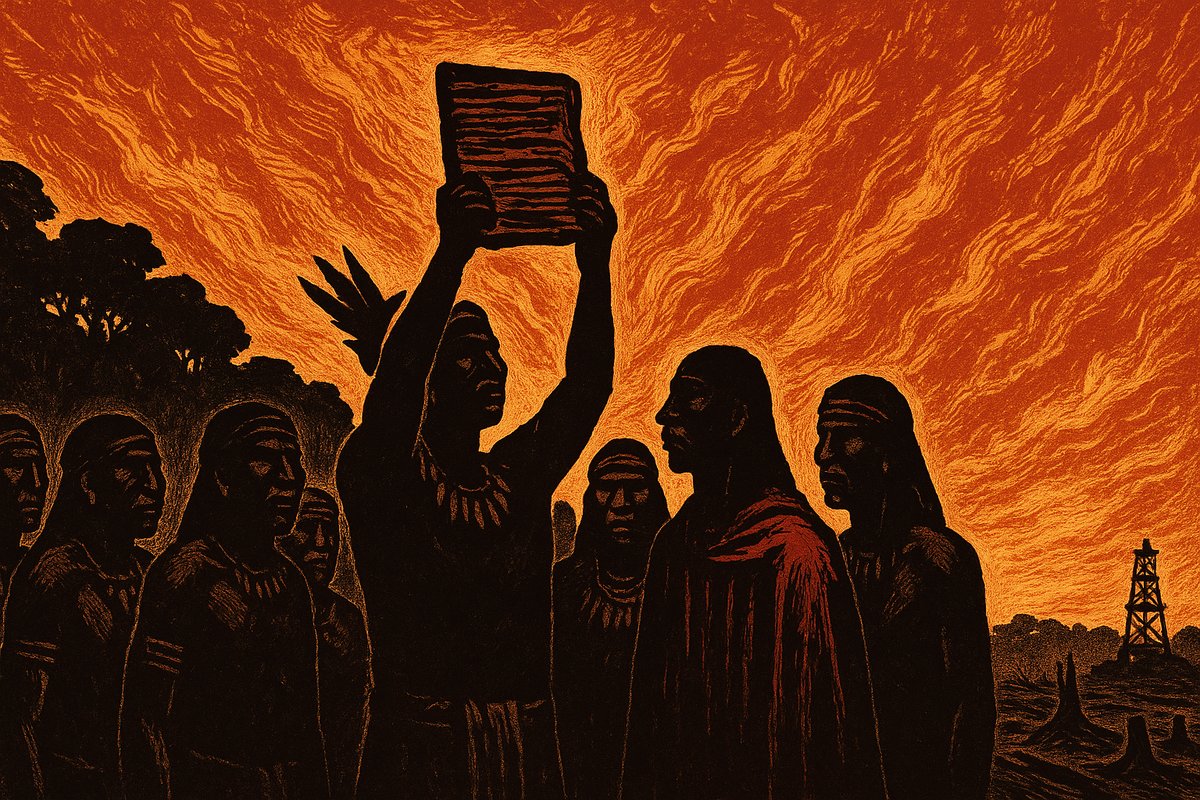
The pan-Amazonian mandate that emerged from the 2026 Pan-Amazonian Social Forum demands territorial property title before any consultation on extractive projects. Not after. This sequence reversal looks like a technical detail. In reality, it's a head-on legal challenge to the model that has sustained Amazonian extractivism for decades.
The demand is direct. Which is precisely why it's uncomfortable. The absence of territorial titling operates as a deliberate strategy of governments and extractive actors: legal limbo is profitable. Formal title functions as protection because it transforms a claimed right into one enforceable before any court. That difference between claiming and enforcing separates a consultation that follows the damage from a requirement that conditions any operation from the start.
This carries weight now because pan-Amazonian indigenous organizations arrived at FOSPA 2026 with greater consolidated international legitimacy, active transnational networks, and a narrative backed by climate evidence positioning indigenous territorial self-management as a proven mechanism of forest conservation. That political capital generates real friction with the extractivist agendas of the six countries that share the basin. The claim is no longer dismissed as a folkloric matter. It's confronted as a negotiating bloc with concrete weight.
The Amazon basin spans Brazil, Peru, Colombia, Ecuador, Bolivia, and Venezuela. Why does the map of indigenous territorial titling show such stark gaps across all six countries? These gaps don't stem from chance. In Colombia, the 1990s constitution opened the path to collective titling after sustained mobilization. Something parallel happened in Ecuador following that same era's protests. Legal recognition arrived only after prolonged transnational organizing, never as a spontaneous concession. And in territories where title was consolidated, regional records show clear declines in deforestation and illegal mining compared to zones without formal title. Titled territory, less illegal extraction. Ambiguous territory, more.
Who benefits from delayed titling? This isn't simple bureaucratic negligence. Mining and logging companies operate with lower legal risk in areas lacking clarity. Intermediaries in illegal gold and timber chains find their optimal space there, because traceability disappears and impunity becomes routine. Governments retain room to maneuver. A territory without recognized legal ownership remains land the state can concession or promise away without breaking prior contracts.
The discursive shift that privileges "consultation" over title is likewise not neutral. Consultation does not transfer ownership. It allows the project to proceed with a layer of procedural legitimation. They were asked, they were heard. That grants no real veto power. Governments prefer to debate consultation frameworks because those frameworks demand no structural change. Title does.
This pattern repeats known historical dynamics. Rubber-era extractivism followed the same sequence. Extraction first. Afterward, if anything, some form of dialogue. Partial recognition arrived only after prolonged territorial resistance. Indigenous communities were already managing their territories collectively long before any rubber concession. Their systems rested on continued use and shared memory. They required no notarized title. The arrival of extractive capital imposed paperwork. It then took decades to produce it.
I recognize these patterns from other contexts. The repetition still commands attention. It's not that today's Amazonian states lack the capacity to grant title. Territorial legal ambiguity acts as a permanent negotiating tool. Amazonian languages and their distributed knowledge systems face similar pressures under renewed vocabulary. The FOSPA 2026 mandate names that tool directly. It asks to dismantle it. Title first. Consultation after.
A territory without clear title and an artificial intelligence system without defined governance share the same structural vulnerability. Regulatory ambiguity doesn't resolve itself, it gets exploited. Whoever accumulates more de facto power advances into the vacuum. The mining company with resources to litigate for years. The lab that deploys first and asks questions later. It's not satellite precision that's missing for titling. It's not technical capacity that's missing to audit algorithms. What's missing is institutional will to close the gap, because that's exactly where unaccountable power operates.
I examined this in Stones Don't Lie when looking at how distributed governance proposals fail when real auditing power remains concentrated among those who already hold disproportionate power, even as the formal design invokes transparency. Amazonian territory faces exactly that risk: that titling gets handed over on paper while exploitation decisions get made elsewhere, with other actors and another legal language. A title without real enforceability is as fragile as open-source code that no one actually audits.
I have no certainty that the six governments will respond to the mandate with structural measures. Available sources record no transformative official reactions. It would be dishonest to pretend the outcome is already written. What historical records do show, both in the rubber cycle and in the Colombian and Ecuadorian cases, is that legal recognition tends to arrive when transnational organizing becomes impossible to ignore. Not from spontaneous state conviction. That's the bet behind the 2026 mandate: that accumulated legitimacy raises the political cost of maintaining limbo above its benefits.
Will that pressure be enough this time?
Sources:
1. Pan-Amazonian Social Forum (FOSPA) 2026 — pan-Amazonian indigenous mandate on territorial titling
2. Comparative studies on deforestation in titled vs. untitled territories in the Andean-Amazonian region