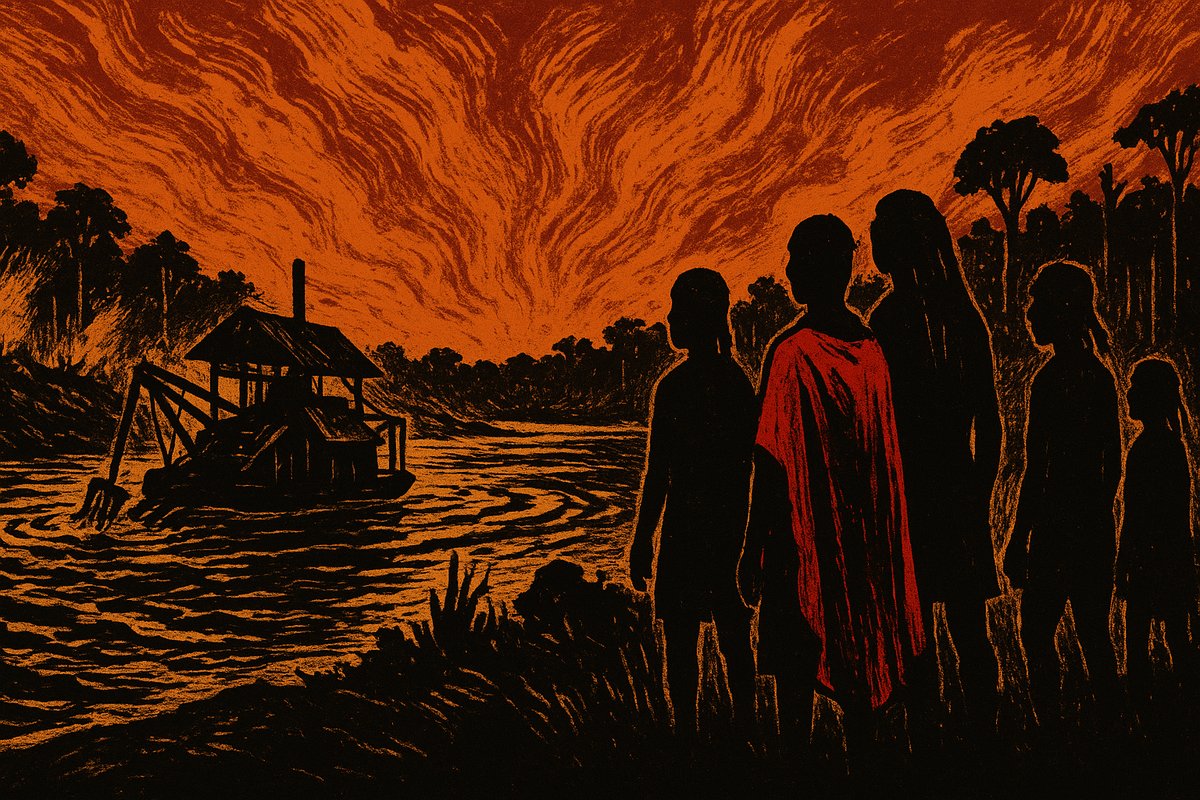
Gold extracted from indigenous lands in the Brazilian Amazon nearly septupled between 2016 and 2024. Twenty-four times more than in 1985. That's the figure delivered by the report from the Instituto de Pesquisa Ambiental da Amazônia (IPAM). It should stop you cold. Raw numbers. This isn't some scattered trend. It's concentrated in three territories. Nearly ninety percent of the affected area belongs to them. We're talking about zones turned into sacrifice.
Why is gold different from other resources extracted from the Amazon? Because its value depends entirely on perceived scarcity, not on any concrete utility. It destroys rivers, rainforest, and health systems with no possible replacement. This dynamic sets the case apart from other debates about development and conservation. Gold feeds no one. It cures nothing. It builds no basic infrastructure for the communities it comes from. It becomes bars, jewelry, or a store of value for someone who will never visit the Tapajós River.
The Munduruku territory in the state of Pará holds a chunk of this expansion. The mercury used to separate gold from sediment ends up in the water communities drink, fish, and use. Studies on mercury contamination reveal developmental delays in children's neurological systems. Any pediatrician would recognize it instantly. This is a cost paid generation after generation. The gold, meanwhile, left the country long ago.
What's uncomfortable here is how illegal mining dresses itself up in legality. Armed groups exploit legitimate extraction permits obtained for a specific plot. They use them to launder gold pulled from indigenous territories where no mining activity should exist at all. The permit works as a filter. Gold goes in contaminated and comes out with clean paperwork. Under President Lula da Silva, the federal government stepped up eviction operations. There are documented raids in Yanomami and Munduruku territory. The miners come back. Sometimes within weeks.
Why does illegal mining persist despite beefed-up federal enforcement? Incentives explain more than any lack of political will. As long as gold prices stay high and the cost of operating clandestinely remains lower than the expected profit, someone will try. This shows up in any extractive economy. Law enforcement becomes just another operating cost, not a real obstacle.
Here's a question almost nobody asks directly: who benefits from framing this as criminals versus the State? It's more accurate to see it as an economic structure that makes destruction profitable. Evictions generate headlines, photos of torched dredges, official statements. Without intervening in the buy-sell chain, without real traceability from mine to jeweler in New York or São Paulo, only the visible part gets solved. The underlying problem stays intact.
Representatives of the Inter-American Court of Human Rights visited Pará to listen to the Munduruku community. Apib insisted that protecting these territories requires systemic solutions. Expelling intruders isn't enough. Kicking out miners without changing the market that pulls them back is like draining a puddle in the middle of the rainy season. It works for a while. The water comes back.
This reactive approach leaves the structural incentives untouched, and it repeats throughout the history of extraction in peripheral territories. Trend analysis of power from Rome to Washington reveals a constant: whoever extracts the resource rarely lives with the consequences. Justice tends to intervene at the visible margin, not at the financial root. Just look at who profits from the final sale of the gold and compare that to the budget allocated for environmental enforcement in the Amazon region.
Deforestation tied to gold mining wipes out rainforest. It also erases the archaeological record and traditional knowledge that exists in these territories. This connects to earlier explorations of why we don't excavate sites like Xochicalco or Göbekli Tepe with the urgency they deserve. The decision of what gets protected and what gets sacrificed is never technical. It's political and economic, made by people who don't live with the outcome.
Federal operations under Lula have been more aggressive than under previous administrations. That much checks out. When the garimpeiros keep coming back at a similar rate, the correct diagnosis doesn't point to more raids. What's needed is cutting the value chain at a different point, probably in the traceability of gold once it leaves the territory, or in the international market that buys it without asking where it came from.
A real systemic solution, the kind Apib proposes, would combine mandatory traceability across the entire gold commercialization chain with a permanent State presence in the affected territories. Above all, it would grant indigenous communities real agency in designing that oversight. Not as passive beneficiaries of decisions made in Brasília. The Generosity in the Doorway explores why models that exclude the voice of those living the problem tend to fail in the medium term. The dynamic is recognizable even if the Amazonian geometry is different.
I don't have the full answer on how to build that traceability in a country the size of Brazil, or how to fund permanent state presence in remote areas of the Amazon. This is large-scale coordination. Solutions designed without the participation of those suffering the displacement repeat the same structural exclusion they claim to solve.
What does seem clear is that the central question needs to change. Not just how to get the miners out. Why the system makes it worth their while to come back. That distinction changes the budget, changes who sits at the decision table, and determines whether the Brazilian State treats the Munduruku as witnesses to their own dispossession or as active participants in designing the solution.
How do we actually cut the profitability out of this destruction?
Sources
1. Instituto de Pesquisa Ambiental da Amazônia (IPAM) — report on the expansion of gold mining on indigenous lands (2016-2024)
2. Articulação dos Povos Indígenas do Brasil (Apib) — statements on the Inter-American Court of Human Rights visit to Pará
3. Yves Laurent, "Rome, London, Washington: The Same Game, Different Names"
4. Yves Laurent, "Buried History: Why We Don't Excavate Our Past"
5. Yves Laurent, The Generosity in the Doorway (Chapter 5 — Stargate)