There's an idea that circulates with an air of profound wisdom. That humanity would only truly unite once an external threat arrived. That aliens would show up and borders, political parties, and Twitter wars would dissolve. The idea is almost always signed with a name: Liu Cixin, the Three-Body Problem trilogy. I myself included it in an earlier version of these essays, claiming it posited true unity of the species only in the face of an existential threat from space.
A common enemy is cheap glue, because it binds fast and charges dearly. What it bonds is obedience. Genuine cooperation only appears sometimes. The difference matters, because the popular version conflates the two.
The thesis seems to have its reasons. World War II aligned entire economies toward a single purpose within months. After the September 11, 2001 attacks, support for the U.S. government skyrocketed. Anyone who has seen a team close ranks in front of an angry client knows the mechanism in miniature. Real cooperation in the face of shared risk also exists. The 1987 Montreal Protocol on the ozone layer remains one of the few environmental treaties that actually worked.
The trilogy itself contains scenes that seem to support this. A Planetary Defense Council. Fleets built by nations that once spied on each other. The Wallfacer Project as a coordinated bet by the entire species. The easy summary is misleading. The invaders arrive. Earth organizes itself. The end. That outline fits in a tweet. The actual trilogy doesn't.
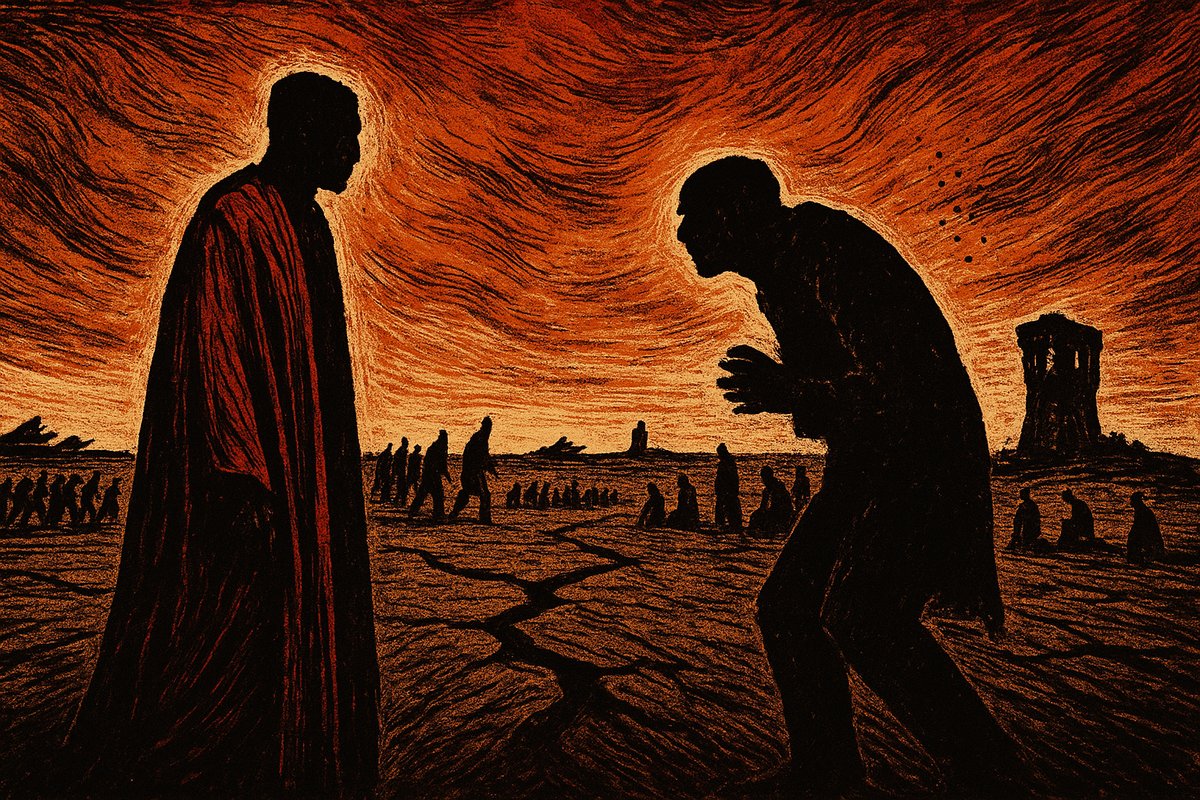
So what does the threat actually do to humanity within the trilogy? Almost the opposite. The first organization to emerge around first contact is the Earth-Trisolaris Organization, made up of human beings. It fractures almost immediately into factions. One wants the invaders to punish the species. Another worships them as gods, and a third negotiates its own place in the world to come. In The Dark Forest, escapism appears. Fleeing in starships triggers inevitable conflicts. Over who gets to leave and who stays behind. Defeatism also arrives. The conviction that the war is already lost. The Great Ravine emerges, the social collapse that follows defeat. Fear does not produce community. It produces rout.
The threat functions as a solvent. It dissolves trust because it forces each group to bet on a different version of how the world ends. Each bet becomes an identity.
Is there anywhere in the trilogy where the threat does cohere a society? Yes, exactly one place. Trisolaris. The invaders' home world endures the most extreme existential pressure, with a chaotic planet that destroys civilizations over and over. That society acts as a single bloc. Pure dictatorship. Trisolaran unity is obedience under coercion. An entire species subordinated to survival, with no room for dissent. If the trilogy proposes a thesis, it is this one. Existential threat produces total unity only where no one is left who can say no.
Liu Cixin doesn't offer clean morals. His books are deliberately ambiguous. Attributing to him the opposite of what he dramatizes is like reading the table of contents and skipping the chapters. This matters beyond bibliographical accuracy. Whoever claims that only a threat will unite us is usually close to manufacturing one, or exaggerating one that already exists. I've seen in organizations how "we're in crisis" summons cooperation in the first month and replaces it with surveillance by the third. At the scale of the state, that logic justifies almost anything.
I already explored that dynamic with the Chinese mini-programs that classify citizen complaints without deliberation. Against what Cybersyn attempted in Allende's Chile. Coordination without voice still coordinates. That's precisely what makes it so tempting. This is where Rojava comes in, which I've worked on in Stones Don't Lie. The autonomous zones of northern Syria were born under real external pressure, with the Islamic State as an immediate threat. They achieved forms of organization that avoid both total dictatorship and total collapse. They remain in an uncomfortable place between those two fates.
Stones don't lie, but historians sometimes do. I'm still not clear on how to scale those in-between paths.
What price would we be willing to pay for the unity that the next threat claims it will bring us?