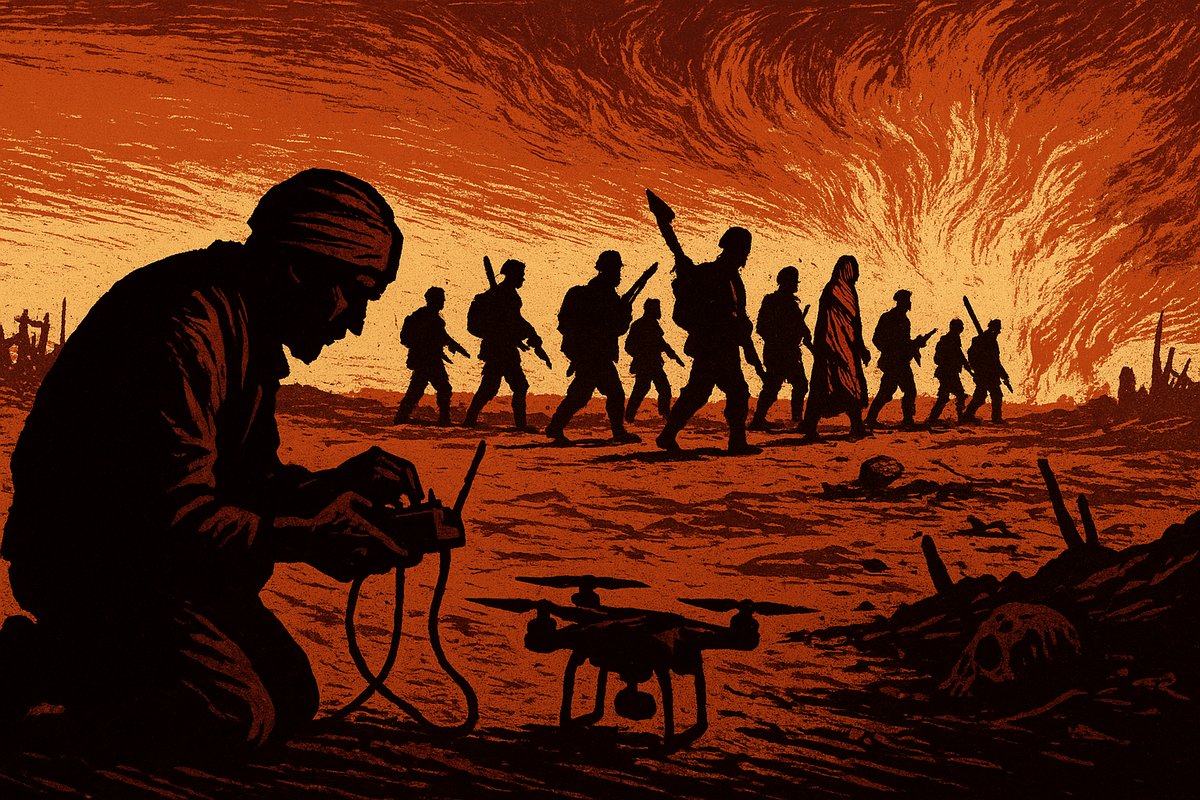
Fifty-nine thousand dead. Thirteen million people displaced. Amid those figures a detail emerges that complicates any simple reading of the conflict: nearly two thousand Colombian ex-combatants operate drones and weaponry for the Rapid Support Forces in Darfur and Kordofan. A recent report from the UN fact-finding mission confirms it, with routes, names, and lines of responsibility traced out.
Mercenarism in Sudan is a transnational business because it converts prolonged suffering into predictable cash flow. The report doesn't describe an isolated civil war. It shows an international supply chain with visible links in Colombia and Chad. Networks of this kind find in the duration of conflict a profitable model, and that becomes evident between the lines of the document.
Colombia generates this human surplus after years of irregular combat. Internal de-escalation left thousands of operators with real experience and few stable exits. That volume doesn't disappear. It relocates. Crossed interests. It was already seen in Yemen, with contractors supporting Emirati forces. It's seen now in Sudan, with concrete numbers on drones, logistics, and training flowing toward the RSF.
Why does Sudan in particular attract these mercenary networks? Its resources. Gold, fertile land, and a strategic location on the Red Sea interest several regional and global actors. The confrontation between the Sudanese army and the Rapid Support Forces reflects that dispute over control of territory. It isn't reducible to an internal fight. External sponsors sustain both sides while staying in the shadows.
Here arises the question few want to answer clearly. Who benefits from the war continuing? Arms suppliers who find a market with less scrutiny. Contracting firms that charge per deployed operator. Regional governments that prefer a fragmented Sudan over one capable of negotiating its own terms. Convenient silences.
Chad cooperated with UN investigators. Colombia also provided information. Other countries offered no substantial answers. Cooperating once the damage is done differs from preventing one's own citizens from joining these chains, and diplomatic language usually conceals that choice.
Similar patterns appear in earlier contexts. Morocco used migration flows toward Ceuta as a pressure tool without needing a declared war. In Sudan the mechanism is inverted: specialized military capacity is imported to prevent the conflict from reaching a negotiation point through exhaustion.
During the Cold War, outside powers fed proxies in various theaters. Angola, Mozambique, Nicaragua. The calculation was clear: prolonged war served interests as long as it didn't escalate into direct confrontation. Today the scheme has been privatized. Contractors, shell companies, and diffuse routes let the states of origin deny direct responsibility.
This dynamic connects with Eisenhower's warning in his 1961 speech about the military-industrial complex. Today's mercenarism represents its decentralized version, extended to a global scale. It requires sustained conflict to remain viable.
Ending the war in Sudan demands more than an agreement among local factions. What's needed is dismantling the financial and logistical infrastructure that crosses at least half a dozen borders. An extended arms embargo, as the UN recommends, hits only part of the chain. Training, operators, and payments keep moving unless there is real will to investigate the origins.
The chapter on Rojava in Las Piedras No Mienten shows a parallel phenomenon. Long conflicts under external pressure generate power structures that find advantages in maintaining the state of exception. The cohesion produced by war can become an obstacle to peace. Sudan has been walking that same path since 2023.
I still don't know how this cycle gets fully broken. The transparency demanded by the UN report, with names, routes, and money flows, represents a necessary but insufficient first step. Sanctions without sustained enforcement don't change the incentives of those profiting from duration. Sudan is producing displaced people at a rate that already surpasses the worst moments of other recent conflicts.
Who with real capacity to interrupt these flows has genuine incentives to do so?