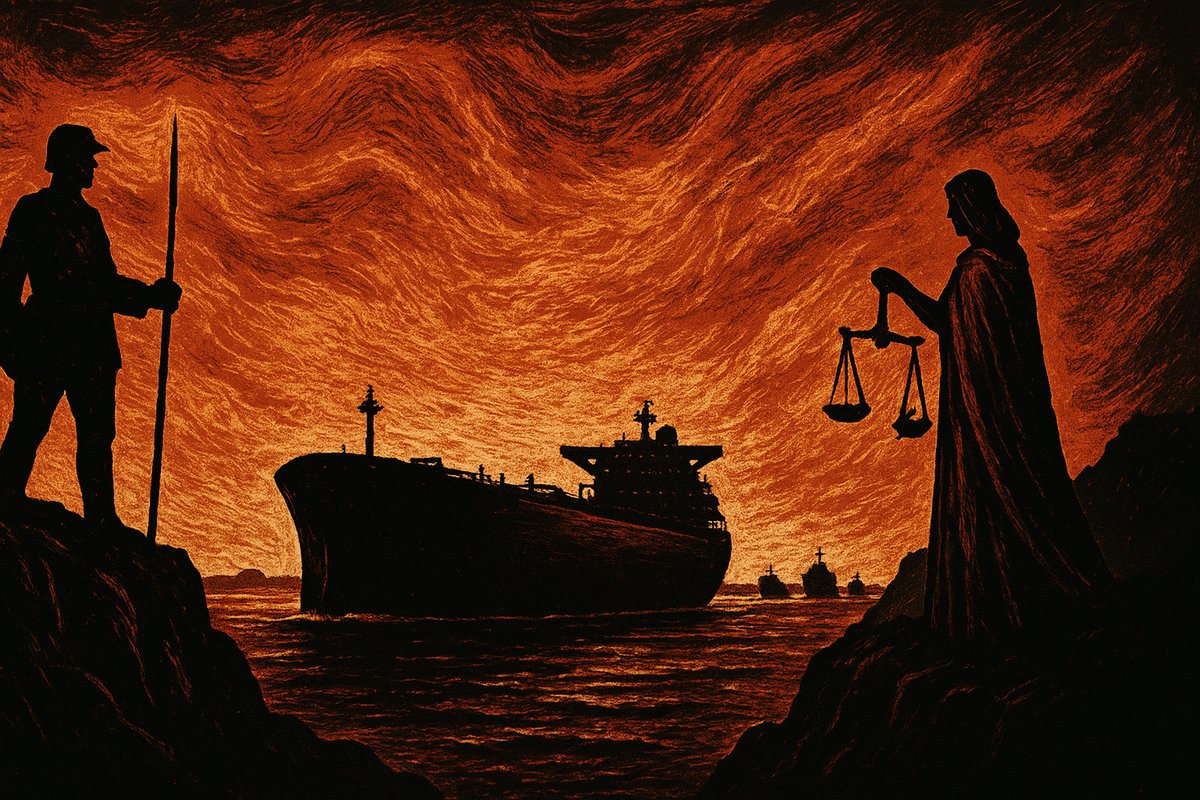
On July 13, 2026, Trump announced on Truth Social that the United States would become the guardian of the Strait of Hormuz. It would charge twenty percent on all cargo transiting the strait as reimbursement for the security it provides. The proposal didn't last. Pressure from Gulf allies and the shipping industry forced a retreat within days. That announcement, however, left behind a question more durable than any decree: who has the right to set a price on a passage that no one owns.
A maritime toll is legitimate when it's collected by the coastal State and based on characteristics of the vessel rather than the value of the cargo. That's exactly what happens at Suez and Panama. The United States couldn't apply that logic in Hormuz. It isn't a coastal State. The International Maritime Organization pointed this out beyond any doubt: the charge had no legal basis. Even so, for a few days the world had to seriously consider that twenty percent of the value of every cargo bound for the Persian Gulf might end up in the hands of the U.S. government.
Roughly a fifth of the world's oil passes through the Strait of Hormuz. Along with Malacca and Gibraltar, it forms one of the chokepoints that hold up global trade as we know it. Shipping companies normally pay between two and three percent of the value of their goods in transit fees. Twenty percent. That's not a fee. It's something else.
Hormuz exposes a legal void because no international treaty grants a third State unconnected to the coastline the authority to monetize passage through an international strait. The underlying argument deserves to be heard first. The United States maintains a sustained naval presence in the Persian Gulf: aircraft carriers, destroyers, personnel, logistics. The Fifth Fleet doesn't operate for free. If much of Hormuz's security depends on that presence, the question of who absorbs the cost isn't unreasonable.
But the form reveals the core of the episode. The announcement came via social media, without consulting Gulf allies, without its own legal framework, without multilateral negotiation. This wasn't a diplomatic proposal. It was a unilateral price-fixing on a good that didn't belong to whoever set the price. The same tendency shows up in Greenland, in trade pressure against Spain, in the stance toward Iran and toward China. Rules get pushed to the tolerable limit and pulled back when the political cost becomes excessive.
Why did the toll fail if no explicit rule clearly forbade it? The brake came from politics. Gulf allies — Saudi Arabia, the UAE, Qatar — depend on that transit for their own economies and weren't going to silently accept an external tax. The global shipping industry, already operating on thin margins, wasn't either. That combined resistance forced a quick retreat. It wasn't international law that stopped the charge. It was immediate political calculation. That leaves the door open: the decisive variable in the next attempt will still be how much opposition can be mustered.
Months earlier, the same administration had argued exactly the opposite. Iran couldn't charge tolls for Hormuz because that would open a Pandora's box. If Iran charges for Hormuz, nothing stops Malaysia from charging for Malacca or Spain and Morocco from charging for Gibraltar. Marco Rubio signed the joint statement rejecting any toll. Iranian Foreign Minister Abbas Araghchi responded with an irony that needed no embellishment: if whoever guarantees safe passage deserves compensation, then Iran deserves it too. The argument built to contain Tehran ended up justifying Tehran.
This void doesn't appear only at sea. The Generosity in the Doorway examines how the Moon and orbital space share the same structural problem: commons with no recognized arbiter. The absence of clear authority doesn't mean the absence of rules. The rules are written by whoever first achieves physical presence and the capacity to enforce them. The fuel blockade against Cuba follows the identical dynamic on another scale. Whoever hunts the mammoth, the whole tribe eats.
What does this mean for other critical infrastructures that today seem shielded? The same logic operates in seemingly distant domains. Who decides the terms of frontier artificial intelligence? The answer doesn't lie in a treaty either. It lies with whoever controls the models, the data centers, and the physical infrastructure. Voids don't stay empty. They get filled by whoever arrives first and has the resources to defend the position while everyone else is still organizing.
Any proposal for a social arrangement — a basic income, a mechanism for collective coordination — presupposes an actor with the authority to carry it out. Almost never is it examined what force obliges that actor to respect the limits supposedly binding it. The Hormuz episode is the maritime version of that blind spot. It's not enough to ask whether twenty percent was a fair rate. One must ask who had the power to attempt it, and what, ultimately, stopped them.
What stopped the toll was a balance of forces that, on this occasion, turned out unfavorable. The rules of the sea, like the rules of almost any commons, exist only as long as someone actively enforces them — not because they're written into a treaty everyone obeys out of conviction. That's no reason for pessimism. It's reason to watch closely who is building physical presence and negotiating power in the spaces the law hasn't yet reached. That's where the rules get written that later get presented as if they had always existed.
What will happen the next time an actor with naval capability announces a similar toll at another critical point, and the balance of forces favors them instead?
Sources
1. Truth Social — post by Donald Trump, July 13, 2026
2. International Maritime Organization (IMO) — statements on the legal regime of international straits
3. Joint statement by Gulf allies and Marco Rubio on tolls in the Strait of Hormuz
4. Statements by Iranian Foreign Minister Abbas Araghchi in response to the announcement
5. The Generosity in the Doorway, Yves Laurent (ASIN B0H6RT5Y32)