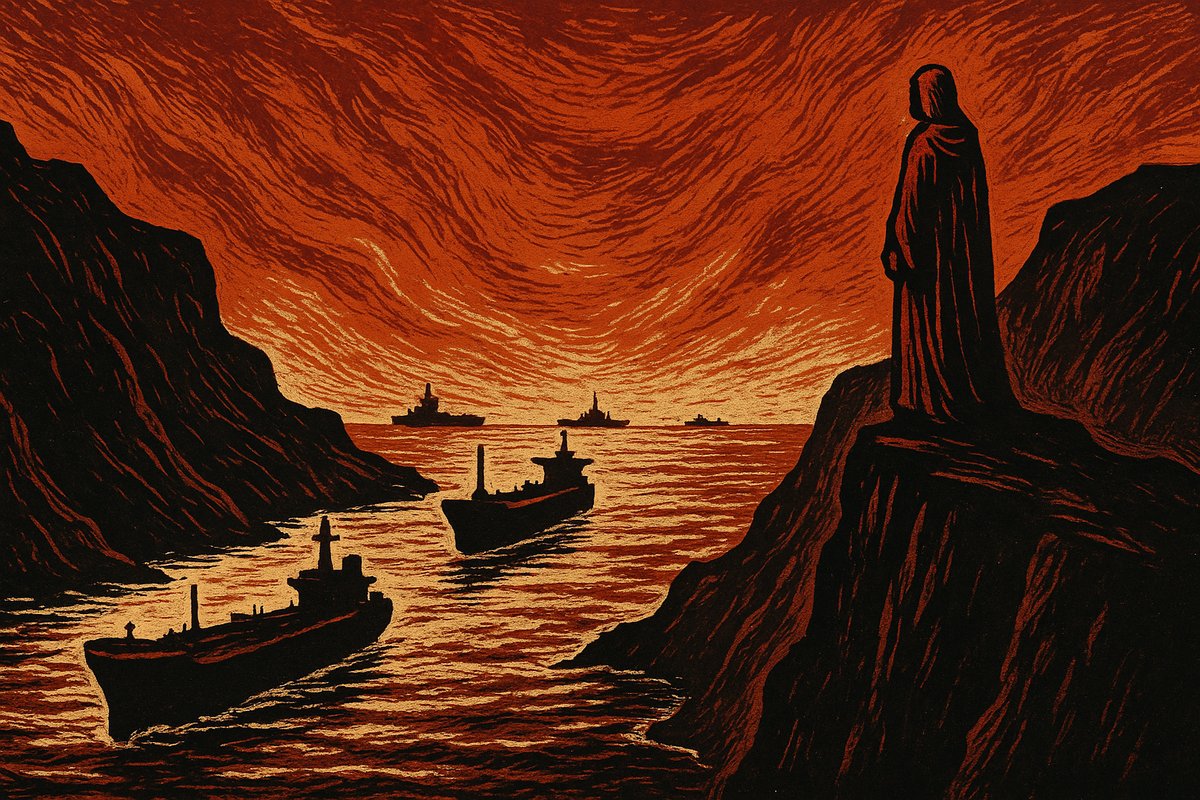
The Strait of Hormuz is a maritime channel thirty-three kilometers wide at its narrowest point. That narrowness explains why nearly a fifth of the world's oil transits through a space that would fit, without exaggeration, inside the urban footprint of a mid-sized city. Control of the Strait of Hormuz means dominion over a critical route because it determines the flow that props up half the global economy. When Trump talks about seizing the strait, he's describing, in his blunt style, control over that energy pipeline.
The thesis making the rounds has internal logic. The United States already maintains a permanent naval presence through the Fifth Fleet based in Bahrain. Iran controls the northern shore. Oman controls much of the southern shore, and the United Arab Emirates has coastline at the mouth of the channel. Trump's version presents itself as a logical extension of the role Washington has played for decades as the naval guarantor of maritime trade.
Why does this idea resonate even among people who usually distrust Trump? It starts from an uncomfortable truth. No one has ever exercised unilateral dominion over Hormuz. That ambiguity has generated real instability. Iran has threatened to close the passage on several occasions since 1980. Maritime insurers hike premiums with every flare-up. If the core of the argument is ensuring the oil keeps flowing, there's a market logic here that shouldn't be dismissed just because it's wrapped in imperial rhetoric.
Hormuz is an international strait under customary maritime law. No country can claim exclusive sovereignty over a shared waterway. That legal definition is precisely what Trump's proposal would have to break. Seizing an international strait isn't foreign policy. It's a fracture in the structure that has held up global maritime trade since the 1982 Montego Bay Convention. The United States never ratified that treaty. The detail many repeat as trivia carries real weight here. Washington can argue it isn't bound by rules it never signed.
The popular thesis shows cracks under close examination. Iran controls only the northern shore. Oman administers the Musandam, the peninsula that defines the southern shore of the narrowest stretch. Oman is not Iran. It has been a historic ally of Washington and a constant mediator between Tehran and the West. Its perceived neutrality is the foundation of its diplomatic survival among hostile neighbors. An operation that treats the strait as territory for unilateral management puts Oman in an impossible bind.
The United Arab Emirates built oil infrastructure specifically to avoid depending on Hormuz. The Habshan-Fujairah pipeline exists for exactly that reason. Countries in the region were already shielding themselves against blockades or external control years before Trump put the issue front and center. This is not a minor detail.
China, Japan, South Korea, and India are the main buyers of the crude that crosses Hormuz. They would find themselves subject to a risk contingent on their bilateral relationship with Washington. That doesn't guarantee free transit. It turns the passage into an instrument of selective foreign policy. International maritime law was designed to prevent precisely that risk.
This approach repeats a pattern I've already explored regarding tensions with Venezuela, Cuba, Greenland, Iran, and Mexico. These aren't isolated cases. It's about redefining access to strategic assets under the banner of ensuring they keep working. The vocabulary changes between Greenland, Panama, or Venezuela. The structure of the argument remains identical: this should be ours because we guarantee it operates.
Few dispute who actually benefits from the strait having a single administrator. Charging tolls for transit wouldn't solve the geopolitical problem. It would turn it into a revenue stream. A maritime commons protected by convention would become an asset with an owner and a price tag. Uncertainty remains. It isn't entirely clear whether this is a maximum-pressure tactic, similar to the tariff threats that later morph into bilateral deals, or whether it reflects an intent toward permanent, exclusive military presence. Trump has used both registers. Telling them apart from the outside is trickier than it seems.
In The Generosity in the Doorway, I explore the idea of the Snowpiercer train as a metaphor: systems where the ordering of the cars is presented as natural law when it's actually a decision of power sustained through effort. Hormuz works in a similar way. For decades, the comfortable fiction was that the strait was neutral space, managed by convention and protected by the world's largest navy almost as an act of altruistic service. Trump's statements reveal, without meaning to, that this service always had an owner. It just wasn't said out loud before.
A fact that contradicts common intuition. The United States imports less than ten percent of its oil through Hormuz, thanks to the domestic fracking boom. Those who actually need the channel free of friction are China and the Asian economies, not Washington. Dominion over Hormuz wouldn't protect America's energy supply. It would give the United States leverage over the economies that do depend on that route, starting with the strategic rival Trump has singled out for years.
Total control. Hard to achieve without stepping on multiple actors with crossed interests. The question that remains is whether this locomotive can have a single driver without derailing the rest of the train.