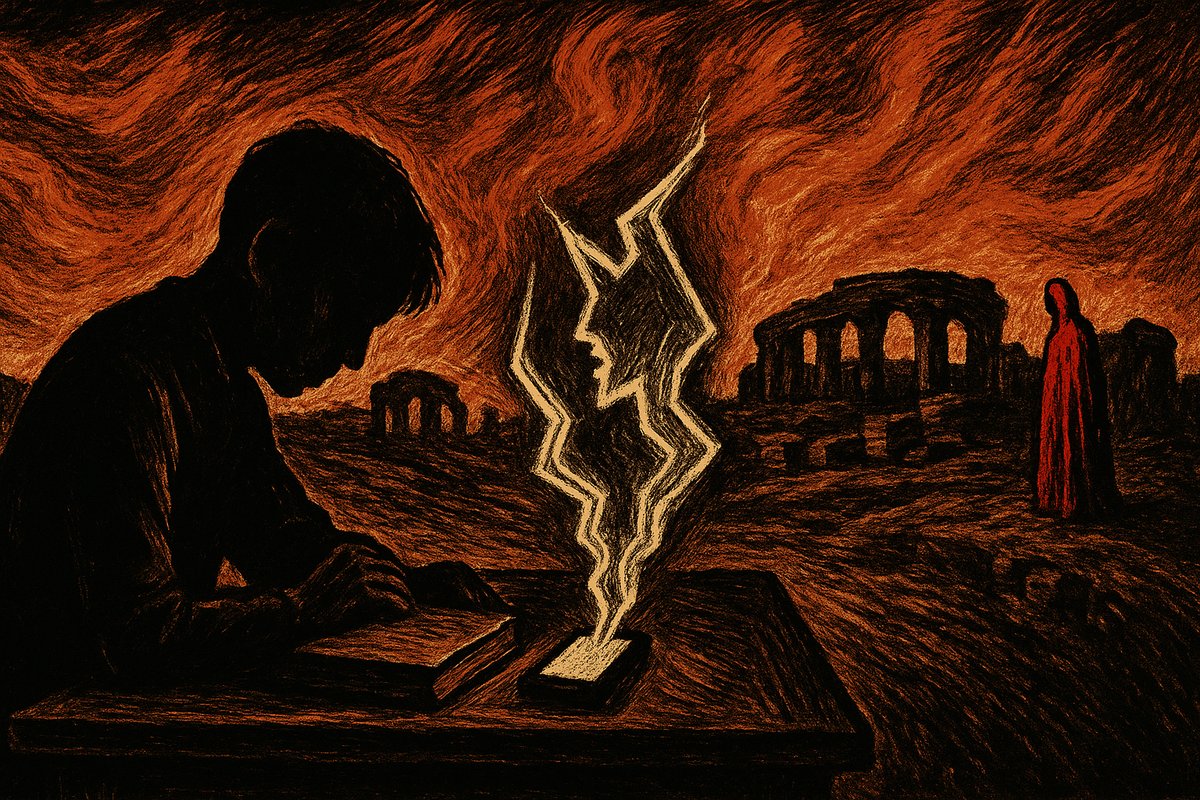
Twenty-five points. That's how much the average reading comprehension score dropped among fifteen-year-olds according to the OECD's PISA test, comparing 2018 to 2025. It's the steepest decline in the quarter century the exam has been measured, and it equals, by the organization's own calculations, a full year of lost schooling. A fifteen-year-old today reads, on average, the way a fourteen-year-old did seven years ago.
Reading comprehension is the ability to hold a complete argument in your head long enough to judge it, because without that retention there is no possible analysis, only reaction. That's what's being lost, according to Andreas Schleicher, the OECD's director of education. Not the ability to read words. The patience to read long, complex ideas. The figure is uncomfortable: 46 percent of students use AI chatbots weekly for schoolwork, and that habit turns them into hurried readers. They ask for the summary. They don't read the text. When the closed-book exam arrives, without the digital crutch, performance collapses.
This pattern fits something already documented in other domains. Structures that promise to resolve the friction of human thinking end up atrophying the very muscle they were supposedly meant to free.
Las Piedras No Mienten addresses a similar structural problem, though in a different context. What happens when a society delegates its capacity for coordination to a system that decides on its behalf without anyone noticing the exact moment of delegation. The book examines how certain governance structures — from ancient community councils where carved stones served as collective memory and a point of debate, to modern systems of citizen feedback — depend on participants exercising active judgment. When that judgment gets automated, the structure keeps functioning in appearance, but the human content that sustained it disappears.
What the PISA case adds to that thesis is a measurable process, with hard numbers and an entire generation as the sample. A standardized exam applied to millions of teenagers across dozens of countries, with a consistent decline attributable to a specific habit. Using AI as a shortcut rather than as a tool for exploration.
Why should this matter to someone who finished school years ago? Reading discernment is the cognitive infrastructure on which every later act of civic judgment is built. Reading a contract, evaluating a news story, detecting political manipulation. If that infrastructure weakens at fifteen, it doesn't repair itself by twenty-five.
The study doesn't claim that technology itself is the poison. Passive use of technology is. There's a difference between asking a chatbot to hand over the answer and using it to formulate questions you must answer yourself. The OECD calls this Socratic questioning in its reform recommendations, reaching for a method more than two thousand years old to fix a problem produced by the newest technology on the planet. The Socratic method never handed over the answer. It returned the question, reformulated, until the student had to build his own mental scaffolding.
This partially challenges the book's thesis on one specific point. Technology is a variable, not a cause in itself. The real problem lies in the institutional design that decides how that technology gets deployed. The PISA case confirms that argument with a precision the book didn't have available when it was written. The reform the OECD proposes — banning phones in the classroom and redirecting AI toward questions instead of answers — represents exactly the kind of structural redesign that separates a tool that strengthens judgment from one that replaces it. The chatbot didn't decide to atrophy a generation's reading. The decision to integrate it as a substitute rather than as a coach did.
There's something else. The phenomenon doesn't occur only in poorer schools or those with less access to technology, as one might expect from a traditional technology-gap problem. It occurs more strongly where access to generative AI is greater. It's the same tendency observed when an algorithmic governance tool classifies citizen complaints without real deliberation. The more efficient the system appears at resolving friction, the less training the user receives in tolerating that friction. That's where critical thinking lives.
Yves Laurent has seen the same trap in organizations. Automating the uncomfortable part of the process, the part that forces someone to think, always looks like an efficiency improvement. Until someone needs that muscle. And discovers it's no longer there. Hunt a mammoth. The whole tribe eats. Three times.
What does this mean for whoever is reading this article and probably passed fifteen a long time ago? The same habits of passive consumption operate in adults with the same logic, only without a PISA exam to measure it. A teenager is still forming the capacity. An adult who loses it is dismantling it.
The question the OECD report leaves open, and one the book doesn't fully resolve either, is what happens when an entire generation reaches adulthood having never built the capacity to hold a long argument in their head. This isn't some distant hypothetical scenario. It's the cohort that is fifteen years old today and will, in a decade, be making decisions about governance, work, and technology. If for them nothing exists except what social media comments say or what AI answers, what becomes of humanity? A civilization without the habit of doubting accepts whatever appears first, without filter or depth. This topic remains open; it's not yet clear how to fully reverse it.
What kind of future does a generation trained not to doubt end up building?
Sources:
1. OECD, PISA 2025 report on reading comprehension and generative AI use among fifteen-year-old students.
2. Statements by Andreas Schleicher, OECD Director for Education and Skills, on the cognitive impact of weekly chatbot use.
3. Yves Laurent, The Stones Don't Lie (Amazon Kindle, ASIN B0GX2XWBPK, 2026).