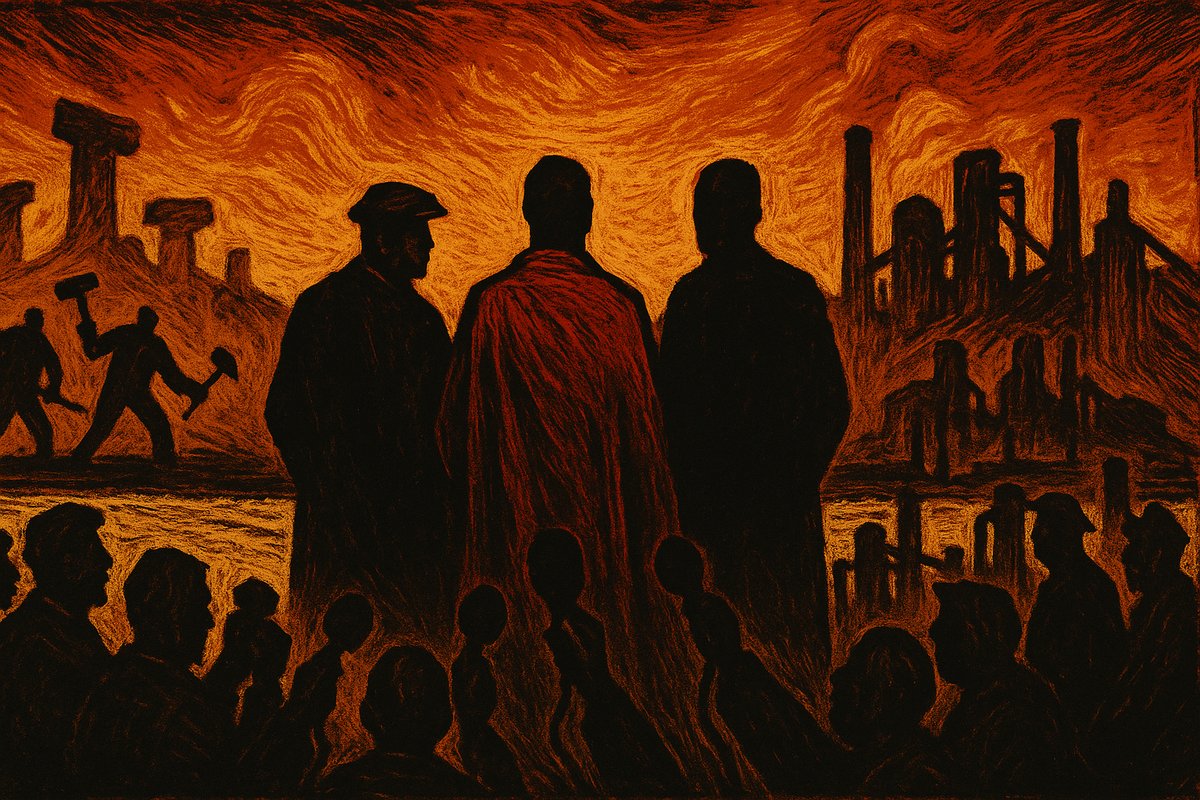
Laval, Quebec, September 15, 2026. Roxanne Brown stands before a group of journalists alongside Marty Warren and Nicolas Lapierre, the Canadian leaders of the union representing eight hundred fifty thousand workers across two countries. The message is simple. Stop fighting each other and go fight the one who's actually taking your market.
A binational union is an organization that represents workers from more than one country under a single bargaining structure. This matters because it reveals something that political borders insist on hiding. The steel supply chain doesn't ask an ingot where it came from before it crosses Ontario into Michigan. The United States imposed a fifty percent tariff on steel during the summer of 2026. Canada answered with mirror tariffs. And there the two governments stood, each looking at the other as if the problem were on the other side of the line.
Brown isn't asking anyone to concede out of goodwill. She's pointing to an asymmetry. While Washington and Ottawa charge each other tariffs, Chinese steel keeps coming in at prices no North American mill can match. It's a war on the wrong front.
I've seen this pattern show up whenever cooperative systems come under pressure. The actors with more bargaining power tend to fragment the resistance of those with less. It happens whenever nobody builds the processes to prevent it. Two countries with intertwined steel industries. With unions representing the same trades on both sides of the border. And they end up treating each other as competitors instead of allies against a third party that actually is playing that game.
Why would a union have more strategic clarity than two entire governments? Incentives explain a lot. A government responds to short-term electoral cycles and to the pressure of looking tough in front of the neighbor. A union like the USW responds to something more basic. The worker in Hamilton and the one in Pittsburgh draw a paycheck from the same kind of plant, face the same risk of closure, and neither gains anything if the plant shuts down because of a tariff that doesn't even come from Beijing.
Here the issue stops being about steel. It becomes about coordination, which is the topic that genuinely interests me. Inside organizations I've seen the same mistake. Two teams that should be cooperating end up competing for internal resources while the real external competitor sits back and watches. It isn't stupidity. Incentive structures are almost never designed to reward long-term cooperation over tactical victory.
The parallel with Chinese state planning is tempting. I explored it some time ago when analyzing their five-year plans. There, coordination gets imposed from the top, with decade-long horizons and no need for democratic consensus. Here in North America, coordination would have to be built from intermediate structures—unions, binational chambers, sector agreements—because neither the United States nor Canada is going to hand sovereignty over to centralized planning. The USW represents exactly that kind of intermediate structure. Neither state nor pure market. An organization that aggregates the interest of hundreds of thousands of people and turns it into a negotiating voice.
What's curious is that this same dilemma over who controls the collective voice shows up in far-flung contexts. I've explored how China exports mini-programs that sort citizen complaints without leaving room for real deliberation, comparing it to experiments like Cybersyn in Chile under Salvador Allende and Stafford Beer. The underlying question is the same. Who decides which complaint counts and which one gets tossed out? In the case of steel, the question translates like this. Is the worker's interest aggregated through a union with real bargaining power, or does it dissolve between two government apparatuses competing to look tough for their own domestic electorates?
Archaeology has something to say here. At Göbekli Tepe, the Neolithic site in southeastern Turkey that has occupied a good deal of my attention in Stones Don't Lie, the evidence shows that hundreds of people coordinated a massive construction effort with no centralized state forcing them to. It wasn't perfect. Nor peaceful. There was surely friction, hierarchy, disputes over who ate first at the ritual feasts that probably sustained the collective labor. But it worked for centuries without a king ordering it. Large-scale cooperation doesn't necessarily require a central authority. It requires shared mechanisms of reciprocity and enough clarity about who benefits from what.
North American steel has the opposite problem. There are central authorities, two of them in fact, but there's no shared process of reciprocity between them. Each government acts as if the other were the rival when the real structural challenge comes from a third source, Chinese steel overproduction, a problem the Organization for Economic Co-operation and Development has been documenting for years and that no bilateral tariff between Washington and Ottawa is going to fix.
I still don't have a clear formula for how two governments with such different electoral incentives manage to see this the same way at the same time. Roxanne Brown can stand in Laval and say it with all the clarity in the world. A union, however representative, doesn't sign trade treaties. It can only push, pressure, remind each government that eight hundred fifty thousand people are watching the same screen.
Hundreds of thousands of workers. Waiting. What happens when the structure that best understands the problem, the binational union that sees the actual flow of labor and capital crossing the border, is also the structure with the least formal power to solve it?