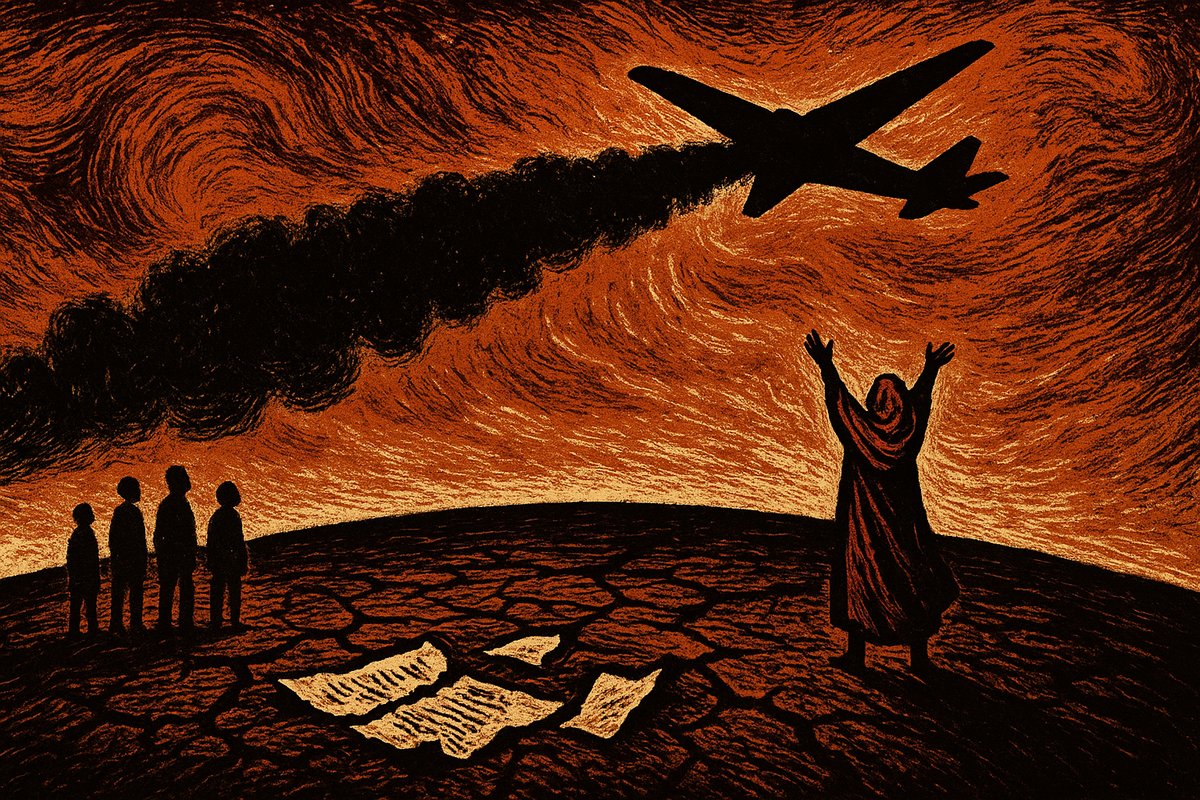
A company incorporated in Delaware, headquartered near Tel Aviv, planned to begin releasing particles from a modified aircraft in April 2026, several kilometers up in the sky. The particle is secret. No one outside the company knows what it is. In its 2023 pitch to investors, Stardust Solutions described itself as the only technologically viable solution to climate change, projecting revenue of over a billion dollars a year, paid by governments.
Stardust is a private solar geoengineering company that aims to modify the planet's shared atmosphere and charge for it. Its technology remains closed to any independent audit because the exact composition is protected as a trade secret. This case stands apart from any other climate debate: it doesn't question whether the planet is warming. It asks who would hold the key to turning down the temperature, and what happens if they decide not to let go of it.
In October 2025 the company raised sixty million dollars, the largest round ever recorded for solar geoengineering. That brings total funding to seventy-five million. Its investors include Lowercarbon Capital, Chris Sacca's climate fund, the Agnelli family, former Facebook executive Matt Cohler, and Awz Ventures, a Canadian-Israeli firm with reported ties to Israel's Ministry of Defense. The money arrived fast. The governance didn't.
The founders are no amateurs. Yanai Yedvab was deputy chief scientist of the Israel Atomic Energy Commission. Amyad Spector worked as a nuclear physicist at the Negev Nuclear Research Center. Eli Waxman comes from the Weizmann Institute. Three physicists with backgrounds in state nuclear programs now run a private company that wants to inject particles into the stratosphere and bill for the service. MIT Technology Review, Politico E&E News, and Heatmap have documented the record in detail. The EPA has been clear on one point: the U.S. government does not conduct outdoor testing or large-scale deployment of this kind of technology. What Stardust is proposing, no state is officially doing yet.
Hundreds of academics have called for an international non-use agreement. No one has signed it. There is no arbiter with real authority over the atmosphere. There are climate treaties, there are UN frameworks, there are declarations. But no body can tell a Delaware company "you can't do that twenty kilometers up" and actually enforce it. The academic petition has been circulating for years without becoming binding law in any relevant bloc.
Mount Pinatubo helps calibrate whether this even works. In 1991 the eruption threw so much material into the stratosphere that it cooled the planet by nearly half a degree for over a year. It's the natural experiment cited by every serious study of solar geoengineering. A volcano has no investors. The physics is real and measurable: particles reflecting solar radiation, global temperature dropping. Stardust's problem was never whether the atmospheric science works. It's who decides to activate it, with what particle, and under what rules.
Current warming is human-caused, and no serious available data disputes that. Antarctic ice cores show CO2 concentrations oscillating between one hundred eighty and three hundred parts per million over eight hundred thousand years. Today we're above four hundred twenty ppm, with a rate of change one or two orders of magnitude greater than any glacial transition recorded in that ice archive. This isn't statistical noise. Fully accepting the solidity of the climate diagnosis makes the argument against Stardust stronger, not weaker. The real problem stays exactly where it should: governance.
There is legitimate skepticism worth holding onto. The uncertainty ranges in long-term projections are wide and real. Catastrophist rhetoric with deadline dates has failed often enough to generate fatigue and justified public distrust. Whoever sells the solution has a direct interest in sizing the problem to exactly match their product. Stardust doesn't present itself as one option among several. It presents itself as the only technologically viable solution. That phrase, in a pitch to investors, is market positioning.
The same pattern repeats in other arenas. Sam Altman and Elon Musk promote universal basic income while their companies carry out layoffs and invest hundreds of billions in AI. The Generosity in the Doorway traces how the same actor can build the infrastructure of a problem and then administer its remedy, collecting at both ends. Stardust reproduces that dynamic, but raised to planetary scale. This isn't about jobs or knowledge. It's about the atmosphere the entire planet breathes.
Once a stratospheric aerosol system is deployed at scale, stopping it abruptly doesn't return the planet to its previous state. It triggers a sharp thermal rebound. The warming accumulated over decades of emissions is still there underneath, waiting. That turns whoever operates that system into something other than a service provider: a structural hostage of all humanity, with humanity as hostage too. There is no shutoff button without catastrophic cost.
What does this mean for a government that signs a contract with Stardust? It means it's not buying a reversible service but entering a dependency that can only escalate. If the company raises the price, there's no alternative provider with the same particle, because it's secret and proprietary. If it goes bankrupt or is acquired, who inherits the obligation to keep the system running? If a country demands transparency about the chemical composition of what's being sprayed over its territory, it has the right to refuse to let the flight continue. None of these questions has an institutional answer today.
The concentration of power this implies has no easy comparison. In the chapter on climate financialization in Stones Don't Lie, it describes how genuine concern for the planet became justification for speculative carbon markets. Stardust takes that logic a step further because it no longer sells a financial instrument about the climate. It sells direct physical dominion over it. Questioning the model risks the rhetorical trap of seeming indifferent to global warming.
If Stardust acts and something goes wrong, the consequences would be difficult to assign. If monsoon rains in South Asia fail a year after a deployment, and the correlation between stratospheric aerosols and regional precipitation patterns is a documented concern, which country claims damages, before what tribunal, against a Delaware company with investors spread across California, Turin, and Tel Aviv? No legal mechanism today can answer that question clearly. There is a wrongful termination lawsuit filed against the company by a former employee, Justin Mabie, with allegations that haven't been proven in court and that change nothing about the underlying governance problem that matters here.
I'll admit I don't have a clean answer for how that missing international arbiter would be built. No one does yet. Public debate has focused almost entirely on whether solar geoengineering works technically. Pinatubo already answered that more than three decades ago. The urgent question is a different one.
Stones don't lie, but historians sometimes do.
Who authorizes a private actor to modify a common good that belongs to no one in particular because it belongs to everyone?
Sources:
1. MIT Technology Review — coverage of Stardust Solutions and solar geoengineering funding
2. Politico E&E News — profile of founders and ties to Israel's nuclear sector
3. Heatmap News — analysis of investors and Stardust's business model
4. EPA (U.S. Environmental Protection Agency) — statements on geoengineering testing
5. Public records of the Mount Pinatubo eruption (1991) and its measured climate effect