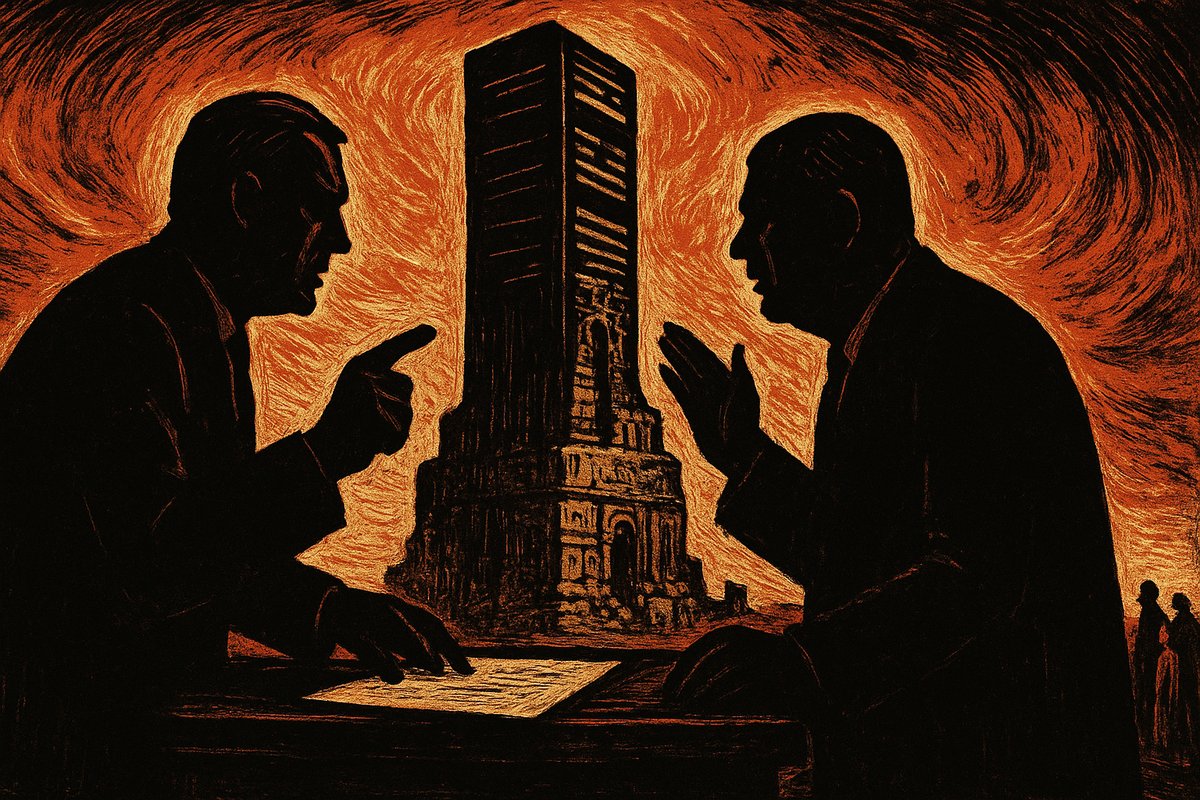
Xi Jinping and Donald Trump sat down at the White House to discuss trade, security, and narcotics. At some point in that conversation, an idea emerged that deserves more attention. Both agreed on the need to maintain human oversight over artificial intelligence. Xi went further and noted that cooperating on AI is preferable to mutual distrust. It sounds reasonable. It sounds hopeful.
Human control over AI is a hollow phrase because it doesn't specify which people are involved, through what processes, or audited by whom. Two heads of state can sign any declaration of principles they like. That doesn't produce a single line of verifiable code, a single audit method, or a single institution with real capacity to enforce that oversight. The declaration is the wrapping. The contents remain completely open.
This isn't cynicism talking. Amazon publicly flagged risks at Anthropic, the company it had invested billions in. The warning looked like a gesture of responsibility. Underneath, it was a regulatory positioning move, a way of voicing concern about safety without ceding real operational control. The language of caution and the language of effective oversight rarely coincide when they come from whoever already holds the power.
Las Piedras No Mienten devotes a good part of its analysis to explaining why auditable AI remains, today, an unfulfilled technical promise. This isn't pessimism. It's honesty about the current state of the technology. Advanced models are still operational black boxes. Accessible interpretability — the kind that would let anyone without technical training understand why a system decided something — hasn't been solved. Human override processes require engineers with code access, not citizens with real capacity to intervene. Xi and Trump talk about human oversight as if it were a switch that already exists and just needs flipping on. That switch doesn't exist.
There's something else at play: models of algorithmic regulation are openly competing with one another. China exports mini-programs for managing citizen complaints that classify, prioritize, and resolve grievances with no real deliberative component whatsoever. The citizen reports. The algorithm decides. No one discusses the criteria. Pure efficiency. This is the exact opposite of what Stafford Beer tried to build with Cybersyn in Salvador Allende's Chile — a structure that sought real-time feedback while preserving space for human negotiation rather than mere automatic classification. Does the cooperation Xi mentions point toward something like Cybersyn, or toward the classification mini-programs? The summit didn't clarify this. That ambiguity is not a minor detail.
What does this summit add to what we already knew about AI regulation between superpowers? It confirms, with fresh evidence, that human-oversight rhetoric functions more as a diplomatic tool than as a concrete technical proposal. Trump needed to project negotiating strength on technology vis-à-vis China without compromising the advantage held by American companies. Xi needed to show international openness while protecting the centralized algorithmic regulation model operating within his own borders. Neither one gains anything by signing on to a real, verifiable, enforceable audit process. Both gain from a statement of intentions that can be cited later without anyone checking whether it was actually honored.
Bernie Sanders and Greg Casar's legislative proposal to ban artificial superintelligence exposed something similar. The institutional void isn't an accident. It's the condition that allows powerful actors — governments, corporations, or both — to operate without effective oversight while talking about it. Banning something by law with twenty-year sentences sounds forceful. Until you ask who monitors compliance, with what budget, and with what independence from the very companies the law claims to regulate. The Xi-Trump summit presents the inverse problem. It bans nothing; it merely declares good intentions. But it shares the same absence of a verifiable process.
There's also an asymmetry that rarely shows up in coverage of these summits. The parallel media dispute — where Judge Timothy Kelly issued a temporary order regarding the restoration of press credentials for CNN, Politico, and other outlets at the White House — isn't an isolated data point. It's part of the same trend. Whoever controls access to information also shapes the narrative about how much real human control actually exists over the systems that govern us. If the press covering these summits faces restrictions, who audits the auditor?
Does this undermine the idea that viable alternatives to centralized dominance exist in the form of distributed regulation? Not exactly. It complicates it in an uncomfortable way. The notion that rotating citizen audits, accessible interpretability, and effective human override are possible someday remains valid as a horizon. What this summit confirms is that neither the United States nor China is moving in that direction. They build declarations that gesture toward that horizon while consolidating opacity through other channels. The Generosity in the Doorway explores how whoever builds the AI infrastructure — data centers, computing capacity, raw computational power — ends up defining the regulatory remedy as well. With Xi and Trump, we're watching a geopolitical version of that same dynamic play out. The two states investing most heavily in AI development are the same ones proclaiming themselves guarantors of human oversight over that AI. No outside party verifies that self-declaration.
This has implications for anyone following these negotiations from outside Washington or Beijing. The language of cooperation and human oversight deserves to be read as the opening move of a negotiation, not its conclusion. The question that remains open — one that no bilateral summit between superpowers seems ready to answer yet — is whether any AI regulatory framework can be built outside the logic of who holds more computing power and more narrative control over their own declaration of good intentions. Black boxes. I still don't have a clear picture of how this gets fully resolved.
Ancient stones recorded the decrees of real power. They revealed who truly decided. Today algorithms decide without leaving behind any visible equivalent.
Can genuine human oversight be built that escapes the grasp of those who hold the most power?
Sources:
1. Xinhua Español, coverage of the Xi Jinping–Donald Trump meeting at the White House.
2. Le Devoir, report on U.S.–China bilateral relations and artificial intelligence cooperation.
3. Judicial coverage of Judge Timothy Kelly's order regarding press credentials at the White House (CNN, Politico).
4. Yves Laurent, Las Piedras No Mienten (chapter on auditable AI: promise and problems), ASIN B0H9T9ZRQC.
5. Yves Laurent, The Generosity in the Doorway, ASIN B0H6RT5Y32.