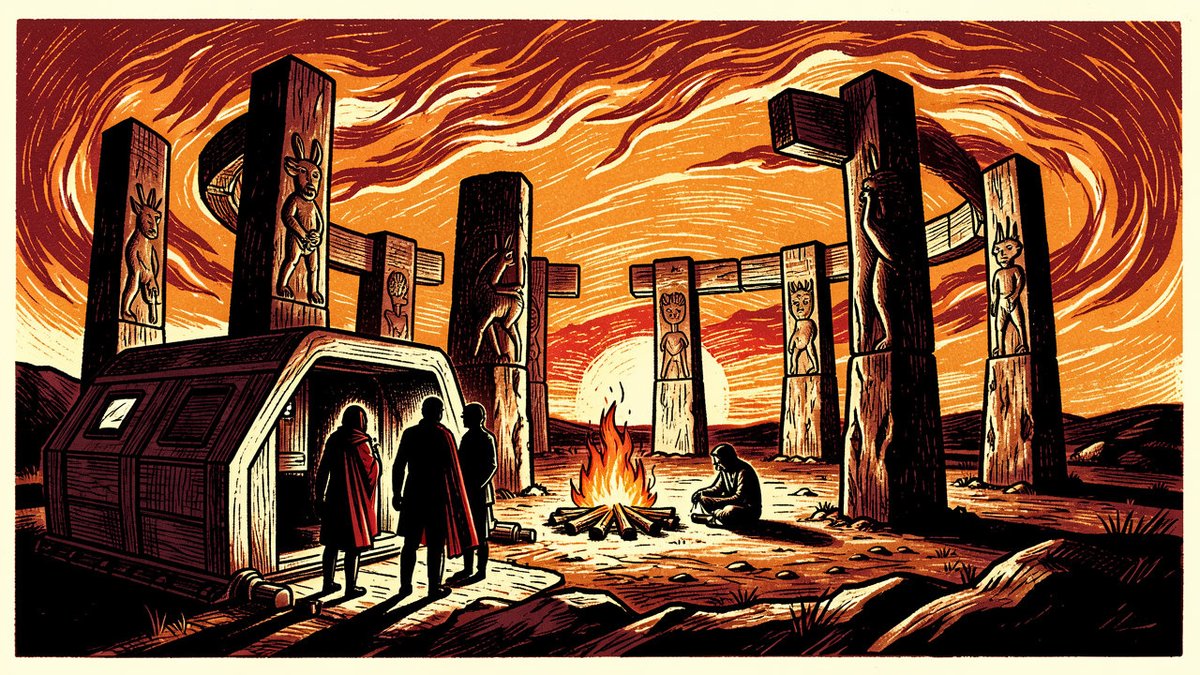
Four people walk out of a 158-square-meter house in Houston after 378 days without setting foot outside. Ross Elder, Ellen Ellis, Matthew Montgomery and James Spicer make up the crew of CHAPEA 2, NASA Johnson Space Center's second Mars simulation mission. A simulated habitat is a social experiment disguised as a spacecraft, because what's being measured isn't the rocket but the group that has to live inside it together.
They went in in October 2025. Since then they've lived with everything a long voyage would demand: communication delays like the ones between Mars and Earth, limited resources, and distance as a permanent condition. Nobody asked them to be heroes. They were asked to be research subjects, which is considerably less glamorous.
The routine gives a sense of it. They drew their own blood samples, ran routine medical checks with no doctor at their side, and kept up heavy exercise sessions because without enough gravity, or without movement, the body sends the bill eventually. Drawing your own blood on some random Tuesday as part of the job, in front of your roommates. That ordinary, and that strange.
Now comes the part you don't see in the exit photos. Two weeks of post-mission evaluations await them, and then the reunion with their families. Leaving is also a test — readjusting to noise, to people, to deciding what to eat without an inventory making the decision for you.
Why does NASA invest more than a year in locking four people up in Houston? Because the bottleneck of a Mars mission isn't just engineering. People are the least predictable component of the system. A rocket fails in ways that can be modeled. A group isolated for months fails from exhaustion, from a comment taken the wrong way, from silences that pile up. CHAPEA's data feeds NASA's Human Research Program, which is preparing long missions to the Moon and Mars. And applications are already open for the next simulation. The experiment is conceived as a series, not a one-off event.
The actors here are few, and that's what makes it interesting. Four volunteers, one agency, one research program. No market, no shareholders pressing for quarterly results. There's an uncomfortable question underneath it all: what does a small group need to cooperate under pressure over a long stretch of time. I've seen in different contexts that the answer is almost never technology, but clear rules, meaningful tasks, and people who tolerate each other with some affection.
And what does this mean for those of us who will never go to Mars? Quite a lot. A closed habitat is a cheap laboratory for what we already live out on a larger scale — dependence on systems we don't control, mediated communication, work that measures our bodies and our moods. What NASA learns about sleep, stress and cohabitation could apply to polar stations, night shifts, or remote teams. There are things I don't fully understand, like how much of what was observed depended on the four of them knowing they were being watched. That's no small doubt, and it's kept psychologists up at night for decades.
The practical consequences are more sober than the epic ones. If the results are good, schedules, diets, medical protocols and crew composition will get fine-tuned. If they're bad, the problems will be found out before they cost lives. What loses either way is the illusion that Mars is just a matter of engine thrust. To me, that's the best news hidden in this story.
There's an old echo here. At Göbekli Tepe about eleven thousand years ago, hundreds of people coordinated across generations to build monumental enclosures without a state, without writing, and without our really knowing who was in charge. As I argue in The Generosity in the Doorway, large-scale cooperation rarely springs from an order. It tends to arise from shared rituals, feasts and reciprocal obligations — imperfect and full of friction. We don't know what ritual the four in Houston came up with, but they surely invented one. A Sunday dinner. A running joke. The stones don't say more than that, and maybe neither does NASA's file.
The four will walk out. They'll be weighed. Their blood will be drawn again, this time by other hands, and they'll be hugged. There's already an online form for the next group. What will be left of those improvised rituals once Earth becomes noisy and ordinary again?