Meta description: OpenAI dismantled two influence campaigns built with ChatGPT: a fake think tank and seven invented journalists. Who watches the watchman?
A covert influence operation is a campaign that hides its origin because a message is more persuasive when it appears to come from someone with no stake in the outcome. That's the entire technique. Everything else is logistics. And the logistics are now supplied by a machine that never tires.
According to the summary of OpenAI's transparency report, that machine was ChatGPT. The Russian operation went by the code name Dark Clark. It leaned on a think tank that never existed, the Social Research Center (SRC), and on a person who didn't exist either: Mia Clark, an AI-generated figure who put a face and a byline on the analyses. An invented think tank needs a voice that sounds credible. Mia Clark filled that role.
The targets were Latin America and Europe. The summary details a TikTok video from March containing false information about Ecuador and a fabricated audio clip from May about Bolivia. The formats chosen travel fast and get checked rarely. OpenAI rated this campaign a five out of six on its impact scale.
The Iranian operation was called Bogus Bylines. Here there was no think tank. There were seven journalists who didn't exist, each with a constructed personality. Their opinion pieces appeared in small and mid-sized online outlets. OpenAI gave it a four out of six. The method is clever precisely because of its modesty. Nobody asks a columnist at an understaffed regional outlet for a birth certificate. The text arrives, gets published, and the outlet, unknowingly, lends its credibility to the ghost.
Why fabricate a think tank instead of publishing propaganda outright? Propaganda flying its own flag gets read with suspicion. A research center with a veneer of neutrality gets cited as a source. A journalist in a hurry picks it up. A content creator shares it, and for the algorithm it's just one more authoritative voice. The invention of the SRC functions as provenance laundering. The message goes in with an owner. It comes out looking orphaned and impartial. With generative AI, building that facade costs almost nothing. It used to require a team writing in neutral Spanish. Now it just takes knowing how to ask for it.
Three actors appear in this story. The Russian and Iranian apparatuses used the available tool to project their narratives wherever the barrier to entry is low and oversight is scarce. It's the same logic you see whenever a common referee is missing. The third actor is OpenAI. It builds the tool, detects the abuse, and rates it on its own scale. Then it publishes the finding in its own report. Manufacturer, police force, and chronicler, all at once.
Publishing these reports is better than publishing nothing. There are serious people doing this work. Systems that audit themselves tend to see clearly only what they already know how to look for. How many operations go unreported simply because the detector doesn't recognize them, or because they ran on a different model with no central administrator? The report can't know. Its one-to-six scale measures only what it found.
This matters because Ecuador and Bolivia were direct targets. Their citizens have no seat at the table in the conversation about how the tool is governed. Decisions about what gets detected, what gets published, and by what criteria impact is measured are made in offices in San Francisco. The Generosity in the Doorway traces how whoever builds the infrastructure ends up defining its remedy too. The regions where the effects land remain scenery, not participants. A fake audio clip about Bolivia gets measured on a scale designed far from Bolivia.
The immediate consequences are modest. Accounts get closed and the report gets published. Detectors get updated. Small outlets now bear a verification cost they can't afford. Any reader who already lived with low trust gets confirmation that everything might be fake. That generalized suspicion helps the liar more than any specific lie does. Whoever sells detection and trust as a service comes out ahead.
Almost nothing.
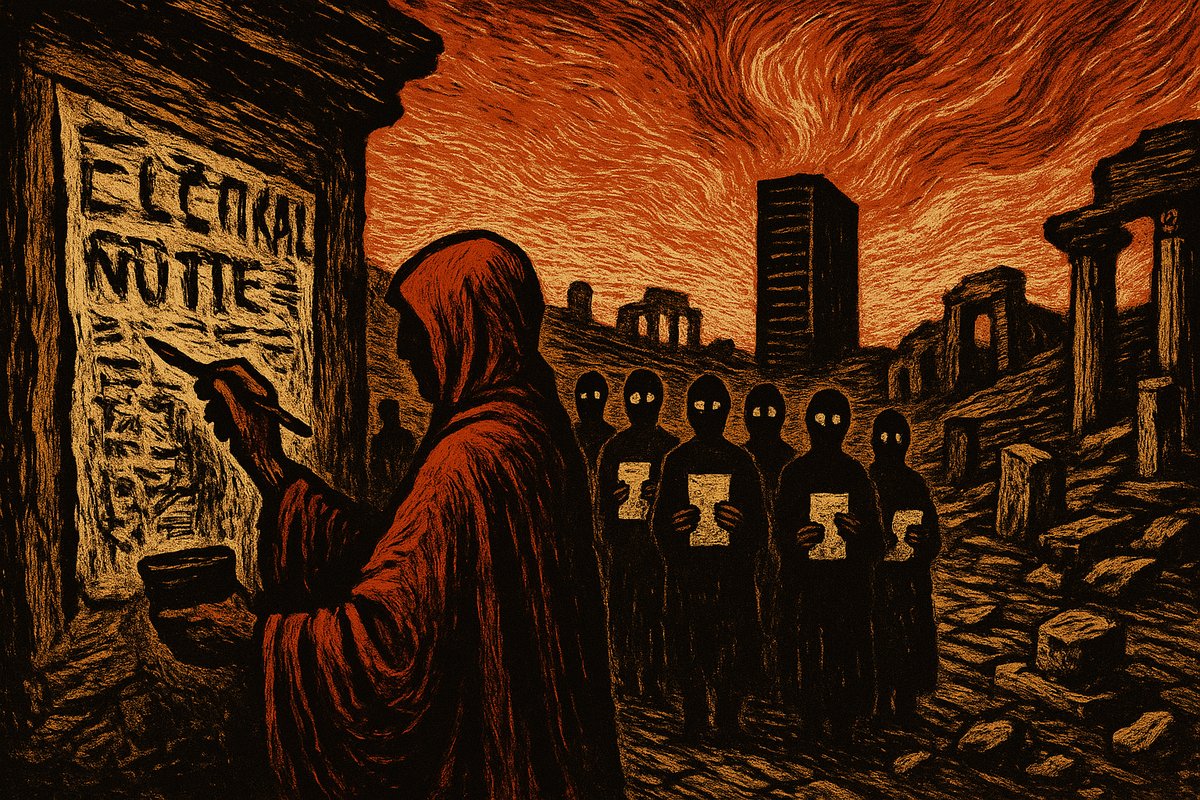
The ruins of Pompeii hold something similar. Their walls still carry hundreds of electoral notices. Archaeologists working on the Corpus Inscriptionum Latinarum still argue over which were genuine endorsements, which were paid propaganda, and which were simple mockery. The stones preserved the message but not the receipt of who painted it.
Two thousand years from now, someone will catalog the servers that once hosted the Social Research Center. Mia Clark will have her file, her generated biography, her articles, her photo. The scholarly debate will go on. How will we tell the genuine digital inscriptions from the fabricated ones then?
Sources:
1. OpenAI, transparency report on disrupting covert influence operations ("Dark Clark" and "Bogus Bylines" operations); data taken from the available summary, not the full report.
2. Corpus Inscriptionum Latinarum, vol. IV: Pompeian wall inscriptions (electoral notices).
3. Yves Laurent, The Generosity in the Doorway (Kindle, ASIN B0H6RT5Y32).