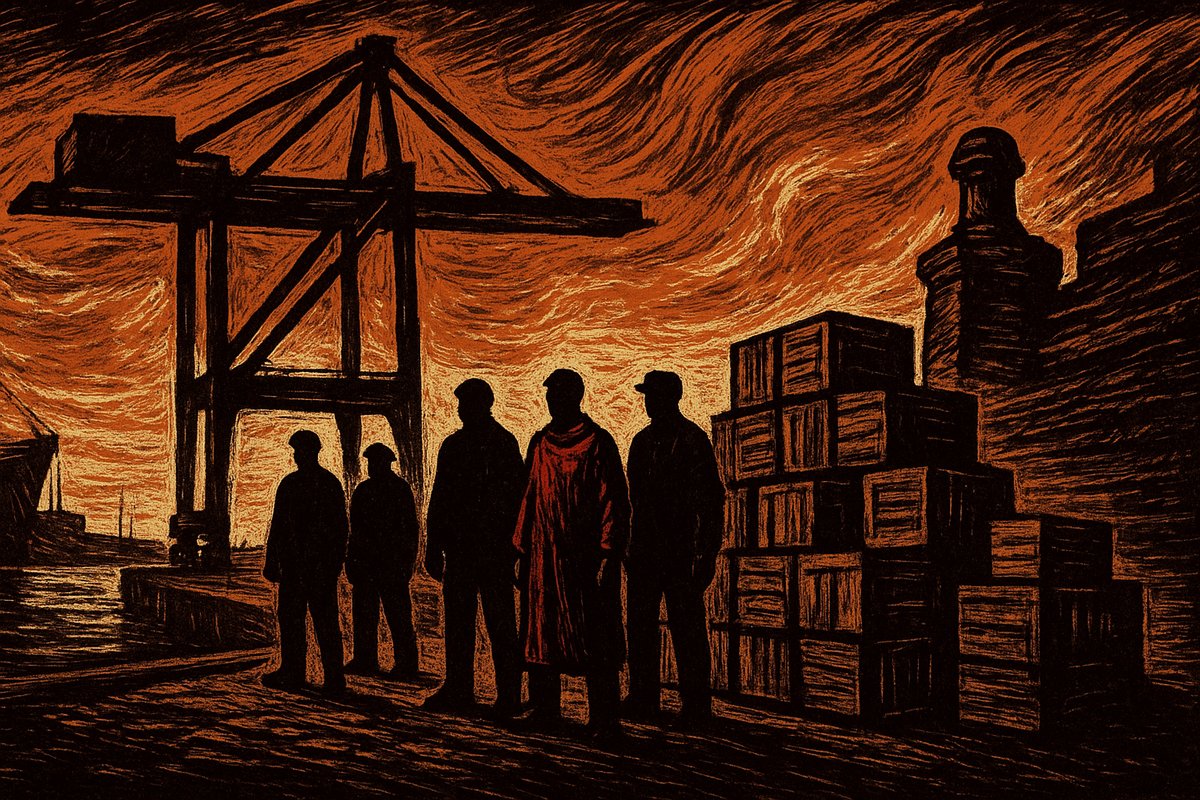
A port is a control node because everything that travels by sea ends up, sooner or later, in human hands that can refuse. That capacity to veto underpins a mobilization that hasn't happened yet. Dockworkers' unions in six European countries have announced a coordinated day of action for October 30 against arms shipments and the militarization of ports. The announcement came out of a meeting in Paris.
This is a plan, not a fact. There are no public details about specific cargoes, exact ports, or numbers of workers involved. There is only a stated intention to block arms shipments. The analysis is limited to that intention.
A precedent is useful here. In 1920, dockworkers at London's docks refused to load munitions bound for Poland aboard the Jolly George. This happened in the middle of the Polish-Soviet War, when much of the British labor movement opposed London's intervention. Months later, that same movement created a Council of Action to prevent any military action. The dockworkers' refusal and its political effect are what's certain. What exactly happened to the cargo itself is something I won't assert without records.
The underlying mechanism is straightforward. A group that controls a physical bottleneck exercises veto power over a political decision nobody consulted them on. No parliament directly controls that point. That's why the October 30 action, if it materializes, will appeal to the geography of flows rather than to laws or votes.
Systems rarely fail where the diagram predicts they will. They fail where nobody mapped out an alternative route. A port that refuses is a local failure. Logistics designs exist precisely to absorb such failures by rerouting cargo to another dock or another country.
Coordination changes the calculus. An isolated blockade gets dodged with rerouting. A simultaneous blockade across six countries narrows the exits. If the rerouted cargo also runs into hands that refuse, the system's own redundancy starts working against whoever's running it. There's also talk of bringing in ports from Asia and Africa. Their real weight will be measured by how many actually join in.
Another dispute is playing out in the narrative. The unions champion \"civilian ports, not arsenals.\" Governments pushing militarization present ports as security infrastructure. Whichever framing prevails will determine how the day gets read. The first frames it as workers' conscience refusing to be a link in a war. The second turns it into a threat to defense supply and opens the door to legal measures.
Each reading benefits someone. Defense contractors and logistics operators win if the flow continues uninterrupted. It suits them to keep the debate technical — schedules, containers, contracts. The unions gain power if they demonstrate real blocking capacity, and lose it if the announcement remains a mere gesture. For governments, the prize is making the protest look like a security problem rather than a debate over who decides to ship weapons. Nobody is free of their own interests. Not even the unions.
The contrast with 1920 is the most telling part. Back then, solidarity traveled by telegraph and organized itself into councils of action. Today the network is instantaneous. The system meant to be disrupted has changed far more. Ports are more automated. Supply chains are transnational and operations are split among private companies.
Cranes that decide on their own. That changes everything. The power to block no longer lives solely in the back of the worker loading cargo. It's distributed among whoever operates the crane, whoever programs the terminal system, and customs, which authorizes the movement.
This fragmentation cuts both ways. It multiplies the points where someone could refuse. Each point, however, belongs to a different operator who can replace workers or add automation. The success of the day shouldn't be measured by the announcement or the protest's optics, but by a cold question: how much military cargo was actually delayed or rerouted, and how much it cost to work around it.
Any effect on European military cooperation remains a hypothesis. A visible blockade could force a search for less exposed routes, push legislation to shield ports, or lead to negotiations with the unions. It's equally possible the system absorbs the day the way it absorbs a storm. There's no way to know in advance, and I distrust anyone who claims otherwise.
In Stones Don't Lie, when examining geopolitical escalation as a positive feedback loop, it's described how each deployment justifies the next. The cycle breaks only if someone stops feeding it. A dockworker who refuses to move a crate is one of the few forms of negative feedback available to people without diplomatic power. That's why October 30 deserves close attention — without excessive enthusiasm or premature cynicism.
The full automation of ports and their integration into military supply chains raises an uncomfortable question. Where, then, will the human fulcrum of the lever be left?
Sources
1. Press reports on the announcement of the coordinated October 30 day of action by dockworkers' unions in six European countries (no publicly verified detail on unions, ports, or cargoes).
2. Historiography of the British labor movement on the Jolly George (May 1920) and the Council of Action (August 1920).
3. Yves Laurent, Stones Don't Lie (on geopolitics and feedback loops).