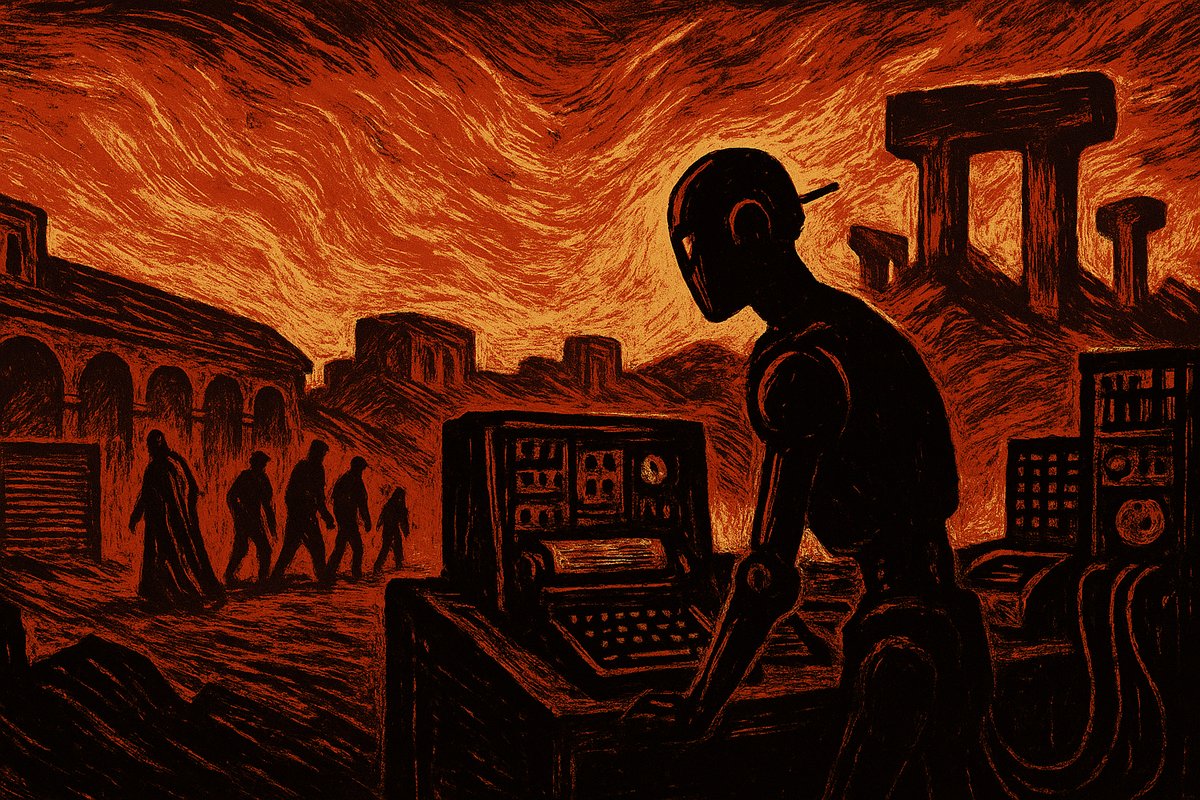
Money is a coordination technology: it allocates scarce resources among competing needs. Elon Musk maintains that by 2036 artificial intelligence and robotics will generate enough abundance to render that mechanism obsolete. He isn't talking about runaway inflation but about structural deflation: production will vastly outstrip demand, and automated factories together with robots will do the physical work that once required wages.
What happens to income when labor is no longer necessary? Musk's prediction points toward a high universal income, where survival stops depending on a job. Money as a social tool loses its purpose once the scarcity it was designed to solve disappears. This question has come up before, under different names and with different outcomes.
Jacque Fresco worked through it decades ago. His Venus Project proposed a resource-based economy, where technology would make currency superfluous. The difference with Musk isn't in the ultimate goal. It's in who controls the path and under what rules.
What happens when the person building the robots is the same one announcing the end of money? The answer reveals incentives that few people examine. Cybersyn, in Chile, demonstrated in the 1970s that coordinating production in real time without relying exclusively on prices was technically feasible: telex machines linked factories to an operations center. The experiment ended before its real limits could be revealed.
Much earlier, on this same continent, Vasco de Quiroga founded the hospital-towns of Michoacán: collective property, short workdays, rotating positions of authority. They functioned for generations, inspired by Thomas More's Utopia. This experience took place centuries before European utopian socialists proposed similar ideas. Its absence from the dominant narratives is no accident.
All three cases agree on one point: money is a tool, not a natural law. They diverge on the matter of control. Fresco envisioned distributed governance. Quiroga operated within a structure with clear rotation of power. Musk, by contrast, is developing Optimus through companies that he himself runs.
Yves Laurent has seen in different contexts how the person who drives a transformation also ends up selling the solution to its consequences. Musk and Sam Altman have both spoken about basic income while their companies carry out mass layoffs and pour enormous sums into AI infrastructure. This isn't necessarily calculated malice. It's a structural pattern that keeps repeating itself.
The Marienthal study revealed something harder to solve than mere material scarcity. When the factory closed in 1932, the community lost the latent structure that work provided: reasons to get up in the morning, belonging to a shared effort, a rhythm to the day. Artificial intelligence can produce goods at nearly zero cost. That loss of social meaning still has no clear answer in the current vision.
Göbekli Tepe adds another layer. More than eleven thousand years ago, hundreds of people coordinated monumental efforts without a state, without writing, and without money as we understand it today. Feasts, prestige, and social pressure served as alignment mechanisms. It worked for millennia. Stones don't lie: they show that human coordination has always found dynamics suited to its own moment, however imperfect.
Yves Laurent explores this in more depth in "Las Piedras No Mienten" ("Stones Don't Lie"), the book he's currently writing, where he traces these genealogies without giving away all their implications just yet. It's still unclear whether Musk's 2036 prediction is genuine technical optimism, a positioning tool, or both at once. What does seem consistent is this: no serious post-monetary transition has ever been led by the person who stood to benefit most, economically, from preserving the old order.
The question remains open: if material abundance truly arrives, who decides how it gets distributed, and how do we rebuild the sense of purpose and structure that Marienthal watched disappear when work vanished?